Introduction
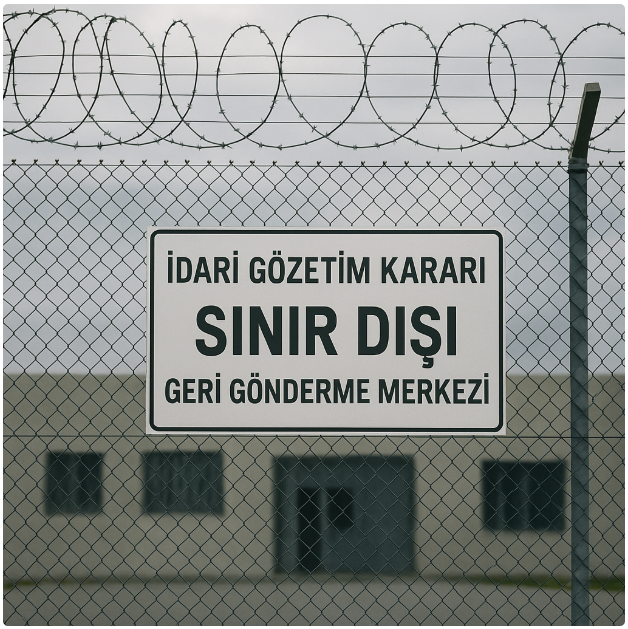
This study analyzes the definition, decision-making process, duration, and termination conditions of the institution of “administrative detention” at the request of lawyers, within the framework of the academic literature provided. Administrative detention, unlike measures in the field of criminal law, is defined as a measure where the personal liberties of foreigners, against whom a deportation decision has been made, are restricted under administrative law for the purpose of executing this decision. This practice, which was not legally grounded before the Law on Foreigners and International Protection No. 6458 (YUKK), led to violation decisions against Turkey by the European Court of Human Rights (ECtHR). With the enactment of YUKK, the conditions, duration, appeal procedures, and procedural safeguards of administrative detention have been provided with a legal framework.
1. Definition, Legal Nature, and Conditions of the Administrative Detention Decision
Administrative detention is considered not a “sanction” (penalty) but a “measure” resorted to for the execution of the deportation process. This measure, as it directly restricts the right to personal liberty and security, is exceptional in nature and should be resorted to only as a last resort. Various international organizations emphasize that the administrative detention of asylum seekers should always be an exceptional measure to be resorted to as a last resort” (911074).
In accordance with the LFIP, not every foreign national for whom a deportation decision has been made is placed under administrative detention. For a decision to be made, the existence of specific conditions stipulated in the law is sought. The administrative detention decision is issued for “those against whom a deportation decision has been made and who pose a risk of absconding or disappearing, violate Turkey’s entry or exit rules, use fake or fraudulent documents, fail to leave Turkey within the given period without an acceptable excuse, or pose a threat to public order, public security, or public health.”
2. Decision-Making, Notification, and Transfer to the Center Process
The administrative detention decision is issued by the governorship. Before the decision is made, the administration must conduct an assessment. The law stipulates a forty-eight-hour assessment period to decide whether a person will be placed under administrative detention. During this period, even if the person is not under administrative detention, their right to personal liberty and security is restricted.
The next stage after the decision is the foreigner’s transfer to a removal center. This process is also tied to a specific period by law. Foreigners for whom an administrative detention decision has been made are taken to removal centers by the law enforcement unit that apprehended them within forty-eight hours. Furthermore, notification of the decision and its consequences to the person concerned is a legal obligation.
3. Administrative Detention Periods
In the literature, administrative detention periods are discussed under three main headings: general rule, extension, and special circumstances:
General Period (6 Months): According to YUKK, the basic rule is that administrative detention cannot exceed six months. YUKK art. 57/3 states that an administrative detention decision can be applied for a maximum period of 6 months.
Extension Period (Additional 6 Months): This six-month period can be extended, but it is not arbitrary. The extension depends on the foreigner impeding the deportation process due to their own fault. This period can be extended by a maximum of six additional months if the deportation procedures cannot be completed due to the foreigner’s lack of cooperation or failure to provide accurate information or documents regarding their country. Thus, the maximum period reaches twelve months. The Constitutional Court’s decision of violation in the Abdulkadir Yapuquan application, on the grounds that de facto detention beyond the twelfth month has no constitutional and legal basis, demonstrates the finality of this period.
Period for International Protection Applicants (30 Days): Unlike those placed under administrative detention for deportation, a much shorter period is stipulated for international protection applicants. The administrative detention period for the applicant cannot exceed thirty days.
4. Review and Termination of Detention
Administrative detention is not a static measure throughout its duration. The Governorship is obliged to regularly oversee whether the detention should continue. An assessment of whether continued administrative detention is necessary is carried out monthly by the Governorship, without waiting for a month if required.
In cases where continued administrative detention is not deemed necessary, the measure is terminated immediately. Conditions for termination include the anticipation that the deportation decision cannot be executed within six months from the date of the foreigner’s administrative detention”, “the elimination of the risk of absconding or disappearance” and “the foreigner applying for voluntary return support. Foreigners whose detention is terminated may be subject to obligations such as residing at a specific address or reporting, as alternatives to administrative detention.
Conclusion
According to the presented literature, the administrative detention decision is an exceptional administrative measure that restricts personal liberty, bound by specific procedures and principles under the Law on Foreigners and International Protection (YUKK). In summary, the process is as follows:
Decision and Assessment: The Governorship may issue an administrative detention decision regarding the apprehended foreigner within 48 hours if the conditions stipulated in the law are met.
Referral to Center: Following the decision, the foreigner is taken by law enforcement to the Removal Center within 48 hours at the latest.
Duration: As a rule, the detention period is a maximum of 6 months. If the foreigner does not cooperate, this period can be extended by another 6 months, totaling 12 months. For international protection applicants, this period is limited to 30 days.
Supervision and Termination: The necessity of supervision is inspected monthly by the governorship and immediately terminated if the conditions cease to exist.
The administrative detention practice, which lacked legal basis in the pre-YUKK period and was frequently criticized by the ECHR, has been brought into a legal framework with the current regulations. However, as shown by the decisions of the Constitutional Court and the ECHR, it is essential that the practice does not lead to arbitrariness, adheres to the principle of proportionality, and meticulously complies with the periods and procedural safeguards (right to object, periodic review, etc.) stipulated in the law. A paper suggestion.
Why is Expert Legal Support Necessary?
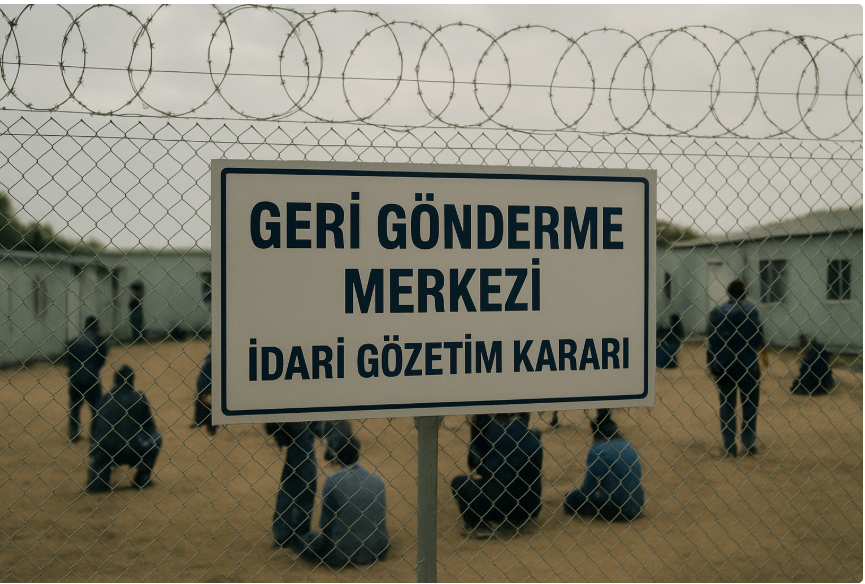
Administrative detention decisions are exceptional measures that directly restrict a person’s right to liberty and security. For this reason, professional legal support is of great importance both for the effective operation of legal oversight mechanisms and for the protection of individual rights. Particularly, administrative detention processes applied in places such as Tuzla Removal Center located in and around Istanbul, Tuzla, Pendik, Tepeören, are subject to strict formal requirements under both YUKK and international human rights standards.
In this process;
Objection to the administrative detention decision,
Application to the Magistrate Criminal Court,
Legal review against the extension of the detention perisiod,
Preparation of defense in accordance with the jurisprudence of the ECHR and the Constitutional Court,
each of such steps requires expertise.
An administrative detention lawyer plays a vital role in both ensuring that the process is conducted within a legal framework and ensuring that the restriction on the foreigner’s personal liberty is proportionate and reviewable.
Expert immigration lawyers operating in the Tuzla, Pendik, and Tepeören regions provide legal support to foreigners under administrative detention and their relatives at every stage of the process. This prevents the loss of rights and accelerates the objection and release processes.
Istanbul Immigration Lawyer
Tuzla Removal Center Lawyer