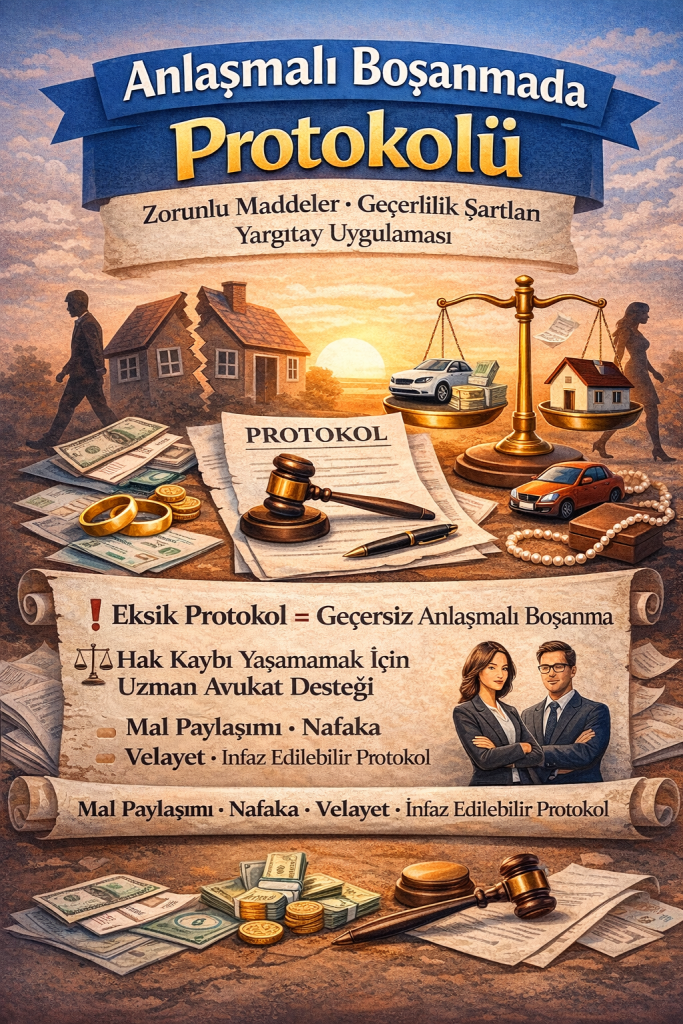
Anlaşmalı boşanma protokolünde hangi hususlar zorunlu olarak yer almalıdır?

Türk Medeni Kanunu m.166/3 ve Yargıtay kararlarına göre; protokolde boşanmanın mali sonuçları (nafaka, tazminat) ile çocukların durumu (velayet, kişisel ilişki, iştirak nafakası) mutlaka açık ve net şekilde düzenlenmelidir. Bu unsurlardan biri eksikse veya “saklı tutulmuşsa”, anlaşmalı boşanma kararı verilemez.
Mal paylaşımı anlaşmalı boşanma protokolünde yazılmak zorunda mı?

Hayır. Mal rejiminin tasfiyesi, boşanmanın zorunlu fer’î sonucu değildir. Taraflar isterse mal paylaşımını protokole koyabilir, isterse boşanmadan sonra ayrı bir dava açabilir. Ancak mal paylaşımı protokole yazılacaksa; taşınır ve taşınmazların tek tek, ismen ve açık şekilde belirtilmesi zorunludur. “Tüm malları paylaştık” gibi genel ifadeler geçerli sayılmaz.
Anlaşmalı boşanma protokolü icra edilebilir mi?
Evet, ancak şartları vardır. Protokol hükümlerinin hakim tarafından uygun bulunması, mahkeme kararının hüküm fıkrasına açıkça geçirilmesi ve taraflarca imzalanması gerekir. Sadece “not edilmesine” karar verilen protokoller, tek başına ilamlı icra kabiliyeti kazanmaz.
1. Legal Basis and Essential Conditions of the Agreed Divorce Protocol
According to Article 166/3 of the Turkish Civil Code (TMK), for a consensual divorce decision to be rendered, the protocol must contain certain minimum elements and the case must comply with specific procedural requirements. In light of the Supreme Court’s decisions, these essential conditions are as follows:
Marriage Duration: The marriage must have lasted at least 1 year.
Declaration of Will: It is essential that the spouses personally declare their intention to divorce before the judge, and that the judge is convinced that this intention has been freely expressed.
Scope: It is mandatory that the protocol contains a full consensus accepted by the parties regarding the financial consequences of the divorce and the situation of the children, and that this arrangement is approved by the judge.
2. “Ancillary Consequences of Divorce” That Must Be Included in the Protocol
According to the decisions of the 2nd Civil Chamber and the General Assembly of Civil Chambers of the Supreme Court, for a protocol to be considered “suitable for consensual divorce,” it must contain clear provisions on the following matters:
Financial Consequences:
Material and Moral Compensation: Compensation amounts or a clear statement that there is no claim for compensation within the scope of Articles 174/1-2 of the TMK.
Alimony for Indigence: Arrangement for alimony to be paid for the spouse according to Article 175 of the TMK.
Children’s Situation:
Custody: To whom the custody of the common children will be given.
Personal Relationship: Arrangement regarding the time and duration of the personal relationship to be established between the child and the spouse who has not been granted custody.
Child Support: The amount of child support for children’s care and education expenses, in accordance with Article 182 of the Turkish Civil Code (TMK).
The Supreme Court of Appeals emphasizes that protocols which do not contain arrangements regarding any of these elements (e.g., child support or compensation rights), or which “reserve” these rights, do not constitute a valid agreement in the sense of Article 166/3 of the Turkish Civil Code (TMK), and therefore, a consensual divorce decree cannot be issued in such cases.
3. Optional Elements That Can Be Included in the Protocol (Property Regime and Others)
The liquidation of the property regime is not a direct ancillary (appendix) to divorce. Therefore, it is not mandatory for the protocol to contain an arrangement regarding the property regime; the parties can separately sue for their rights concerning this matter within the statute of limitations after the divorce. However, if the parties wish, they can also add the following points to the protocol:
Liquidation of Property Regime: Claims related to contribution share, value increase share, or surplus value.
Division of Goods: Sharing of jewelry and household goods.
Transfers of Property Rights: Real estate title registration, transfer of vehicle ownership, transfer of shares, or commitment to pay a certain amount of money.
Important Warning: If the provisions regarding the property regime are included in the protocol, these provisions must be “unambiguously clear.” The 8th Civil Chamber of the Supreme Court of Appeals has ruled that general and vague statements such as “we have shared all assets, we have no receivables” will not liquidate the property regime; rather, movable and immovable properties must be specified individually, by name, and in separate clauses.
4. Validity and Enforcement Conditions of the Protocol
Judge’s Approval and Intervention: The judge may make necessary amendments to the protocol, considering the interests of the parties and the children. If these amendments are accepted by the parties, a divorce shall be decreed.
Inclusion in the Judgment Clause: For the protocol to acquire the nature of a judgment and to be enforceable, merely stating “the protocol is approved” is not sufficient; the provisions of the protocol must be individually included in the operative part of the court’s decision.
Signature Requirement: It is mandatory for verbal statements to be recorded and signed by the parties, or for the written protocol to be personally verified in court.
5. Information Obtained from Secondary Sources
Judicial decisions, which serve as secondary sources, provide the following additional contexts regarding the protocol’s content:
It has been stated that comprehensive release statements in the protocol, indicating that “no future claims will be made,” are binding on the parties and that subsequent property regime lawsuits may constitute a violation of the rule of good faith.
In protocols that foresee the transfer of immovable property, explicitly stating who will bear the land registry fees and expenses prevents disputes during the enforcement phase.
The detailed specification of children’s education expenses (school bus, meals, private lessons, etc.) can continue the payment obligation, even if there is a change in custody, due to the principle of adherence to the contract.
It has been emphasized that if the judgment regarding a consensual divorce decision is not served for a very long time (e.g., 9-10 years) after the decision is made, this impairs the sincerity of the intent to divorce and can be considered an abuse of right. A paper suggestion.
Why Is Expert Lawyer Support Necessary?
While consensual divorce is the fastest way to divorce, it is also the type of divorce where most mistakes are made.
Especially the consensual divorce protocol is not an ordinary document; it is a legal text that becomes final and binding with a court decision.
Incomplete or Faulty Protocol = Invalid Consensual Divorce
In Supreme Court practice;
Where child support is not regulated
Where the right to compensation is “reserved”
Where personal contact hours with children are not clearly specified
Protocols where asset sharing is left undefined are not considered suitable for consensual divorce and the cases turn into contested divorces.
Protocol Law is a Technical Field
Issues such as participation receivables, child support, personal relations, title deed transfer, vehicle transfer, and share ownership require independent technical regulation. A single wrongly written sentence can lead to new lawsuits and significant loss of rights years later.
Local Practice Knowledge is Critically Important
Especially in the regions of Istanbul, Tuzla, Kartal, Pendik, Tepeören, Gebze, and Çayırova, the Family Courts have;
Protocol review
Judge’s intervention
There are different practices regarding the binding nature of hearing statements. For this reason, managing the process with a lawyer experienced in Tuzla divorce law / Istanbul divorce law provides a significant advantage.
Secure Protocol with 2M Law Firm
2M Law Firm prepares consensual divorce protocols;
In accordance with Supreme Court precedents
Enforceable
by preparing them in a way that minimizes the risk of subsequent litigation, thereby safeguarding their clients’ rights. Consensual divorce requires speed, but the protocol requires expertise.