Anlaşmalı boşanmada mal paylaşımı yapmak zorunlu mu?

Hayır. Yargıtay’a göre mal rejiminin tasfiyesi, anlaşmalı boşanmanın zorunlu unsuru değildir. Türk Medeni Kanunu m.166/3 uyarınca tarafların sadece nafaka, tazminat ve çocukların durumu konusunda anlaşmaları yeterlidir. Mal paylaşımı, boşanma sırasında protokolle yapılabileceği gibi, boşanma kesinleştikten sonra ayrı bir dava konusu da yapılabilir.
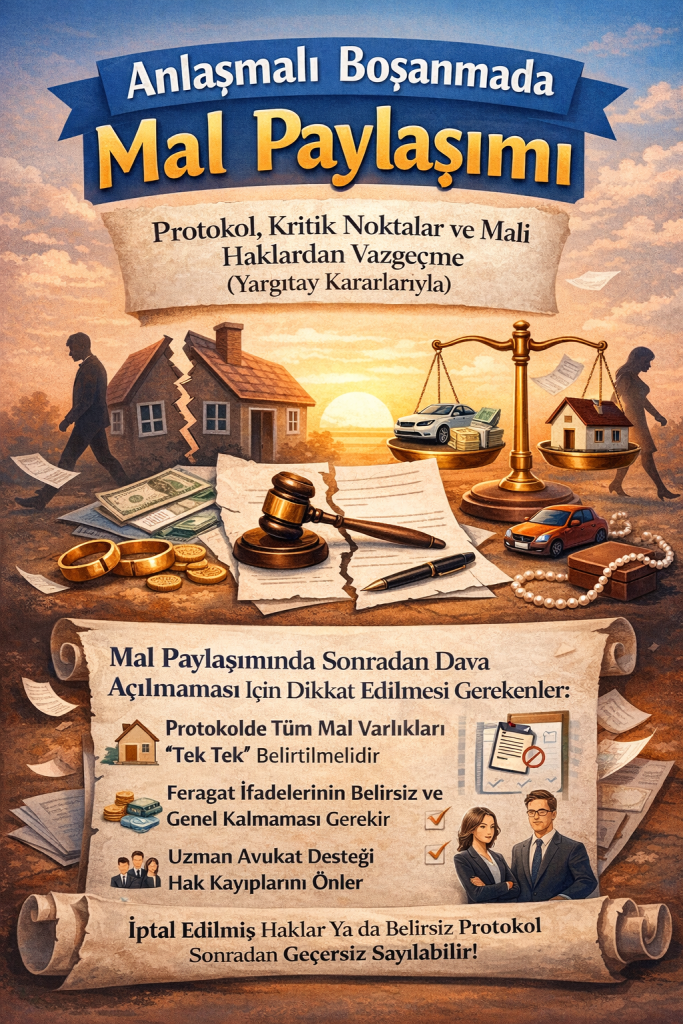
Protokolde “başkaca maddi talebim yoktur” yazıyorsa mal paylaşımı davası açılamaz mı?

Her zaman hayır. Yargıtay’ın yerleşik içtihatlarına göre bu tür genel ve soyut ifadeler, kural olarak katılma alacağı, katkı payı ve değer artış payı alacaklarını kapsamaz. Mal paylaşımının geçerli sayılabilmesi için protokolde malvarlıklarının tek tek sayılması veya bu alacaklardan açıkça ve teknik ifadelerle feragat edilmesi gerekir.
Anlaşmalı boşanma duruşmasında mali taleplerden vazgeçmek bağlayıcı olur mu?
Evet, ancak belirli şartlarla. Duruşma tutanağına geçen ve imzayla doğrulanan açık beyanlar mahkeme içi ikrar niteliğindedir ve bağlayıcıdır. Eğer taraf “katılma alacağı, katkı payı ve mal rejiminden doğan taleplerim yoktur” şeklinde açık beyanda bulunmuşsa, sonradan açılacak davalar dürüstlük kuralına aykırı kabul edilerek reddedilebilir.
1. Legal Nature and Procedure of Property Division in Uncontested Divorce
According to Supreme Court decisions, property division (liquidation of the property regime) in uncontested divorce is not an ancillary (additional) issue to divorce. Therefore, for an uncontested divorce decision to be rendered in accordance with Article 166/3 of the Turkish Civil Code (TMK), it is not a mandatory element for the parties to have agreed on the property regime. Spouses can liquidate the property regime concurrently with the divorce process, or they can pursue these rights as a separate lawsuit within the statute of limitations period (Supreme Court HGK-2019/335, 8. HD-2016/16216 ).
However, if the parties have reached an agreement on property division, the following procedural conditions must be met for this agreement to be valid:
Protocol and Approval: Provisions regarding property division must be included in the divorce protocol or recorded as a signed statement in the hearing minutes. For this agreement to be binding, it is essential that it is approved by the judge and incorporated into the judgment (Supreme Court 2nd Civil Chamber-2023/1061 K, 8th Civil Chamber-2014/9610 K).
Judge’s Intervention: The judge may make necessary changes to the protocol, considering the interests of the parties and children; if these changes are accepted by the parties, divorce and liquidation will be ruled (Supreme Court 2nd Civil Chamber-2013/26214 K).
2. Critical Considerations for Property Division
The Court of Cassation seeks specific criteria for the validity of property division agreements and to prevent subsequent lawsuits:
Principle of Clarity and Specificity: The agreement text must be “clear beyond any doubt”. Abstract, vague, ambiguous, or obscure expressions (e.g., “I have no other financial demands”) do not cover the liquidation of the property regime. Elements subject to liquidation, such as real estate, vehicles, company shares, or jewelry, must be listed “individually and by name” (Court of Cassation GCE-2019/335 K, 8th CD-2012/3587, 8th CD-2013/827 ).
Unconditional Nature: Waivers or acceptances regarding property division cannot be made conditional. For instance, making the payment for a piece of real estate conditional on retirement is considered invalid because it does not finally resolve the dispute (Court of Cassation 2nd CD-2013/26214 ).
Defect of Will and Fraud: The protocol must have been signed with free will. If defects of will such as deception (fraud), intimidation, or error are proven, the protocol may be deemed invalid. However, conditions like severe depression treatment alone have not been considered sufficient for a defect of will (Court of Cassation 2nd CD-2023/1061 , 2nd CD-2022/10165 K).
Rule of Honesty: A party who declares in the protocol that they have liquidated the property regime, and whose declaration is approved by the court, subsequently filing a lawsuit on the same matter is considered “contrary to the rule of honesty” and “abuse of right” (Court of Cassation 2nd CD-2023/2541, 2nd CD-2022/10165.
3. Validity of Financial Claim Waivers (Waiver)
The waiver of financial claims constitutes a definitive judgment and is binding under certain conditions:
Judicial Admission: The signed statements of the parties during the hearing, to the effect that “we have no claim for contribution share, participation claim, or property sharing,” constitute a judicial admission and are binding on the parties (Court of Cassation 2nd Civil Chamber-2022/10165, 2nd Civil Chamber-2023/4621).
Scope Limitation: General statements such as “I have no claim for pecuniary and non-pecuniary damages” as a rule only cover the ancillary provisions of the divorce; they do not cover rights arising from the matrimonial property regime (participation claim, appreciation share). For a waiver of rights under the matrimonial property regime, it is mandatory that the phrases “contribution share, participation claim, or rights arising from the matrimonial property regime” be explicitly mentioned (Court of Cassation 8th Civil Chamber-2013/827, 2nd Civil Chamber-2023/1441).
Waiver of an Unborn Right: Although some decisions state that, in accordance with the principle that “an unborn right cannot be waived,” a participation claim that has not yet arisen cannot be waived in advance before the divorce becomes final; the prevailing view applied is that these waivers are valid and terminate the right to sue if the protocol is approved and finalized by the court (Court of Cassation 8th Civil Chamber-2013/9389 K, 2nd Civil Chamber-2022/9474 K).
Jewelry: The absence of a clear regulation regarding jewelry in the protocol or the establishment of vague provisions such as “there is no need to decide on jewelry” may not prevent a subsequent lawsuit for jewelry claims (Supreme Court, 2nd Civil Chamber-2024/8560)
4. Secondary Sources and Additional Context
The following matters are included in the decision texts as limited information or special circumstances and are of a secondary source nature:
Post-Divorce Agreements: Agreements, such as “Post-Divorce Agreements” made before a notary after the divorce becomes final, are considered binding for the liquidation of the matrimonial property regime. However, it should be thoroughly examined by the court whether general waivers included in such documents cover specific claims like dowry promissory notes (Supreme Court, 2nd Civil Chamber-2021/5390).
Commercial Assets and Company Shares: General waivers concerning the matrimonial property regime in a divorce protocol may not always automatically cover the transfer of company shares or claims for commercial profit shares. It is particularly emphasized that share transfers must comply with formal requirements, such as a written contract approved by a notary (Turkish Commercial Code art. 520), otherwise, these parts of the protocol may be deemed invalid (Istanbul 10th Commercial Court of First Instance-2022/47, Istanbul Anatolian 4th Commercial Court of First Instance-2023/219).
In conclusion; if property sharing is to be carried out in a consensual divorce, it is essential for the legal security of the parties that all movable and immovable assets are specified individually in the protocol, that concepts such as “liquidation of the matrimonial property regime, contribution share, and participation claim” are explicitly used for waiver, and that this protocol forms the basis of the court’s judgment.
Why is Expert Legal Support Necessary?
Consensual divorce is one of the types of divorce where the most loss of rights is experienced in practice. Especially a small mistake made while preparing a consensual divorce protocol can lead to property division losses that are irreversible years later.
A One-Sentence Mistake Can Lead to Years of Lawsuits
Upon examining Supreme Court decisions, it is observed that in many cases where parties believed they had ‘reached an agreement,’ property regime lawsuits were either dismissed or reopened years later due to the protocol being vague, incomplete, or technically flawed. Phrases like ‘We have no property claims against each other’ or ‘Material rights have been waived’ are not always protective as commonly believed.
Property Division is a Technical Area of Law
Property division includes;
claim for participation,
contribution share,
value increase share,
company shares,
and jewelry, among other rights that need to be technically and separately regulated. When these concepts are not explicitly stated in the protocol, serious loss of rights may arise.
Local Court Practice is of Great Importance
Especially in consensual divorce cases observed in the regions of Istanbul, Tuzla, Kartal, Pendik, Tepeören, Gebze, and Çayırova;
The judges’ meticulousness in reviewing protocols,
The binding nature of courtroom statements,
The interpretation of waivers of property sharing may vary in practice. For this reason, it is critically important to manage the process with a legal professional who is familiar with regional practice, such as a Tuzla divorce lawyer and an Istanbul divorce lawyer.
Safe Process with 2M Hukuk Law Office
2M Hukuk Law Office, in the field of uncontested divorce and property sharing;
In accordance with Supreme Court precedents
Free from uncertainty,
By preparing legally sound uncontested divorce protocols that minimize the risk of subsequent litigation, it prevents clients from suffering loss of rights. An uncontested divorce can be fast;
however, a wrongly prepared protocol can be the beginning of new lawsuits that will last for years.