1. Legal Nature of Property Division in Consensual Divorce
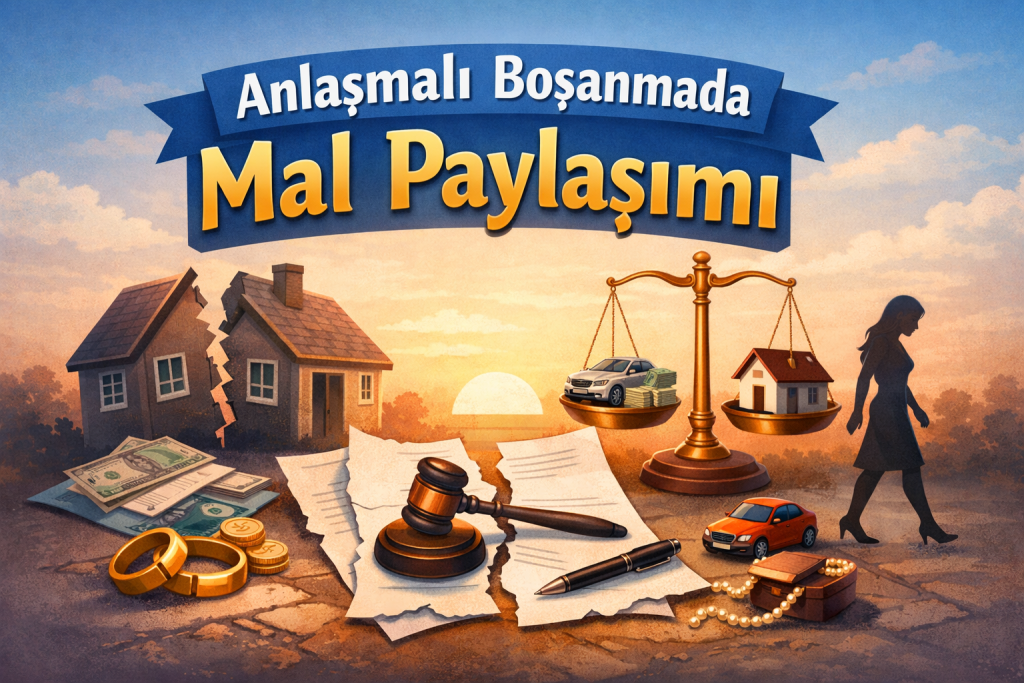
According to the Supreme Court’s decisions, the liquidation of the property regime (property division) in a consensual divorce is not an ancillary (supplementary) outcome of the divorce. Pursuant to Article 166/3 of the Turkish Civil Code, while it is mandatory for parties to agree on the financial consequences of divorce (compensation and alimony) and the situation of the children, it is not a mandatory element for them to agree on the liquidation of the property regime. Spouses can liquidate their rights regarding the property regime together with the divorce case, or they can make these rights the subject of a separate lawsuit within the statute of limitations period. However, if the parties wish, they can also include the liquidation of the property regime within the scope of the protocol; in this case, a separate condition of validity is not required.
2. Principle of Clarity and Certainty in the Protocol
According to the established jurisprudence of the Supreme Court, for a divorce protocol to be accepted as also covering the liquidation of the property regime, the text must be clear enough to leave no room for hesitation.
Inadequacy of General Statements: “The parties have no property claims against each other”, “there are no other material or moral claims” or “the parties divided the assets” – abstract and vague statements such as these, as a rule, do not cover claims arising from the property regime, such as “participation receivable”, “value increase share” or “contribution share” claims. Such general statements can be interpreted as being limited to claims for assets incidental to divorce.
Requirement for Specific Determination: For the liquidation to be deemed complete, the protocol must list movable and immovable properties individually, item by item, or explicitly state in technical terms, such as “I waive my rights to participation receivable, value increase share, and contribution share claims”.
3. In-Court Admission and Binding Nature
Statements made by the parties during a consensual divorce case, recorded in the hearing minutes and approved with their signatures, constitute an “in-court admission”.
If the parties made clear and specific statements during the hearing, such as “we have no claims arising from the property regime” or “we divided the assets as per the protocol”, these statements are binding upon them.
Despite the provisions of the protocol approved and finalized by the court, filing a subsequent property regime lawsuit is evaluated by the Court of Cassation as “a violation of the principle of good faith” and “abuse of right”, and such lawsuits are dismissed.
However, if the statements made in court are solely directed at “sharing of goods/items”, this does not imply a waiver of claim rights arising from the liquidation of the matrimonial property regime.
4. Concept and Conditions of Waiver
For rights arising from the matrimonial property regime to be waived, the waiver must be; related to a concrete right, unconditional, unequivocal, and clear, leaving no room for doubt. In accordance with the principle “There can be no waiver of a right not yet born,” general waiver clauses for claims not yet liquidated or explicitly stated in the protocol may not always be considered binding. Specifically, a waiver of “contribution share” does not imply a waiver of “claim for participation in residual value.”
5. Approval of the Protocol and Issuance of Judgment
For the provisions regarding the matrimonial property regime contained in the amicable divorce protocol to be valid and enforceable, they must be approved by the court and included in the judgment clause, or the protocol must be considered an annex to the decision. The judge cannot, ex officio, issue a declaratory judgment on a matter not included in the parties’ protocol or oral statements (e.g., regarding the liquidation of the matrimonial property regime); this would constitute a violation of the “principle of adherence to demand.”
6. Secondary Sources and Additional Context
The following points were emphasized in decisions acting as secondary sources:
There is no legal provision preventing spouses from retracting their declarations of intent in the protocol until the amicable divorce decree becomes final. If one party declares in court that they do not accept the protocol and requests property sharing, the agreement is voided, and the case turns into a contested divorce.
Documents such as a “Property Sharing Settlement Agreement” made abroad after divorce can liquidate the property regime and constitute grounds for the rejection of subsequent claims, provided their content is clear and undisputed.
Courts are obliged to conduct a detailed investigation into whether ambiguous phrases in the protocol (e.g., “general clauses”) cover the waiver of jewelry or personal belongings. A writing suggestion.
Anlaşmalı boşanmada mal paylaşımı yapmak zorunlu mu?

Hayır. Yargıtay’a göre mal rejiminin tasfiyesi, anlaşmalı boşanmanın zorunlu unsuru değildir. Taraflar isterlerse mal paylaşımını protokole koyabilir, isterlerse boşanma kesinleştikten sonra ayrı bir mal rejimi davası açabilirler. Türk Medeni Kanunu m.166/3 yalnızca nafaka, tazminat ve çocukların durumunda anlaşmayı zorunlu kılar.
Protokolde “birbirimizden mal talebimiz yoktur” yazıyorsa sonradan dava açılamaz mı?
Yargıtay’ın yerleşik içtihatlarına göre bu tür genel ve soyut ifadeler, kural olarak mal rejiminden doğan katılma alacağı, değer artış payı ve katkı payı alacaklarını kapsamaz. Mal paylaşımının geçerli sayılabilmesi için protokolde malların tek tek sayılması veya bu teknik alacaklardan açıkça feragat edildiğinin belirtilmesi gerekir.
Anlaşmalı boşanma duruşmasında söylenen beyanlar sonradan bağlayıcı olur mu?
Evet, belirli şartlarla. Duruşma tutanağına geçen ve taraflarca imzalanan açık beyanlar mahkeme içi ikrar niteliğindedir ve bağlayıcıdır. Eğer taraflar duruşmada açıkça “mal rejiminden kaynaklanan alacak talebimiz yoktur” demişse, sonradan açılan davalar hakkın kötüye kullanılması gerekçesiyle reddedilebilir. Ancak beyan yalnızca eşya paylaşımına ilişkinse, bu durum mal rejimi alacaklarından feragat anlamına gelmez.
Why is Expert Lawyer Support Necessary in Uncontested Divorce?
Uncontested divorce is one of the types of divorce where rights are most frequently lost in practice. Especially a small mistake made while preparing an uncontested divorce protocol can lead to irreparable property division losses years later. When Supreme Court decisions are examined, it is seen that serious disputes arise in many cases where parties believed they had “agreed,” on the grounds that the protocol was insufficient, ambiguous, or technically flawed.
Mistakes Made in the Protocol Can Lead to Irreversible Consequences
An uncontested divorce protocol is not an ordinary document. The moment it is approved by the court, it becomes binding and enforceable. Included in the protocol;
“We have no property claims against each other”
“All financial rights have been waived”
General statements like “The parties have shared the assets among themselves” are often not as protective as the parties assume. A wrongly or incompletely drafted protocol can lead to the rejection of subsequent property regime lawsuits.
Asset Division is a Field Requiring Technical Knowledge and Expertise
Asset division is not just a matter of “who got what”. Technical concepts such as participation claim, value-added share, and contribution claim must be clearly regulated in the protocol. In protocols prepared without the support of an expert Istanbul divorce lawyer, these rights are often lost without being noticed.
Local Practice and Court Procedure Are Very Important
Each Family Court has a different sensitivity in evaluating protocols. Especially in consensual divorce cases seen in the Tuzla, Kartal, Pendik, Tepeören, Gebze, and Çayırova regions;
The limits of the judge’s intervention in the protocol
The binding nature of statements made during the hearing
The scope of asset division statements may vary according to local practice. For this reason, conducting the process with a Tuzla divorce lawyer who is familiar with the Tuzla Istanbul region provides a great advantage.
Secure Protocol with 2M Law Office
2M Law Office, in the field of consensual divorce and asset division;
in accordance with Supreme Court precedents
free from ambiguity
By preparing robust agreed divorce protocols that minimize the risk of future lawsuits, it prevents clients from experiencing loss of rights. It should not be forgotten that an agreed divorce can be quick;
however, a wrongly prepared protocol can be the beginning of new lawsuits that will last for years.