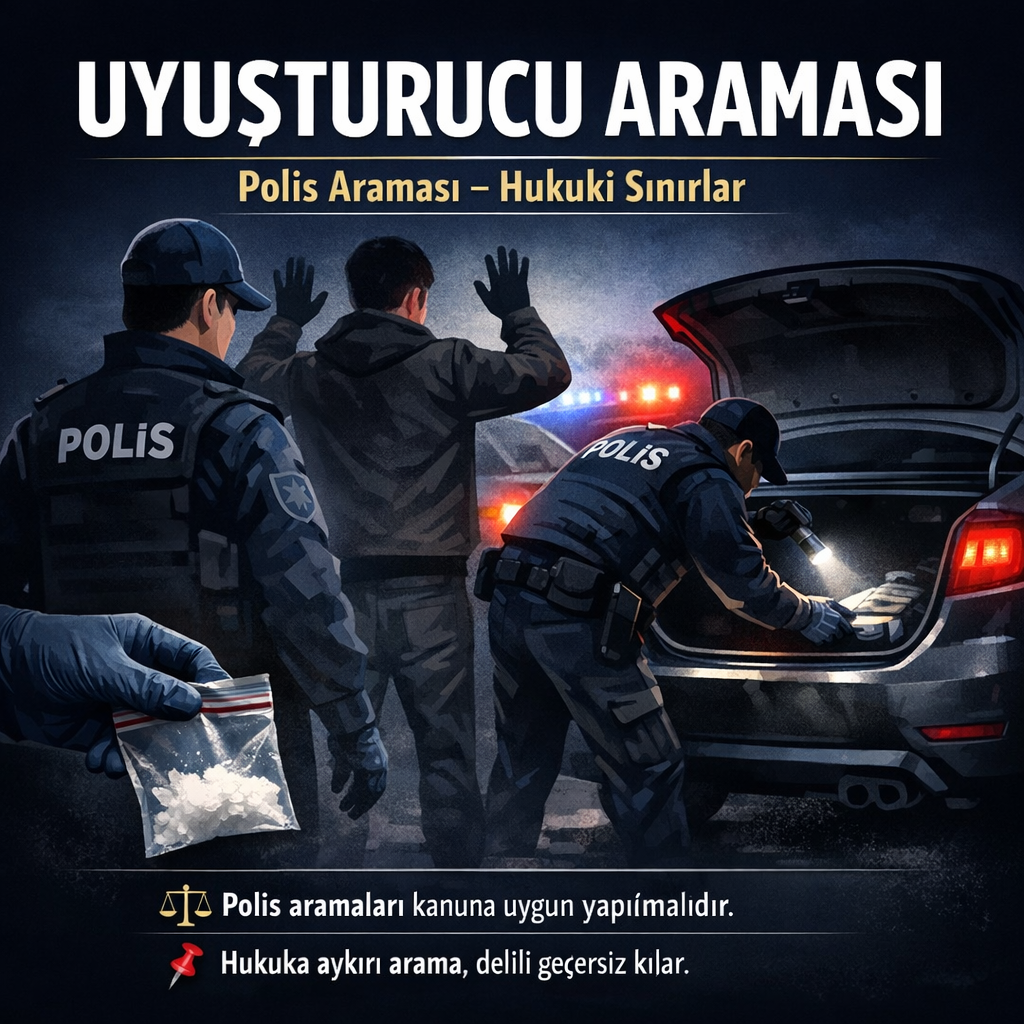
Legal validity and evidentiary nature of searches conducted without a search warrant in drug offenses.
1. General Legal Framework and Basic Rule
According to Supreme Court decisions, the basic rule for conducting searches in drug offenses is the existence of a “judicial search warrant” or “written judicial search order” obtained in accordance with Articles 116, 117, and 119 of the Criminal Procedure Code (CMK) No. 5271. Pursuant to Articles 20 and 21 of the Constitution and the provisions of the CMK, searches conducted without a judge’s decision or, in cases where delay would be prejudicial, without a written order from the public prosecutor are generally considered unlawful.
2. Legal Consequences of Searches Conducted Without a Search Warrant
According to the established jurisprudence of the Supreme Court General Criminal Assembly and relevant criminal chambers, narcotic substances obtained as a result of searches conducted without a judicial search warrant in situations where such a warrant is required are considered “evidence obtained through unlawful methods”. In this context:
Narcotic substances seized as a result of an unlawful search constitute both the “material subject of the crime” and “evidence of the crime,” and cannot be used as a basis for conviction.
Pursuant to Article 38/6 of the Constitution and Articles 206/2-a, 217/2, and 230/1-b of the CMK, a conviction cannot be based on unlawfully obtained evidence.
Even the defendant’s confession (admission of guilt) does not rectify the situation or validate the evidence if the search operation was unlawful.
3. Exceptional Circumstances: In Flagrante Delicto and PVSK Article 4/A Authority
The Supreme Court accepts operations carried out without a search warrant as lawful in some special cases:
Flagrante Delicto (Caught in the Act): Pursuant to Article 90 of the Criminal Procedure Code (CMK) and Article 8 of the Regulation on Judicial and Preventive Searches, there is no need to obtain an additional search warrant or order in cases of flagrante delicto (during the commission of a crime or immediately after, during pursuit). In this situation, the evidence seized is considered lawful.
Inspection within the Scope of PVSK Article 4/A: Pursuant to Article 4/A of the Police Duties and Powers Law (PVSK), law enforcement has the authority to conduct a “pat-down” or “rough body search” on individuals they stop. If a criminal element is encountered during an external hand check (pat-down) of the person, this procedure does not require a search warrant. However, this authority does not cover the detailed search of a person’s underwear or closed items (bag, suitcase, etc.).
4. Limits of a Preventive Search Warrant
One of the most frequently emphasized points in Supreme Court decisions is the distinction between a “preventive search warrant” and a “judicial search warrant”:
Concrete Suspicion of Crime: If law enforcement has received a concrete tip or intelligence that a specific person is carrying or selling narcotic substances (suspicion of a crime with a known perpetrator and nature), a search can no longer be conducted based on a preventive search warrant. In this situation, a “judicial search warrant” must be obtained.
Unlawfulness: In cases where there is concrete suspicion of a crime, vehicle, residence, or body searches conducted based on a general preventive search warrant are considered unlawful, and the narcotic substances obtained are not evaluated as evidence.
5. Concrete Application Examples and Judicial Assessments
Vehicle Searches: A judicial search warrant is required for searches conducted in parts of the vehicle not visible from the outside (glove compartment, trunk, under seats, etc.). However, the seizure of items found in places visible from the outside of the vehicle (open areas such as on floor mats, door pockets) may be deemed lawful in some decisions, being evaluated as “seizure” rather than “search”.
Searches of Closed Items and Bags: As a rule, for the search of closed items such as a person’s luggage, bag, or wallet, a judge’s decision or prosecutor’s order is required. Unless there is a situation of flagrante delicto, searching these items without a warrant/decision is unlawful.
Detailed Personal Search: Searches conducted in a person’s underwear or body cavities exceed the limits of “frisking” and therefore cannot be carried out without a judicial search warrant. Items seized during a detailed personal search of a suspect brought to the police station are deemed invalid if there is no written warrant.
House Searches: A written judicial search warrant or order is mandatory for house searches. House searches conducted with a prosecutor’s verbal instruction are considered unlawful.
In conclusion; searches conducted without a search warrant in drug offenses are valid only when they fall within the limits of “flagrante delicto” or “frisk search under PVSK 4/A”. In all other cases (especially if there is a concrete suspicion of a crime), it is mandatory to obtain a judicial search warrant or a written order; otherwise, the obtained narcotic substances are not accepted as evidence by the courts and serve as grounds for acquittal decisions. An article suggestion.
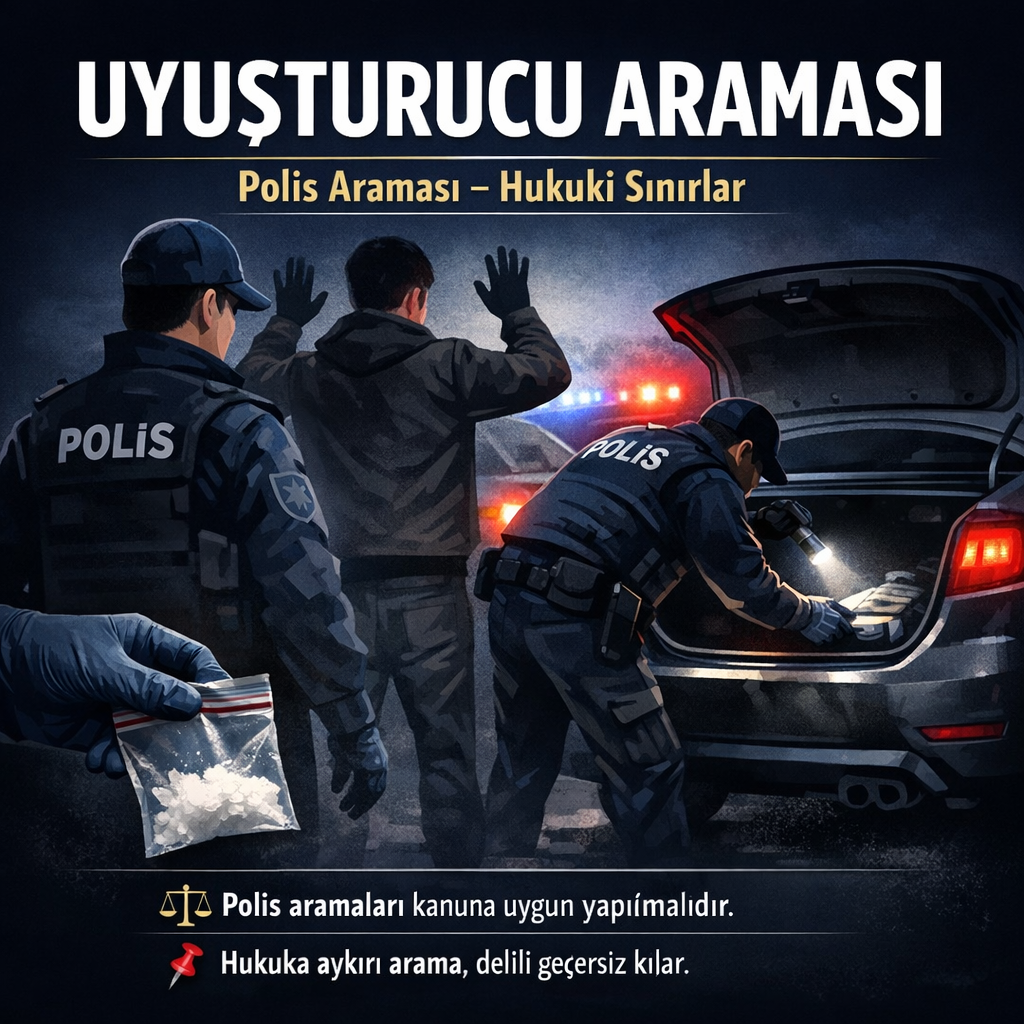
Arama kararı olmadan yapılan uyuşturucu araması geçerli midir?
Kural olarak hayır. CMK’nın 116 ve devamı maddeleri uyarınca, uyuşturucu araması için hakim kararı veya gecikmesinde sakınca bulunan hâllerde savcının yazılı emri gerekir. Bu karar veya emir olmadan yapılan aramalar hukuka aykırıdır ve elde edilen deliller hükme esas alınamaz.
Suçüstü hâlinde arama kararı şart mı?
Hayır. Suçüstü hâlinde (suç işlenirken veya hemen sonrasında takip sırasında) ayrıca arama kararı alınmasına gerek yoktur. Bu durumda ele geçirilen uyuşturucu maddeler hukuka uygun delil sayılabilir. Ancak suçüstü halinin gerçekten mevcut olması gerekir; sonradan gerekçelendirme kabul edilmez.
Polis kaba üst aramasında uyuşturucu bulursa delil geçerli olur mu?
Sınırlı olarak evet. PVSK 4/A kapsamında yapılan kaba üst yoklaması sırasında ele temasla fark edilen suç unsurları hukuka uygun kabul edilebilir. Ancak bu yetki; çanta, valiz, cep içi, iç çamaşırı veya detaylı aramaları kapsamaz. Bu sınırların aşılması hâlinde delil hukuka aykırı sayılır.
Why is Expert Lawyer Support Necessary? | 2M Law Office – Istanbul Anatolian Side
In drug cases, whether the search operation is lawful or not is often the sole determining factor between conviction and acquittal. Even a minor procedural error made by law enforcement can lead to the complete dismissal of the case. However, correctly identifying and asserting this unlawfulness requires expertise.
Especially in drug investigations observed in the regions of Istanbul, Anatolian Side, Tuzla, Pendik, Kartal, Aydınlı, Bayramoğlu, and Gebze; the distinction between preventive search and judicial search, the limits of the flagrante delicto claim, and the exceeding of PVSK 4/A authority are frequently debated.
Why is Expert Lawyer Support Important?
Correctly determining whether the search is judicial or preventive,
Verifying whether the flagrante delicto claim truly exists,
The exclusion of illegal evidence from the file/case within the scope of Articles 206 and 217 of the CPC,
Evaluation of whether the confession legitimizes an illegal search or not,
Effective assertion of procedural errors that could lead to acquittal
is only possible with the follow-up of a lawyer specialized in criminal law.
Effective Criminal Defense with 2M Law Office
2M Law Office, based in Istanbul, provides effective and professional legal support in the Anatolian Side, Tuzla, Pendik, Kartal, Aydınlı, Bayramoğlu, and Gebze regions; regarding illegal searches, evidence prohibitions, and acquittal defenses in drug offenses. 📌 An illegal search in drug cases can lead to the complete dismissal of the case. Expert legal support is vital to not miss this opportunity.