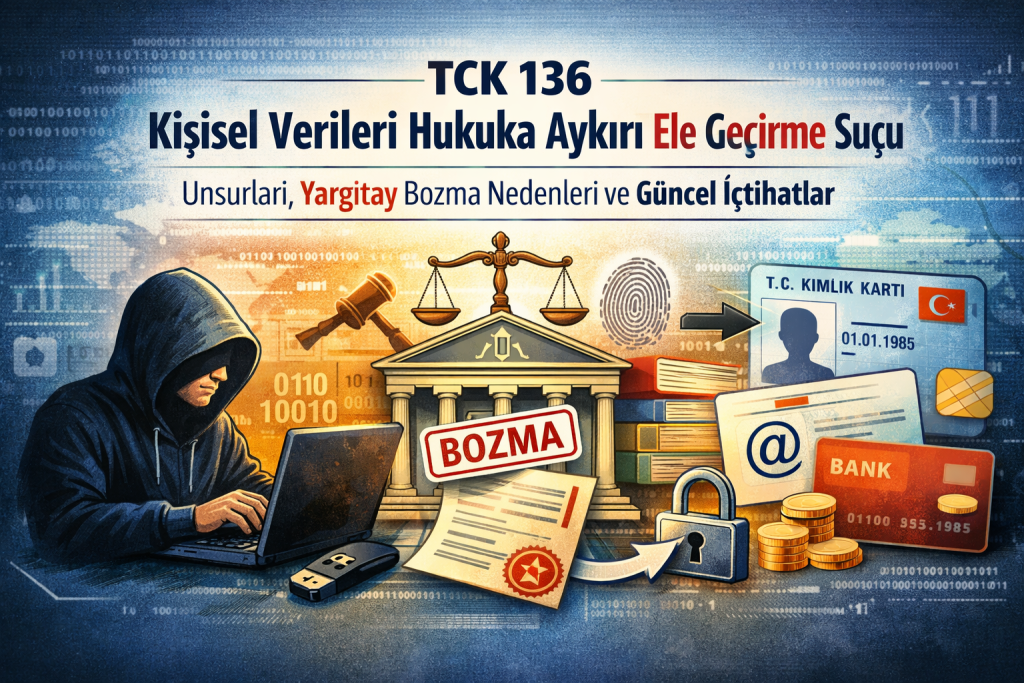
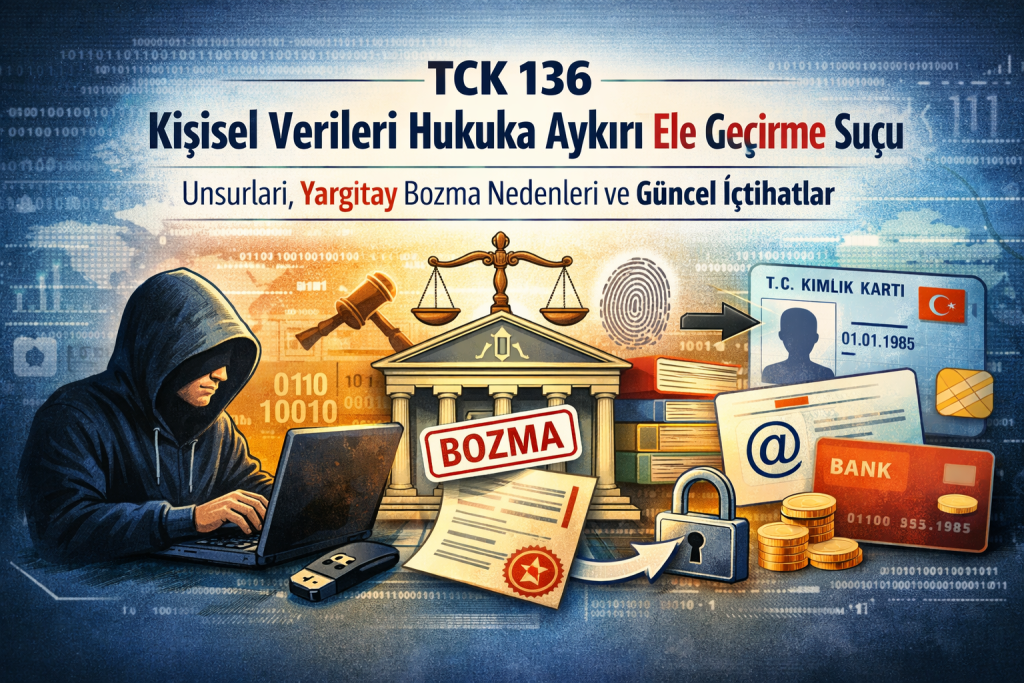
1. Definition and Elements of the Crime of Unlawfully Obtaining, Giving to Another, or Disseminating Personal Data
The crime of “Unlawfully Giving or Obtaining Data”, regulated under Article 136/1 of the Turkish Penal Code (TCK), is defined as the unlawful giving, dissemination, or obtaining of personal data to another person. The offense has an alternative act structure and is completed by the realization of any of these acts.
A. Material Elements and Subject of the Crime
Concept of Personal Data: In the jurisprudence of the Court of Cassation, personal data is considered any information related to a real person. In this context; Turkish ID number, name-surname, place/date of birth, parents’ names such as demographic information; phone number, e-mail address, residence, criminal record, education status, profession, bank account information, fingerprints, DNA, blood type such as biological samples; sexual and moral orientation, health information, ethnic origin, political and religious views are considered personal data.
Condition for Protection of Personal Data: For the crime to occur, the data must be in a “recorded state” and must be given, disseminated, or obtained in this state. Learning data that has not yet been recorded or disclosing information held in memory is not within the scope of this crime, but may be evaluated under TCK 134 (Violation of privacy).
Alternative Acts:
Giving: To transmit or make the data accessible to another person.
Dissemination: To make data known to many people, to publish it on platforms such as the internet or social media.
Acquisition: To unlawfully take data under one’s own control, which is under the control of another person (physically taking the document or digitally transferring it to another object).
B. Mental Element
The mental element of the crime is general intent. It is sufficient for the perpetrator to act knowingly and willingly that they unlawfully gave, disseminated, or acquired the personal data belonging to the victim; no special motive is required.
C. Element of Unlawfulness
For the act to constitute a crime, it must be “unlawful”. The existence of reasons for legality, such as the consent of the data subject, fulfillment of a legal provision, or exercise of a right, prevents the formation of the crime.
2. Most Common Grounds for Reversal in Trials and Case Law Analysis
When examining the decisions of the Court of Cassation and the Regional Courts of Justice, the most frequent grounds for reversal in this type of crime are gathered under the following headings:
I. Error in Crime Qualification
In trials, the most common ground for reversal is the erroneous qualification of the act, even though it falls under other crime types instead of TCK 136.
Distinction for Violation of Privacy (TCK 134): The unauthorized disclosure of images or sounds related to a person’s private life falls under TCK 134/2 and cannot be considered personal data under TCK 136. Furthermore, merely learning data without recording it also falls under TCK 134/1. (Supreme Court 12th Criminal Division-2019/12886K, 2012/25521)
Distinction for Unauthorized Access to an Information System (TCK 243): The mere act of the defendant entering and remaining in an information system constitutes the offense under TCK 243/1, as long as the intent to seize or disseminate data cannot be proven. (Supreme Court 12th Criminal Division-2013/15369K)
Distinction for Recording Personal Data (TCK 135): Merely recording data and giving/obtaining it from another person are different offenses. For example, acquiring someone’s number by calling it from one’s own phone falls under TCK 136, not TCK 135. (Supreme Court 8th Criminal Division-2020/5899K)
Theft via Information Systems (TCK 142/2-e): The act of transferring money from a bank account using identity information constitutes the offense of theft via information systems, not TCK 136. (Bursa Regional Court of Justice 10th Criminal Division-2019/434K)
II. Misinterpretation of the “Acquisition” Element (Read-Only/Query)
There is a significant jurisprudential change concerning queries made by public officials (police, civil registration officers, etc.) within systems under their authority.
Grounds for Reversal: If a public official accesses the system with the given password and only reads the data, but does not save or share it anywhere, the “acquisition” element does not materialize. The General Criminal Board of the Court of Cassation and the 12th Criminal Chamber rule that information merely perceived (read) by the sensory organs cannot be considered an acquisition in the sense of Article 136 of the Turkish Penal Code, and thus issue acquittals. (Court of Cassation General Criminal Board-2021/384K, 12th Criminal Chamber-2022/7038K)
III. The Misconception of Data Being “Known by Everyone”
Grounds for Reversal: The acquittals issued by local courts, on the grounds that photographs or information shared publicly by the victim on social media accounts (Facebook, Instagram) lose their “personal data” quality, are being overturned by the Court of Cassation.
Case Law: The fact that data is known by everyone or easily accessible (e.g., being on the internet) does not change its characteristic as personal data and does not grant third parties the right to disseminate this data without consent. (Supreme Court 12th Chamber – 2018/8186Dec., 2022/4834, 2020/1085Dec.)
IV. Non-application of Provisions for Chain Crime and Ideal Concurrence of Offenses
Chain Crime (TCC 43): In cases where data belonging to multiple individuals is seized or disseminated through the same act, failure to apply the increase in punishment as per TCC 43/2 is a ground for reversal. (Supreme Court 12th Chamber – 2019/12869)
Ideal Concurrence of Offenses (TCC 44): If a single act constitutes both the crime of violating the privacy of private life and the crime of disseminating personal data, judgment should be rendered for the offense requiring the heaviest penalty. (Supreme Court General Criminal Assembly – 2015/708Source)
V. Procedural Errors and Legislative Changes
Law No. 6352 Provisional Article 1: Failure to evaluate the provisions regarding the deferment of prosecution in crimes committed through press and broadcast. (Supreme Court 12th Chamber – 2013/29366)
Permission Requirement: Filing a lawsuit without obtaining the necessary administrative permissions (Ministry of Justice, etc.) for actions related to notary or public service duties. (Court of Cassation 12th Criminal Division-2020/1085)
Insufficiency of Justification: Contradiction between the justification and the paragraph of the ruling, or incorrectly citing the applicable article of law (e.g., mistakenly writing TCK 141 instead of TCK 136). (Court of Cassation 12th Criminal Division-2013/15369)
Why is Expert Lawyer Support Necessary Under TCK 136?
2M Law Firm (Tuzla / Istanbul) Proficient in Court of Cassation Jurisprudence Regarding Personal Data Crimes
The crime of unlawfully obtaining, transferring, or disseminating personal data, regulated under TCK 136, can lead to serious loss of rights due to highly technical distinctions in practice and constantly evolving Court of Cassation jurisprudence. The frequent confusion of the crime with other types of crimes such as TCK 134, 135, 243 or 142, the incorrect interpretation of the element of “obtaining”, and the erroneous application of provisions for continuous offense and ideal concurrence lead to consequences that are difficult to remedy for both the accused and the victim.
Especially issues such as the evaluation of digital evidence, the determination of the boundary between unlawfulness and lawfulness, the questioning and access authorities of public officials, and the nature of social media data as personal data; necessitate an attorney practice specialized in personal data and cybercrimes, beyond general criminal law knowledge.
Therefore, Istanbul Tuzla-based 2M Law Firm, in TCK 136 proceedings:
Defense strategies based on current Supreme Court and Constitutional Court precedents,
Effective objections regarding the legality and auditability of digital evidence,
Effective legal characterization against incorrect crime classifications,
Prevention of procedural errors during investigation and prosecution phases
provides its clients with expert lawyer support on these matters.
Since even a minor legal error in personal data crimes can lead to difficult-to-remedy penalties and criminal record consequences; acting with professional and expert legal support within the scope of TCK 136 is of vital importance.