
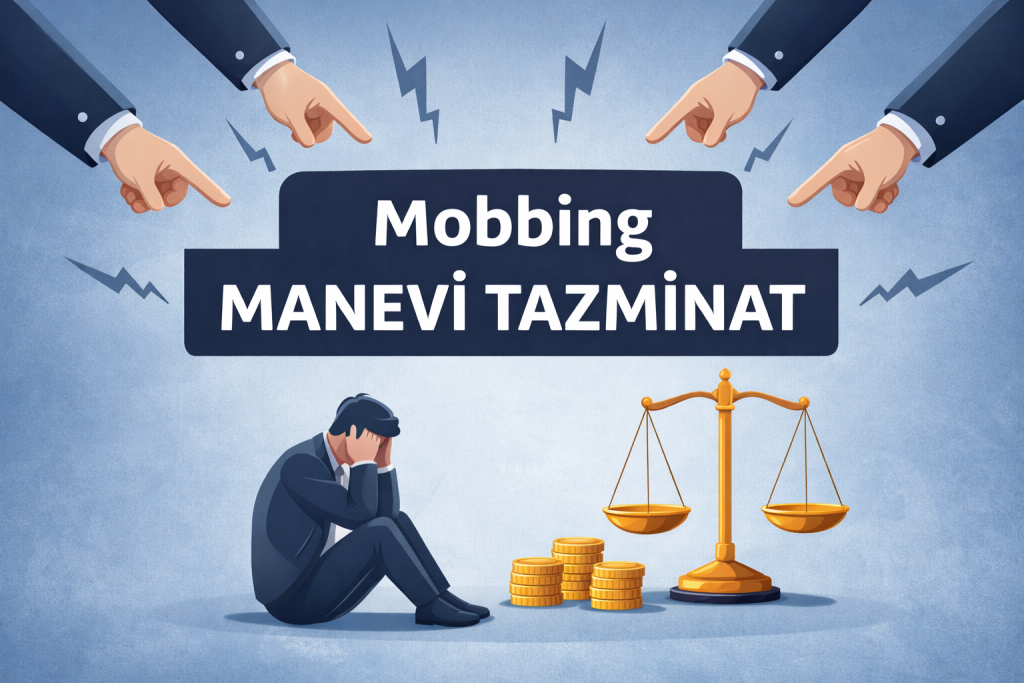
Can Non-pecuniary Damages Be Claimed Due to Mobbing? What Does the Supreme Court Say? In light of the judicial decisions and documents reviewed, it has been determined that filing a lawsuit for non-pecuniary damages due to mobbing (psychological harassment) is possible under Turkish law, and there are precedent decisions in both judicial and administrative courts to this effect. Below, the legal grounds of the lawsuit, conditions for proof, litigation processes, and the courts’ evaluation criteria are detailed.
1. Admissibility of the Compensation Lawsuit and Legal Grounds
Decisions by the Supreme Court (Yargıtay) and the Council of State (Danıştay) clearly indicate that a lawsuit for non-pecuniary damages can be filed due to mobbing, and compensation may be awarded if the conditions are met.
Legal Basis: According to the decisions of the Supreme Court General Assembly of Law (2015/2274K, 2016/1427) and the 9th Civil Chamber of the Supreme Court (2021/12218K), the fundamental basis for mobbing lawsuits is Article 417 of the Turkish Code of Obligations (TCO) No. 6098. This article regulates the employer’s obligation to protect the employee’s personality, show respect, and take necessary measures to prevent psychological harassment. Furthermore, Article 24 of the Turkish Civil Code No. 4721, Article 58 of the TCO (attack on personal rights), and Article 17 of the Constitution (right to protect material and moral existence) constitute the constitutional and legal grounds of the lawsuit.
Type of Lawsuit: These lawsuits can be filed seeking non-pecuniary damages on the grounds of “assault on personal rights due to mobbing” or “breach of the employer’s duty of care to the employee” (Supreme Court 4th Civil Chamber 2015/15518, Supreme Court 22nd Civil Chamber 2016/24622).
2. Definition and Elements of Mobbing
In court decisions, mobbing has been defined as a set of actions that must possess certain elements in order to give rise to a right to compensation.
Systematic and Continuity: In the decisions of the Supreme Court 22nd Civil Chamber (2016/28981) and the Supreme Court 9th Civil Chamber (2016/485), mobbing has been defined as systematic, continuous, intentional behaviors aimed at intimidation and removal from employment.
Isolated Acts Are Not Considered Mobbing: Momentary rude or impolite behaviors that do not show continuity, are not repeated at certain intervals, are not classified as mobbing and are not subject to non-pecuniary damages (Supreme Court 22nd Civil Chamber 2017/42766k). For example, a single incident such as the attempt to search a lawyer’s bag, although an assault on personal rights, was not considered within the scope of mobbing (Supreme Court 9th Civil Chamber 2012/2473).
Assault on Personal Rights: In order to claim non-pecuniary damages, the behaviors constituting psychological harassment must reach the level of violating personal rights (Supreme Court 9th Civil Chamber 2016/17859).
3. Burden of Proof and Evidentiary Status
The most decisive factor in the acceptance or rejection of cases is the burden of proof.
Principle of Approximate Proof: According to the decisions of the Supreme Court General Assembly of Law (2015/2274) and the Supreme Court 4th Civil Chamber (2019/1136), in mobbing claims, “absolute proof” is not required, “approximate proof” is considered sufficient. When the employee presents strong facts that raise suspicion of mobbing (emails, health reports, witness statements), the burden of proof that mobbing did not occur shifts to the employer.
Insufficient Evidence and Rejection Decisions: In cases where concrete and credible evidence cannot be presented, witness statements are based on hearsay, or systematic pressure cannot be proven, claims for moral compensation are rejected (Supreme Court 22nd Civil Chamber 2016/28981, Constitutional Court 15/11/2023, Council of State 8th Chamber 2021/7788).
Court’s Duty to Clarify: The Supreme Court General Assembly of Law (2019/571) stated that mobbing claims should be evaluated by considering the typical course of events and rules of experience, and that the judge has a duty to clarify the case.
4. Judicial Remedy and Competent Court
The judicial path varies according to the status where mobbing occurred (employee or civil servant) and the perpetrator’s situation.
Labor Courts: For private sector employees or personnel subject to labor law, cases are heard in Labor Courts (Supreme Court General Assembly of Law 2014/2277).
Administrative Jurisdiction (Full Judicial Review Case): When public officials are subjected to mobbing through the administration’s acts and actions (e.g., permanent change of duty station, disciplinary penalties), they can file a full judicial review case in Administrative Courts (Council of State, 2nd Chamber 2021/511, Council of State, 2nd Chamber 2020/1868). However, there is a requirement to apply to the administration before filing a lawsuit (Council of State, 2nd Chamber 2021/18986).
Judicial Jurisdiction (Personal Fault): Against a public official, a lawsuit for non-pecuniary damages can be filed in judicial courts based on personal fault due to actions constituting torts outside the scope of administrative authority (insult, physical assault) (Supreme Court 4th Civil Chamber 2016/5195, Bursa Regional Court of Appeals 2022/2192).
5. Determination of Compensation Amount
When courts accept the existence of mobbing, they base the determination of the compensation amount on the following criteria:
The severity and duration of the act.
The social and economic situations of the parties.
The purchasing power of money.
The principle that compensation should not enrich one party and impoverish the other (Supreme Court General Assembly of Civil Chambers 2017/486, Supreme Court 7th Civil Chamber 2013/20568).
Conclusion: When judicial decisions are evaluated as a whole; it has been concluded that it is legally possible to file a lawsuit for non-pecuniary damages due to mobbing, but winning the case depends on establishing the elements of “systematicity”, “continuity”, and “attack on personal rights” with concrete evidence (witness, health report, correspondence, etc.) within the framework of approximate proof rules. A recommended article.
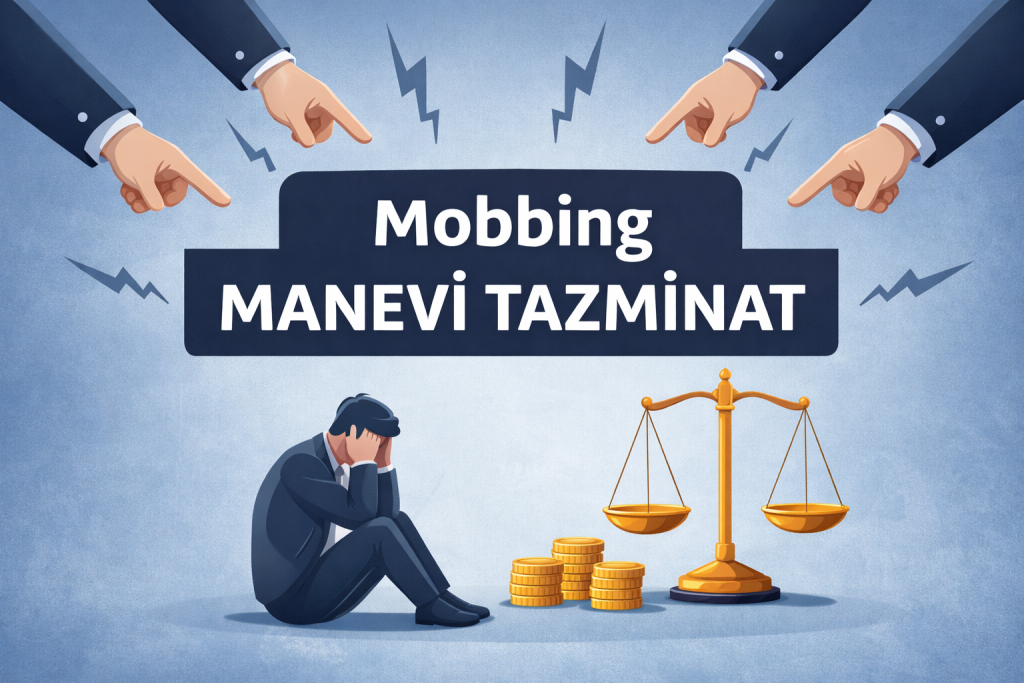
Why is Expert Lawyer Support Necessary in Cases of Non-Pecuniary Damages Due to Mobbing?
Cases for non-pecuniary damages due to mobbing are difficult to prove and technical cases, shaped by the jurisprudence of the Supreme Court and the Council of State. The acceptance of the case depends on demonstrating that mobbing has a systematic and continuous nature, has reached the extent of an attack on personal rights, and is presented with correct evidence within the framework of approximate proof rules. Witness selection, presentation of correspondence, evaluation of health reports, and legal qualification of events play a decisive role in these cases.
The most common mistakes in practice are; alleging isolated incidents as mobbing, presenting incomplete or incorrect evidence, and incorrectly determining the competent judicial authority. Such errors can lead to the rejection of even legitimate claims.
Especially in regions with intense working life such as Tuzla, Pendik, Kartal, Maltepe, Gebze, and Çayırova, mobbing allegations are frequently brought before the judiciary. Tuzla 2M Law Office provides result-oriented legal support in non-pecuniary damage cases due to mobbing, mastering the practices of the Supreme Court and the Council of State, and having a correctly structured evidence strategy. Expert lawyer support is of great importance to prevent loss of rights and ensure the effective conduct of the process.