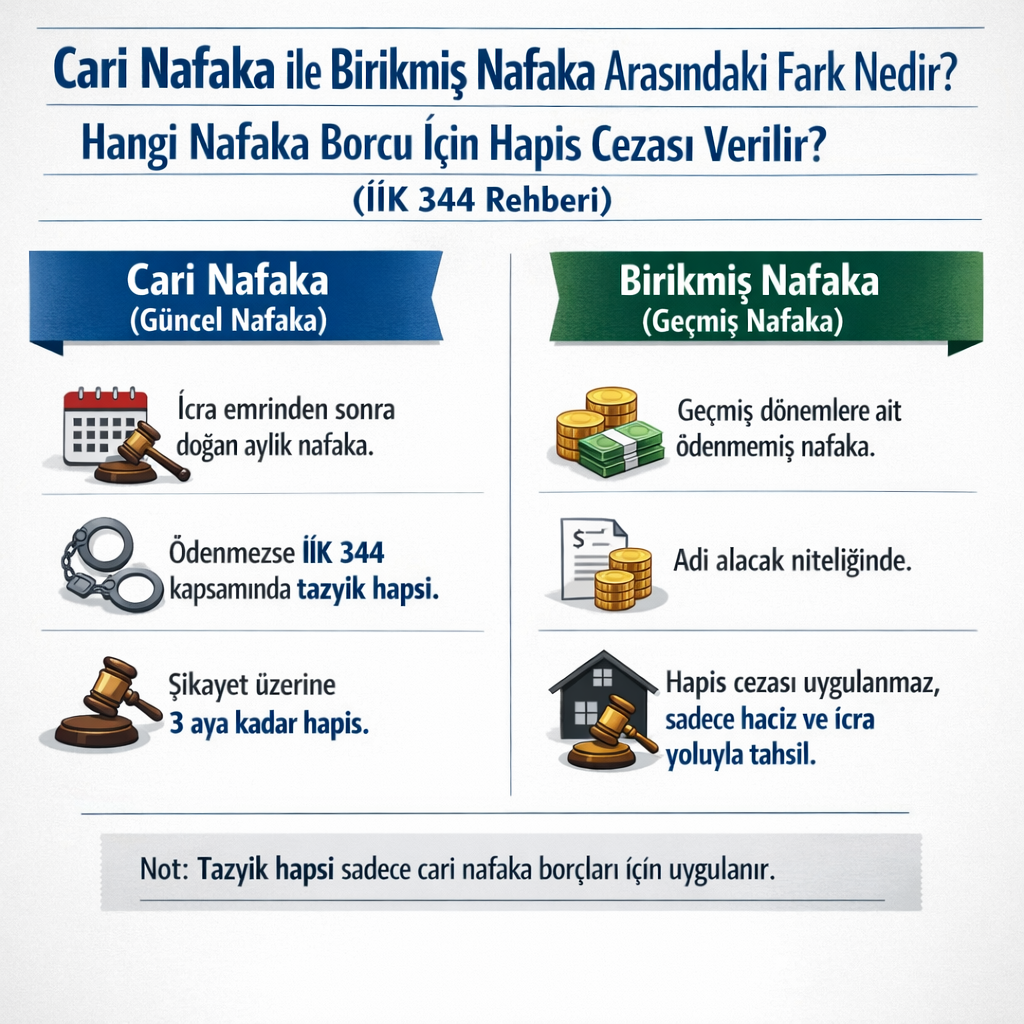
Alimony debts are not uniform in terms of enforcement law. According to the precedents of the Court of Cassation, alimony receivables are divided into two separate categories: “current alimony” and “accumulated alimony”. This distinction is not merely a theoretical one; it directly entails legal consequences in terms of enforcement proceedings, attachment application, and disciplinary imprisonment sanctions.
In practice, the most commonly confused issue is the question of for which alimony debt imprisonment can be imposed. Because, according to the decisions of the Court of Cassation, disciplinary imprisonment can be applied only in the case of non-payment of current alimony; however, imprisonment sanctions are not applied for accumulated alimony debt.
1. CONCEPTUAL FRAMEWORK: WHAT ARE CURRENT ALIMONY AND ACCUMULATED ALIMONY DEBT?
In line with the examined Court of Cassation decisions, alimony debt is divided into two main categories in terms of its legal nature and sanctions: “current alimony debt” and “accumulated alimony debt”:
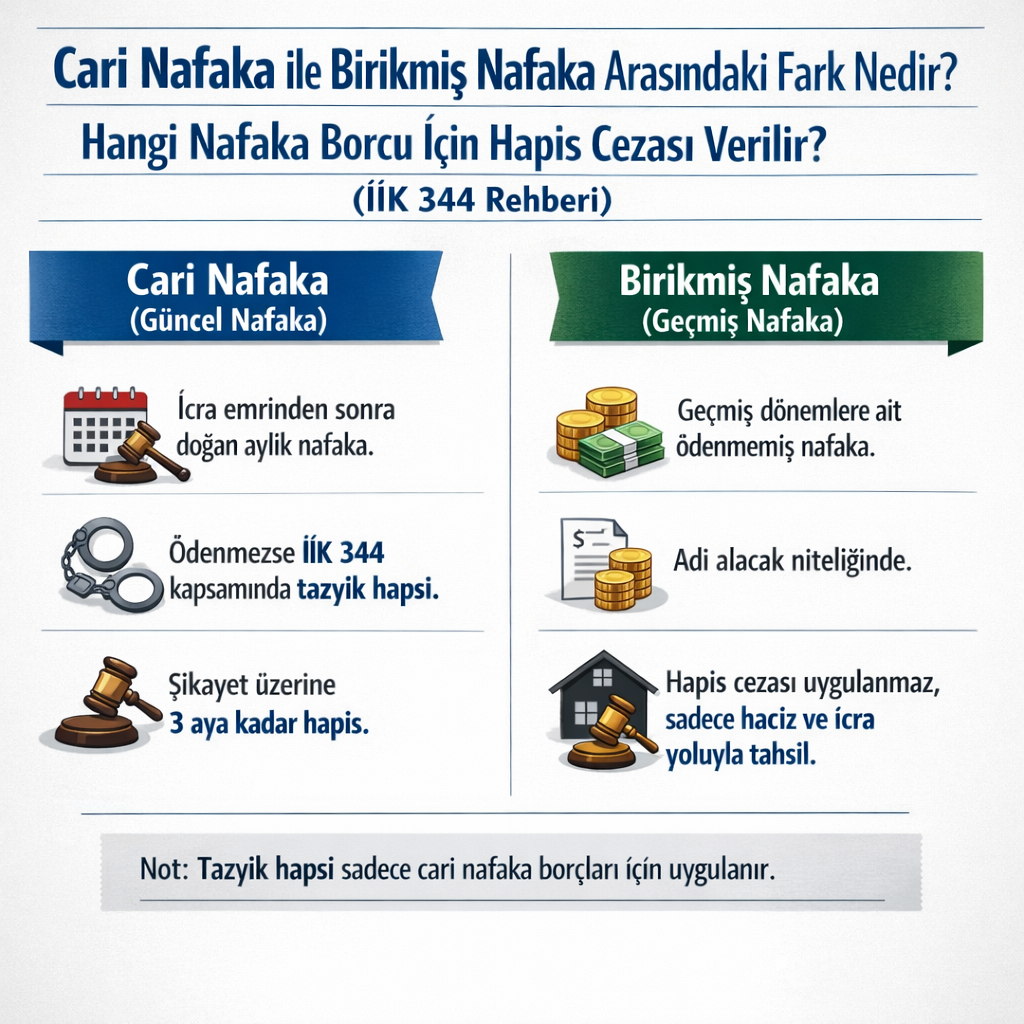
Current Alimony Debt: It refers to the current monthly alimony amounts that accrued, became due, and remained unpaid during the period between the date the enforcement order was served on the debtor and the date of the complaint. It covers ongoing monthly alimony payments and alimony obligations for future/yet-to-be-accrued periods.
Accumulated Alimony Debt: It covers unpaid alimony receivables relating to past periods, accumulated from the date the alimony judgment was rendered, prior to the service of the enforcement order or the date of the complaint. In Court of Cassation decisions, it is consistently accepted that accumulated alimony debt is considered a “simple claim”.ir.
2. ANALYSIS REGARDING COLLECTIBILITY
Both types of alimony/support can be collected through enforcement proceedings based on a final court decision or an interim order (such as interim support). However, there are significant differences in collection methods:
Enforcement Proceedings and Seizure Application: The debtor’s salary can be garnished for the full amount of current alimony/support (monthly alimony/support that will accrue). In contrast, when collecting accumulated alimony/support debt, which is in the nature of an ordinary receivable, according to Article 83 of the Enforcement and Bankruptcy Law (EBL) No. 2004, it is possible to seize the remaining portion after deducting the amount necessary for the debtor and their family to live, and this amount cannot be less than 1/4 of the salary.
Collection Priority and Extinguishment: In payments made to the enforcement file, collection priority can extend from accumulated debts to current debts. If the debtor documents that the debt has been paid (extinguished) within seven days from the notification of the enforcement order, a decision may be made to postpone the enforcement.
Termination Conditions: Child support automatically terminates when the common child reaches majority. Accumulated child support debt for periods after the date of majority is uncollectible.
3. ANALYSIS REGARDING DISCIPLINARY IMPRISONMENT
The decision to impose disciplinary imprisonment for up to 3 months against the debtor due to the offense of non-compliance with alimony/support provisions, in accordance with Article 344 of the EBL, is subject to definitive rules based on whether the debt is current or accumulated:
Current Alimony Debt and Coercive Imprisonment: For the sanction of coercive imprisonment to be applied, there must be at least one month’s current alimony debt incurred between the date of notification of the enforcement order and the date of the complaint. It must be explicitly requested in the enforcement request that current (accruing) alimony is owed. If there is no request for current alimony, the elements of the crime do not arise.
Accumulated Alimony Debt and Coercive Imprisonment: Since accumulated alimony debt is considered an ordinary receivable, non-payment of such a debt does not constitute the crime of non-compliance with alimony provisions. Coercive imprisonment cannot be imposed on the debtor in proceedings solely for the collection of accumulated alimony; if imposed, such decisions are overturned by the Court of Cassation and it is ruled that the punishment should not be served.
Conditions and Enforcement of Coercive Imprisonment:
Complaint Period: The right to complain must be exercised within 3 months from the date the act (non-payment) was learned, and in any case, within 1 year from the date the act was committed.
Prejudicial Question: If there is a pending lawsuit filed by the debtor requesting the abolition or reduction (tenkis) of alimony, coercive imprisonment cannot be applied until this lawsuit is concluded, it is mandatory to treat it as a prejudicial question.
Nature of the Sanction: Coercive imprisonment is a disciplinary arrest; it cannot be converted into alternative sanctions (administrative fines, etc.), prepayment cannot be applied, it cannot be deferred, it does not constitute a basis for recidivism, conditional release provisions cannot be applied, and it is not recorded in the judicial record.
Release: If the requirements of the decision are met after the enforcement of the imprisonment begins (if the alimony debt subject to the complaint is paid), the debtor is immediately released, and the penalty, with all its consequences, is dropped.
4. ADDITIONAL CONTEXT OBTAINED FROM SECONDARY SOURCES
The following information has been compiled from Supreme Court decisions, which provide additional context as secondary information when limited information is found in the judgment texts:
Effect of Partial Payments: Paying less than the ordered amount of current alimony debt (making a partial payment) does not mean the alimony debt has been paid and does not prevent the application of the enforcement imprisonment sanction (16th Civil Chamber 2011/6530 ).
Change in Alimony Type and Procedure: Interim alimony granted during divorce proceedings ceases upon the finalization of the decision and transforms into child support/poverty alimony. In this case, for enforcement imprisonment to be applied, the finalized decision must be separately put into execution, or a new request must be filed under the same file, and a new enforcement order pertaining to it must be served on the debtor (12th Civil Chamber 2021/10935 ).
Proper Service of Notification: For the enforcement imprisonment sanction to be applied, it is a condition that the enforcement order must have been properly served on the debtor. Irregular notifications made contrary to the Notification Law (e.g., direct notification according to Article 35) prevent the offense from occurring (19th Criminal Chamber 2016/92 ).
Violation of Interim Decisions: Interim decisions regarding alimony (interim alimony) do not need to be finalized. Non-payment of alimony ordered by an interim decision and accruing monthly also requires enforcement imprisonment for up to 3 months under Article 344 of the EIL (Enforcement and Bankruptcy Law) (16th Civil Chamber 2009/1884 ).
Contradictions in Decisions: The creation of a contradiction by the courts regarding the nature of the offense between the summary decision and the reasoned decision (for example, between “breach of commitment” and “non-payment of alimony”) leads to the annulment of the injunction of disciplinary imprisonment in favor of the law (16th HD 2009/9312 , 19th CD 2018/3008 ).
Frequently Asked Questions
Cari nafaka ile birikmiş nafaka arasındaki fark nedir?

Cari nafaka, icra emrinin borçluya tebliğ edilmesinden sonra her ay işleyen güncel nafaka borçlarını ifade eder. Birikmiş nafaka ise nafaka kararının verildiği tarihten itibaren biriken ve geçmiş dönemlere ait olan ödenmemiş nafaka borçlarını kapsar. Yargıtay kararlarına göre birikmiş nafaka adi alacak niteliğindedir, cari nafaka ise devam eden bir ödeme yükümlülüğüdür.
Hangi nafaka borcu için hapis cezası verilebilir?
İcra ve İflas Kanunu’nun 344. maddesine göre tazyik hapsi yalnızca cari nafaka borcu için uygulanabilir. İcra emrinin tebliği ile şikayet tarihi arasında en az bir aylık cari nafaka borcunun bulunması gerekir. Buna karşılık yalnızca birikmiş nafaka borcunun ödenmemesi hapis cezası verilmesi için yeterli değildir.
Nafaka borcunun bir kısmını ödemek hapis cezasını engeller mi?
Hayır. Yargıtay kararlarına göre nafaka borcunun eksik ödenmesi (kısmi ödeme yapılması) borcun tamamen ödendiği anlamına gelmez. Cari nafaka borcu hükmedilen miktardan eksik yatırılmışsa, bu durum tazyik hapsi yaptırımının uygulanmasına engel teşkil etmez.
Why is Expert Legal Support Necessary?
The collection of alimony receivables and execution-criminal proceedings related to alimony debts involve highly technical details in practice. Especially the distinction between current alimony and accumulated alimony, which debt payments made in the enforcement file will be set off against, salary garnishment rates, and the conditions for disciplinary imprisonment can often be misinterpreted.
Therefore, it is important that enforcement proceedings related to alimony debts are handled by an experienced Istanbul lawyer. An Istanbul alimony lawyer specializing in family law and enforcement law can provide legal support to clients in the collection of alimony receivables, execution-criminal cases filed due to alimony debt, and disciplinary imprisonment processes.
Operating in the fields of family law and enforcement law, 2M Law Office provides consultancy services for the collection of alimony receivables, alimony increase, and execution-criminal cases related to alimony debt. The team of Istanbul divorce lawyers and Tuzla alimony lawyers working within the office provides legal support to clients, especially in execution-criminal files opened due to current alimony debt and attachment procedures related to alimony debts.
Since mistakes made in enforcement proceedings regarding alimony debts can lead to significant loss of rights, it is of great importance for the process to be carried out by an experienced Tuzla lawyer or Istanbul alimony lawyer to prevent loss of rights.