
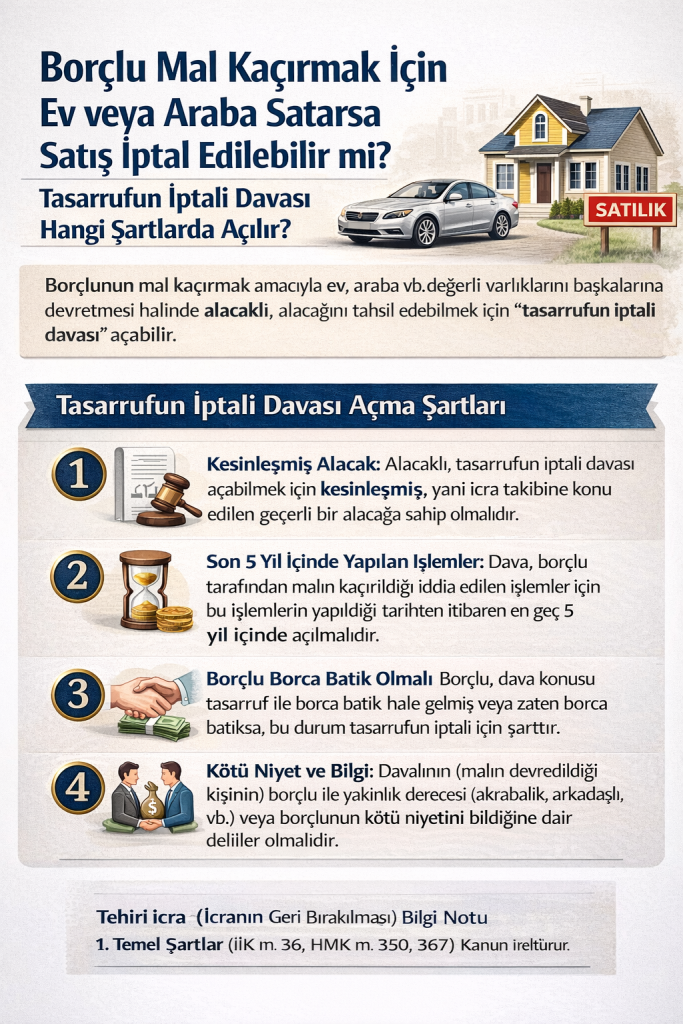
It is a common practice for debtors to transfer their assets such as houses, land, or cars to their relatives to avoid their creditors. In Turkish law, such transactions are supervised by the “action for annulment of disposition” regulated in Articles 277 et seq. of the Enforcement and Bankruptcy Law.
Through this lawsuit, the creditor can achieve the annulment of sales made by the debtor to reduce their assets, thereby acquiring the right to levy and sell the transferred property. However, for an action for annulment of disposition to be filed and for the court to examine the case, certain conditions stipulated by law must be met concurrently.
1. Prerequisites for the Admissibility of the Lawsuit
The annulment of sales of movable (car) or immovable (house) properties made by a debtor to evade creditors is subject to the provisions of Articles 277 et seq. of the Enforcement and Bankruptcy Law (EBL). According to judicial decisions and legislation, the following prerequisites must be cumulatively met for the merits of the case to be examined:
A Genuine Receivable and Enforcement Proceeding: The plaintiff must have a genuine receivable from the debtor, and the enforcement proceeding related to this receivable must have become final.
Priority of the Debt: The disposition (sale) whose annulment is sought must have been made after the debt subject to enforcement arose (EBL Art. 284). The Supreme Court emphasizes that when determining the date of inception of the debt, one should not only look at the dates of bills of exchange/checks, but also meticulously investigate whether the underlying relationship (invoice, current account, etc.) arose before the disposition [Precedent 7, 15, 21].
Certificate of Insolvency: The creditor must possess a temporary or definitive certificate of insolvency issued against the debtor (EIL Art. 277, 105). The absence of attachable assets of the debtor during seizure is also considered a temporary certificate of insolvency [İçtihat 3, 29].
Forfeiture Period: The lawsuit must be filed within 5 years from the date the disposition was made (EIL Art. 284).
2. Grounds for Annulment and Presumptive Situations
The law has regulated the grounds for annulment under three main headings:
A. Gratuitous Dispositions and Donations (EIL Art. 278):
Kinship: Sales between descendants, ascendants, spouses, and blood or in-law relatives up to the 3rd degree are considered donations and are subject to annulment. For example, the debtor selling their immovable property to their niece/nephew, father-in-law, or cousin falls within this scope [İçtihat 6, 17, 20].
Price Difference: If there is a “very low price” (exorbitant difference) between the sale price and the actual value of the property, this transaction is considered a donation. When calculating the value difference, mortgage and attachment records on the immovable property should also be taken into account [İçtihat 8, 9, 14].
B. Dispositions Made While Insolvent (EIL Art. 279):
Payments of undue debts or unusual means of payment made by the debtor while in financial difficulty may be annulled. Specifically, the transfer of an immovable property or a vehicle “in lieu of debt” is a ground for annulment as it is not considered a usual means of payment [İçtihat 5, 16].
C. Intent to Harm (EIL Art. 280):
Transactions made by the debtor with the intent to harm their creditors are annulled if the other party (the buyer) knew of this situation or if there were indications requiring them to know.
Presumption: If the buyer is the debtor’s spouse, close relative, business partner, or a person/company operating at the same address or having a commercial relationship, it is presumed that they knew of the debtor’s bad faith [İçtihat 1, 16, 23].
3. Special Situations in House and Car Sales
House (Immovable Property) Sales: The difference between the sale price in the title deed and the fair value determined by the expert is the most important criterion. Furthermore, the debtor continuing to live in the house despite selling it or being unable to prove that they paid rent is considered “contrary to the ordinary course of life” and evidence of intent to defraud creditors [İçtihat 1, 17, 25].
Car (Movable Property) Sales: Car sales must be conducted in the presence of a notary public (Highway Traffic Law art. 20/d). In an annulment lawsuit, the vehicle’s comprehensive insurance value is compared with its sale price. Acquaintance between the parties, proximity of addresses, and commercial relationship are investigated [İçtihat 6, 28].
4. Outcomes of the Lawsuit (Enforcement and Bankruptcy Law art. 283)
When the lawsuit is won, the sale transaction is not considered entirely invalid; however, the creditor is granted the authority of forced execution over that property (house or car). The creditor can have the property seized and sold without the need for correction of the record.
Monetary Compensation: If the third party has disposed of the property (sold it to a fourth party), they are ordered to pay monetary compensation to the creditor equivalent to the actual value of the property on the date it was disposed of [İçtihat 11, 12, 18].
The rights of good-faith fourth parties are protected unless their bad faith is proven (EBL art. 282).
5. Secondary Sources and Additional Assessments
The following points have been noted as secondary sources providing additional context in court decisions:
Secondary Source: The lawsuit for annulment of disposition is subject to the simple trial procedure. The value of the lawsuit is determined by whichever is less: the value of the claim subject to enforcement or the value of the asset subject to disposition [İçtihat 32, 33].
Secondary Source: In cases where other immovables are registered in the debtor’s name and these are capable of covering the debt, the lawsuit may be dismissed on the grounds that insolvency has not occurred [İçtihat 31].
Secondary Source: Proving that the sale price was paid through a bank and that the payment amount is close to the real value can prove that the disposition was a genuine sale and prevent its annulment, even if there is kinship between the parties [İçtihat 35].
Secondary Source: Also, in cases where the debtor registers an asset in a relative’s name by concealing their own identity (nam-ı müstear), a lawsuit for annulment due to collusion can be filed [İçtihat 27].
Frequently Asked Questions
Borçlu borcunu ödememek için evini veya arabasını başkasına satarsa bu satış iptal edilebilir mi?

Evet. Eğer satış işlemi alacaklıdan mal kaçırmak amacıyla yapılmışsa, alacaklı tasarrufun iptali davası açarak bu işlemin kendisine karşı hükümsüz sayılmasını sağlayabilir. Mahkeme satışın kötü niyetle yapıldığına karar verirse, satış tamamen geçersiz sayılmaz ancak alacaklıya o mal üzerinde haciz ve satış yetkisi tanınır.
Tasarrufun iptali davası açabilmek için aciz belgesi şart mı?
Genel kural olarak evet. Tasarrufun iptali davası açılabilmesi için alacaklının elinde geçici veya kesin aciz belgesi bulunmalıdır. Ancak haciz sırasında borçlunun haczedilebilir malının bulunmadığının tutanakla tespit edilmesi de geçici aciz belgesi hükmünde kabul edilmektedir.
Borçlunun malı akrabasına satması tasarrufun iptali sebebi midir?
Çoğu durumda evet. Kanuna göre borçlunun eşine, altsoyuna, üstsoyuna veya üçüncü dereceye kadar kan veya kayın hısımlarına yaptığı satışlar, bağışlama niteliğinde kabul edilebilir ve iptale tabi olabilir. Ayrıca satış bedeli ile malın gerçek değeri arasında ciddi bir fark bulunması da mahkemeler tarafından mal kaçırma karinesi olarak değerlendirilmektedir.
Information Note on the Annulment of Debtor’s Dispositions Aimed at Evading Assets
The annulment of the debtor’s sales of movable (car) or immovable (house) assets made with the intent to evade creditors is subject to the provisions of Article 277 et seq. of the Enforcement and Bankruptcy Law (EBL). For this lawsuit to be successfully concluded, the existence of certain prerequisites and grounds for annulment is required.
1. Prerequisites for the Admissibility of the Lawsuit
A Real Claim and Enforcement: The plaintiff must have a real claim against the debtor, and the enforcement proceedings related to this claim must have become final.
Priority of the Debt: The disposition (sale) whose annulment is sought must have been made after the debt in question arose (EPL Art. 284; Case Law [8], [15]).
Certificate of Insolvency: The creditor must possess a temporary or definitive certificate of insolvency issued against the debtor (EPL Art. 277, 105). The absence of attachable assets of the debtor during seizure is also considered a temporary certificate of insolvency (Case Law [29]).
Forfeiture Period: The lawsuit must be filed within 5 years from the date of the disposition (EPL Art. 284).
2. Grounds for Annulment and Presumptive Situations
The law regulates the grounds for annulment under three main headings:
Gratuitous Dispositions and Donations (EPL Art. 278):
Kinship: Sales between ascendants, descendants, spouses, and relatives by blood or affinity up to the 3rd degree are considered donations and are subject to annulment.
Price Difference: If there is “a significantly low price” (excessive difference) between the sale price and the real value of the asset, this transaction is considered a donation (Case Law [9], [14]).
Dispositions Made During Insolvency (EPL Art. 279):
Dispositions made by the debtor while in financial difficulty include: payments for debts not yet due, unusual means of payment (e.g., transfer of a car in exchange for a debt), or pledges subsequently given for an existing debt, all of which may be annulled.
Intent to Harm (EFLA art. 280):
Transactions made by the debtor with the intent to harm their creditors can be annulled if the counterparty (the buyer) was aware of this situation or if there were signs that should have made them aware.
Presumption: If the buyer is the debtor’s spouse, close relative, or business partner, it is presumed that they were aware of the debtor’s bad faith.
3. Special Circumstances in House and Car Sales
House (Immovable Property) Sales: The most important criterion is the difference between the sale price stated in the title deed and the fair market value determined by an expert. Furthermore, if the debtor continues to reside in the house after selling it or fails to pay rent, this is considered “contrary to the ordinary course of life” and serves as evidence of intent to hide assets (Case Law [1], [17]).
Car (Movable Property) Sales: Car sales must be conducted in the presence of a notary public (Highway Traffic Law art. 20/d). In an annulment lawsuit, the vehicle’s comprehensive insurance value is compared with its sale price, and the acquaintance/commercial relationship between the parties is investigated (Case Law [7], [28]).
4. Consequences of the Lawsuit (EFLA art. 283)
When the lawsuit is won, the sale transaction is not considered entirely invalid; however, the creditor is granted the authority to enforce execution over that asset (house or car).
Even if the asset remains registered under the third party’s name, the creditor can have the asset seized and sold without the need to correct the registry.
If the third party has disposed of the asset, they will be ordered to pay monetary compensation equivalent to the asset’s value on the date of disposal.
Points to Consider:
The action for annulment of disposition only produces results in favor of the creditor who initiated the lawsuit.
The rights of bona fide third parties (the person who acquired it from the buyer) are protected unless their bad faith is proven (EBL art. 282).
Why is Expert Legal Support Necessary?
Actions for annulment of disposition are among the most technical and challenging cases to prove in enforcement law. For the lawsuit to be admissible, many legal elements such as the certificate of insolvency, date of incurrence of the debt, date of disposition, price difference, kinship relations, and presumption of bad faith must be evaluated together.
In practice, most lawsuits can be dismissed due to reasons such as the lack of a certificate of insolvency, the debt arising after the disposition, or the inability to prove bad faith. Therefore, a detailed legal examination of the file is of great importance before initiating an action for annulment of disposition.
For these processes to be carried out correctly, it is important for a legal evaluation to be made by an experienced Istanbul lawyer. A lawyer specializing in enforcement law can determine whether the debtor’s sales transactions genuinely aimed at asset concealment and whether the conditions for the lawsuit are met.
Operating in the fields of enforcement law and commercial disputes, 2M Law Firm provides legal consultancy services for debt collection, actions for annulment of disposition, and lawsuits filed against the debtor’s asset concealment. The team of Istanbul lawyers and Tuzla lawyers working within the firm provides support to clients, especially in evaluating the legal nature of real estate and vehicle sales made by the debtor after enforcement proceedings and in conducting actions for annulment of disposition.
Since it is of great importance to initiate a legal process without delay in cases where the debtor transfers their assets to relatives, the process being carried out by an experienced Tuzla lawyer or Istanbul lawyer is critically important for the protection of the creditor’s rights.