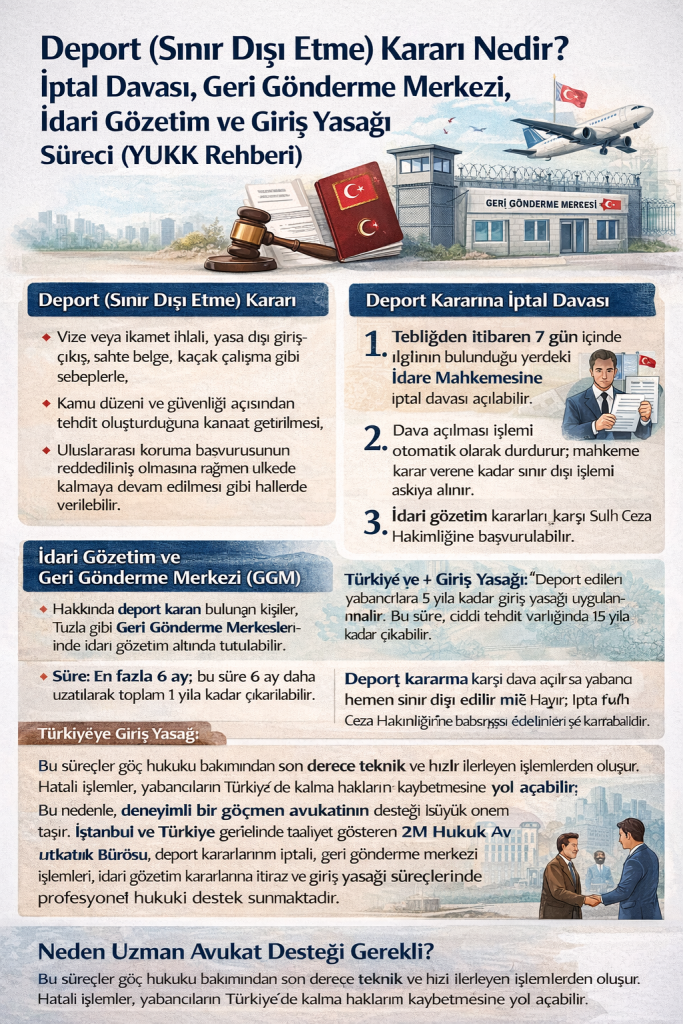
A deportation decision (sınır dışı etme) issued against foreigners in Turkey is a very serious administrative procedure that directly affects personal freedom, the right to travel, and family life. For this reason, questions such as why a deportation decision is issued, in what cases it is canceled, how the removal center process works, how long administrative detention lasts, and how an entry ban to Turkey is lifted are among the most frequently researched topics in practice. In these processes carried out pursuant to Law No. 6458 on Foreigners and International Protection (YUKK), both the administration must comply with strict formal requirements and the foreigner must make an effective legal application within a short period.
This study, in light of Law No. 6458 on Foreigners and International Protection (YUKK) legislation and current legal literature, provides a comprehensive analysis regarding deportation decisions, annulment lawsuit processes, administrative detention, removal centers, entry bans, and the legal rights of foreigners.
1. What is a Deportation Decision and Its Legal Nature
A deportation decision is an administrative procedure that ensures foreigners whose presence in Turkey is deemed contrary to regulations or who are considered undesirable for public order/security are sent to their country of origin, a transit country, or a third country (YUKK Art. 52). The decision is taken upon the instruction of the Presidency of Migration Management or ex officio by the governorships.
In literature, the legal nature of this decision and its effects on personal freedom are frequently emphasized.
“The decision to deport a foreigner is directly related to Articles 19 and 23 of the Constitution, as it affects the foreigner’s liberty and security. In Turkish law, a deportation decision regarding a foreigner is issued through an administrative act.”
Furthermore, it is mandatory for a deportation decision, which is an administrative act, to be reasoned/justified.
“Merely stating the grounds for deportation in Article 54 of the YUKK (Foreigners and International Protection Law) in the reasoning of a deportation decision would be contrary to procedure. Therefore, the specific reason on which the provisions of Article 54 of the YUKK were invoked must be clearly stated in the deportation decision.”
2. In Which Cases a Deportation Decision Is Issued and Those Who Cannot Be Deported
According to Article 54 of the YUKK, the grounds for deportation are restrictively enumerated. These primarily include;
Being a manager, member, or supporter of a terrorist or criminal organization,
Posing a threat to public order, security, or health (e.g., G-87 restriction code),
Exceeding or violating visa and residence permit durations by more than 10 days,
Entering or exiting Turkey illegally,
Using forged documents,
Those whose international protection application has been rejected and who do not have the right to stay.
Those Who Cannot Be Deported (YUKK Art. 55): The legislator has prohibited the deportation of certain foreigners, even if they fall within the scope of Article 54. This includes those facing the risk of capital punishment, torture, or degrading treatment in the country they are to be sent to (Non-refoulement / Prohibition of Return), those unable to travel due to serious health problems, age, or pregnancy, and victims of human trafficking.
3. Annulment of Deportation Order: Litigation Process and 7-Day Period
A judicial remedy is available against the deportation decision. Pursuant to Article 53/3 of the YUKK, an annulment lawsuit can be filed with the administrative court within 7 days from the notification of the decision. (Note: The 15-day period for filing a lawsuit mentioned in some older works in the literature has been reduced to 7 days by Law No. 7196). The court finalizes the application within 15 days, and the decision rendered is final.
The most important legal consequence of filing a lawsuit is that it automatically halts the execution of the process.
“Article 53/3 of the YUKK stipulates that an individual’s application against a deportation order… must be made within seven days. Furthermore, it is regulated that applications made to the court will be finalized within fifteen days… The person will not be deported until the application against the deportation decision is finalized; the finalization of the deportation decision will be awaited.”
4. Administrative Detention and Removal Centers (RCDs)
Among those for whom a deportation decision has been made; those who pose a flight risk, violate entry-exit rules, or constitute a threat to public security are placed under administrative detention by a gubernatorial decision and sent to Removal Centers (RCDs) (YUKK Art. 57).
Duration: The administrative detention period is a maximum of 6 months. If the foreigner does not cooperate, this period can be extended by a maximum of 6 more months (Maximum 1 year).
Objection: An appeal against the administrative detention decision can be made to the Criminal Judgeship of Peace. The judge renders a final decision within 5 days.
Main Debate in the Literature (Effect of Annulment Case on Administrative Detention): Although filing a lawsuit in the administrative court against a deportation decision stops the deportation process, it does not automatically stop administrative detention.
“While under administrative detention due to a deportation decision, applying to the administrative court against the deportation decision also does not stop administrative detention; it only stops the deportation process… However, if the deportation decision is found unlawful and annulled by the court, it will be understood that the person’s freedom was unlawfully restricted.”
However, if the administrative court annuls the deportation decision, administrative detention will also end as it will become groundless. “If the court decides that the deportation decision is unlawful and therefore annuls it, the administrative detention decision taken based on the said deportation decision shall also be immediately terminated by the governor’s office” Additionally, as an alternative to administrative detention, obligations such as residing at a specific address or reporting, in accordance with Article 57/A of the FIPFL, may also be imposed.
5. Entry Ban to Turkey (FIPFL Art. 9)
An entry ban to Turkey is decided by the governor’s office or the Directorate General of Migration Management for foreigners who have been deported. This period, which is generally a maximum of 5 years, can be extended by another 10 years, up to 15 years, in the presence of a serious threat to public security.
The causal link between the entry ban and the deportation decision is carefully examined in the literature.
“For an entry ban decision to be issued due to a deportation decision, the deportation decision must become final. This is because if the deportation decision is annulled, the entry ban decision issued based on it will also become unfounded.”
6. Legal Rights and Guarantees of Foreigners
During deportation and administrative detention processes, the fundamental human rights of foreigners are protected by constitutional and international guarantees. When the decision is communicated, foreigners must be informed of the appeal procedures and deadlines in a language they understand, and legal aid must be provided to those unable to afford a lawyer.
Decisions of the European Court of Human Rights (ECtHR) and the Constitutional Court (AYM) are decisive in this process. Evrim Uzun (2024) states that administrative detention is evaluated within the scope of ECHR Article 5 (Right to Liberty and Security);
“The Constitutional Court… has issued violation decisions due to complaints made under this heading concerning procedural guarantees that contradict Article 19 of the Constitution and the arrest of individuals subject to a deportation decision, the conditions of administrative detention, its duration, extensions, notification to the concerned party, and avenues for challenging administrative detention decisions.”
In conclusion; deportation decisions and related administrative detention procedures are legal processes directly linked to the right to personal liberty and security, subject to strict formal requirements and deadlines for the administration, where judicial review (7-day lawsuit filing period and automatic suspension effect) can be effectively utilized.
Deport (sınır dışı etme) kararı hangi durumlarda verilir?

Deport kararı, yabancının Türkiye’de bulunmasının mevzuata aykırı görülmesi veya kamu düzeni, kamu güvenliği ya da kamu sağlığı açısından sakıncalı kabul edilmesi halinde verilebilir. Uygulamada en sık karşılaşılan nedenler; vize veya ikamet ihlali, kaçak çalışma, sahte belge kullanılması, Türkiye’ye yasa dışı giriş-çıkış yapılması, kamu düzeni açısından tehdit oluşturulduğunun değerlendirilmesi, tahdit kodu konulması ve uluslararası koruma başvurusunun reddedilmesine rağmen ülkede kalmaya devam edilmesi gibi hallerdir. Ancak her olayda idarenin sadece kanun maddesini yazması yeterli değildir; kişiye neden sınır dışı kararı verildiğinin somut ve açık şekilde ortaya konulması gerekir. Aksi halde deport kararı, gerekçe yönünden hukuka aykırı hale gelebilir.
Deport kararına karşı dava açma süresi kaç gündür, hangi mahkemeye başvurulur?
Sınır dışı etme kararına karşı kararın tebliğinden itibaren 7 gün içinde yetkili İdare Mahkemesinde iptal davası açılması gerekir. Bu süre son derece kısa ve hak düşürücü nitelikte olduğundan, birkaç günlük gecikme bile dava hakkının kaybına yol açabilir. Yetkili mahkeme genellikle kararı veren valiliğin veya il göç idaresinin bulunduğu yerdeki idare mahkemesidir. Örneğin karar İstanbul’da verilmişse çoğu durumda dava İstanbul İdare Mahkemelerinde açılır. Dava dilekçesinin doğru hazırlanması, sınır dışı gerekçesinin hukuka aykırılığının somutlaştırılması ve risk durumlarının açıkça anlatılması bu aşamada çok önemlidir.
Deport kararına karşı dava açılırsa yabancı hemen sınır dışı edilir mi?
Hayır. YUKK m. 53/3 uyarınca, deport kararına karşı süresi içinde dava açıldığında sınır dışı işlemi otomatik olarak durur. Bu, uygulamadaki en önemli güvencelerden biridir. Yani yabancı, kendi açık rızasıyla gönüllü geri dönüşü kabul etmediği sürece, dava sürerken sınır dışı edilemez. Ancak burada dikkat edilmesi gereken önemli nokta şudur: deport kararına karşı dava açılması, sınır dışı işlemini durdurur; fakat idari gözetim kararını kendiliğinden sona erdirmez. Bu nedenle kişi geri gönderme merkezinde tutuluyorsa, ayrıca idari gözetim kararına karşı da hukuki başvuru yapılması gerekebilir.
Why is Expert Legal Support Necessary?
Deportation, administrative detention, and removal center processes are highly technical processes in terms of immigration law, administrative law, and fundamental rights and freedoms. Especially the 7-day period to file a lawsuit, whether the foreigner was informed in a language they understand, whether the decision was truly reasoned, the basis of the restriction code, Tuzla Removal Center practices, applications to be made against the administrative detention decision, and evaluations regarding the entry ban to Turkey require professional legal intervention. Even the smallest mistake made in practice can lead to the person’s deportation, separation from their family, or facing a long-term entry ban.
Therefore, it is of great importance that these processes are carried out with the support of an Istanbul immigration lawyer, a Tuzla lawyer, or especially a Tuzla immigration lawyer. This is because, particularly in Tuzla Removal Center cases, procedures progress very quickly; and the application, objection, and lawsuit periods are extremely short. Experienced legal representation plays a decisive role in protecting the foreigner’s rights, both in terms of annulling the deportation decision, lifting administrative detention, and reviewing the legality of the entry ban.
2M Law Office, working in the field of immigration law in Istanbul and across Turkey, offers professional legal support in cases concerning the annulment of deportation decisions, return center procedures, objections to administrative detention decisions, restriction codes, entry ban procedures, and disputes related to the legal status of foreigners. Especially for individuals seeking assistance from an **Istanbul immigration lawyer**, **Tuzla lawyer**, and **Tuzla immigration lawyer**, 2M Law Office provides significant legal support with its expertise in the technical details of immigration law application and its thorough understanding of the processes at the **Tuzla Repatriation Center**.