
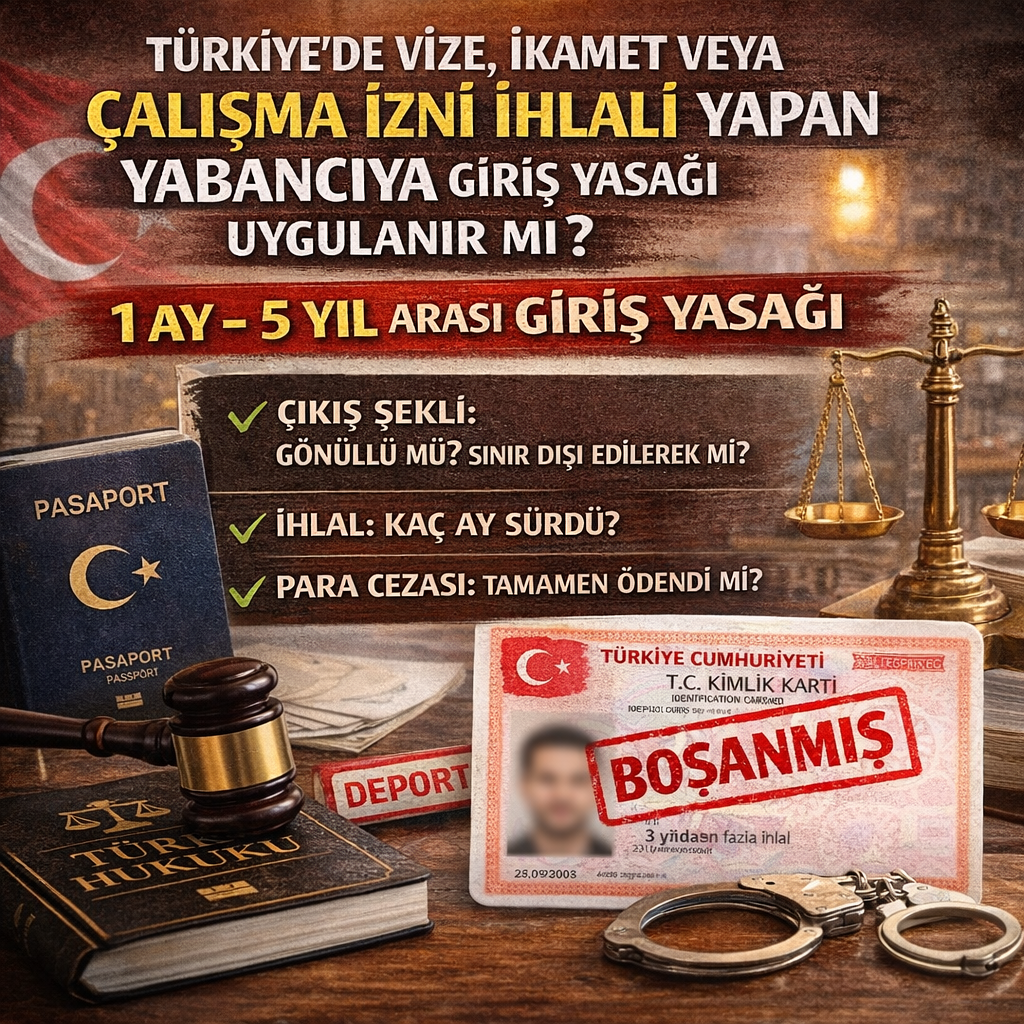
Exceeding the legal right of stay held by foreigners in Turkey under the scope of a visa, visa exemption, residence permit, work permit, or work permit exemption is one of the most common immigration law issues encountered in practice. In particular, under headings such as “illegal stay”, “deportation ban”, “entry ban”, “residence violation”, “visa violation”, and “staying without a work permit”, the question most frequently asked by foreigners is: When the legal right of stay is violated, is an entry ban to Turkey applied automatically, or is the assessment made based on the duration of the violation and the manner of departure?
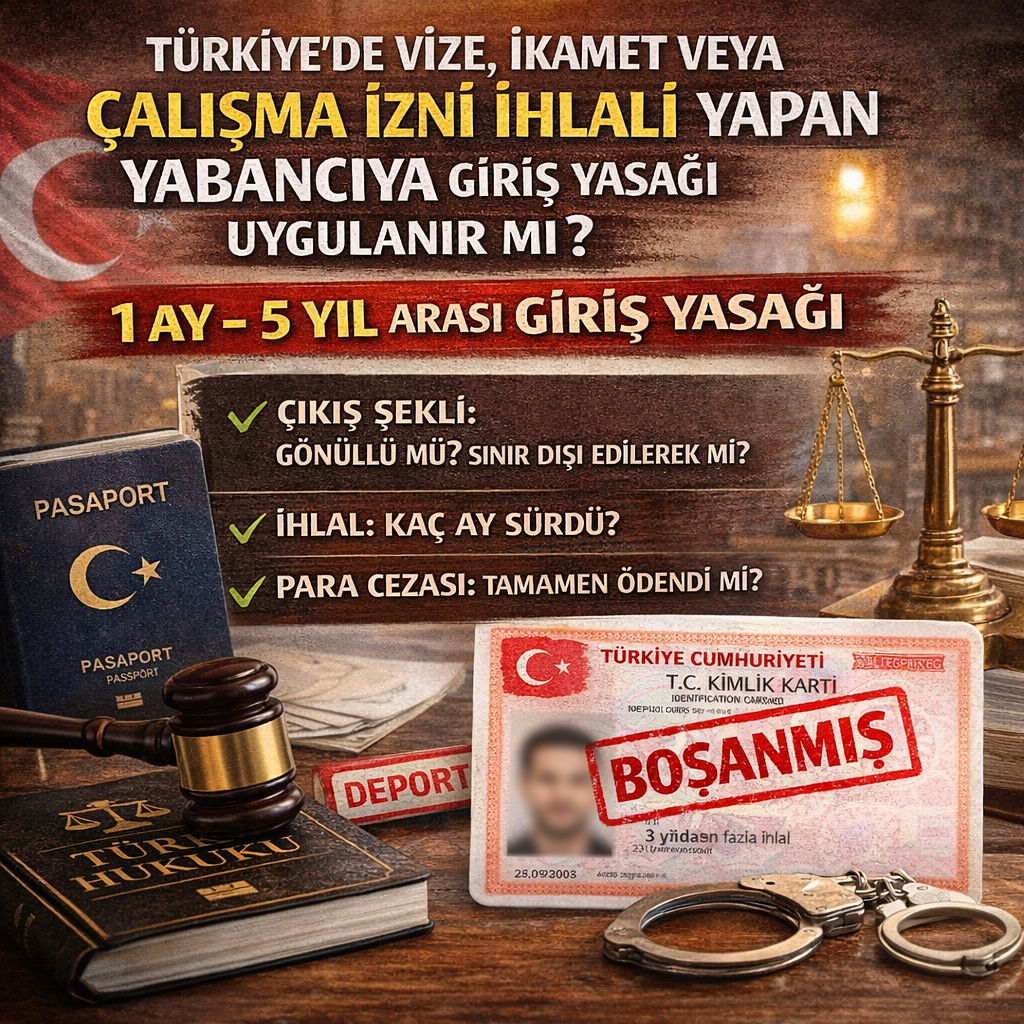
According to the statement dated 09.06.2020, which forms the basis of the Ministry of Interior’s Directorate General of Migration Management practice, the same outcome is not applied to every foreigner who violates the right of legal residence in Turkey. Whether an entry ban will be imposed depends on: how many months the violation lasted, whether the foreigner departed voluntarily, whether the violation was detected by the competent authorities, whether the administrative fine was paid, and also whether a deportation decision was issued against the person. Therefore, the matter is not simple enough to be answered in a single sentence; on the contrary, it is a technical immigration law issue that requires each possibility to be evaluated separately.
What is a Violation of the Right of Legal Residence? Which Situations Fall Under This Scope?
Legal stay violation; means a foreigner exceeding the stay period granted to them in Turkey with a visa, visa exemption, residence permit, work permit, or work permit exemption. In other words, if a person continues to stay in Turkey after the period during which they can legally remain in the country has ended, this is considered a “legal stay violation.”
These violations do not only occur in the classic sense of exceeding a visa period. In practice;
exceeding the visa period,
exceeding the visa exemption period,
continuing to stay in the country after the residence permit has expired,
staying contrary to the conditions of a work permit or work permit exemption,
not leaving the country within the granted period despite the residence permit or work permit application being rejected,
cases such as not exiting within the period after a cancelled residence or work permit, are also evaluated within the same framework.
At this point, the most critical issue is this: Not every legal stay violation directly leads to an entry ban for the same duration. The Ministry’s statement clearly indicates that in some cases, no entry ban will be applied; while in other cases, an entry ban to Turkey ranging from 1 month to 5 years will be imposed.
Can an Entry Ban Not Be Applied at All for Violations Less Than 3 Months?
Yes. According to the Ministry’s statement, regarding foreigners who commit a legal stay violation of less than 3 months, not up to 3 months but excluding 3 months, in some cases, a decision for an entry ban to Turkey is not imposed.
However, not every short-term violation is sufficient for this. There are conditions for not imposing an entry ban. The first of these is that the foreigner wishes to exit by voluntarily going to the border gate before their situation is detected by the competent authorities. The second is that the administrative fine arising from Law No. 492 on Fees has been paid.
In this context, two main possibilities are foreseen:
1. Voluntary Departure Before Detection by Authorities
If a foreigner has violated their legal right to stay for less than 3 months and voluntarily goes to the border gate to exit Turkey before this situation is detected by official authorities, and also pays the administrative fine, an entry ban decision will not be made against them.
2. Departure Within the Granted Period, Even If a Deportation Decision Has Been Made Against Them
If the foreigner is again in violation for less than 3 months, and a deportation decision has been made against them and they have been granted a period to leave Turkey; if they go to the border gate and exit within this period and pay the administrative fine, an entry ban will again not be applied.
As seen here, a short-term violation alone is not sufficient. The timing of the exit and the payment of the administrative fine are decisive.
In Case of a Violation of 3 Months or More, Will an Entry Ban Be Applied Even If Departure Occurs Before Detection by Authorities?
Yes. This is one of the most important points of the Ministry’s statement. In practice, many people think, “If I leave voluntarily, I won’t get an entry ban.” However, this is not true in all cases.
If a foreigner has violated legal stay for 3 months or more and wishes to leave the country voluntarily by going to the border gate before the authorities detect this situation, and also pays the administrative fine; in this case, a decision is still made to impose a Turkey entry ban for 1 month to 5 years.
For foreigners in this group, the entry ban periods stipulated according to the duration of the violation are as follows:
Violation between 3 months – 6 months: 1-month entry ban
Violation between 6 months – 1 year: 3-month entry ban
Violation between 1 year – 2 years: 1-year entry ban
Violation between 2 years – 3 years: 2-year entry ban
Violation of more than 3 years: 5-year entry ban
Therefore, there is a very clear distinction here: For violations less than 3 months, if the necessary conditions are met, an entry ban may not be applied at all. For violations of 3 months or more, even if the foreigner has departed voluntarily and paid the fine, an entry ban will still be imposed.
In Which Cases Do More Severe Consequences Arise? What are the Situations Where an Entry Ban of 3 Months to 5 Years is Applied?
The Ministry’s statement evaluates some cases as more severe. In these cases, a decision is made to impose a Turkey entry ban for 3 months to 5 years on the foreigner. This group represents the files that cause the most disputes in practice.
1. Departure Without Paying the Fine
Even if a foreigner voluntarily goes to the border gate before the authorities detect a violation of legal stay, if they do not pay the administrative fine arising from Law No. 492 on Fees, a more severe entry ban will be imposed. In this case, voluntary departure alone does not provide sufficient protection.
2. Failure to Comply with the Invitation to Depart or Failure to Pay the Fine in Case of a Violation of Less Than 3 Months
A foreigner may have committed a violation for less than 3 months. However, if a deportation decision is made against them and they are given a period to leave Turkey but do not depart within this period, or if they do not pay the fine, they will face a more severe sanction.
3. Those Invited to Depart for Violations of 3 Months and More
If the violation of legal stay is 3 months or more and a deportation decision has been made against the foreigner, granting them a period to leave the country, a more severe entry ban will be applied, regardless of whether they paid the fine.
4. Those Whose Residence Permit Request Was Rejected or Whose Residence Permit Was Canceled
According to the Ministry’s statement, if a foreigner whose residence permit request has been rejected or whose residence permit has been canceled does not depart from Turkey within the period granted to them, an entry ban decision will be made against them, regardless of whether they paid the fine.
5. Those Whose Work Permit Request Was Rejected or Whose Work Permit Was Canceled
Similarly, a foreigner whose work permit application has been rejected or whose work permit has been canceled will face a more severe sanction if they do not leave the country within the given period.
6. Those Who Did Not Apply Within the 10-Day Period Granted After the 90-Day Rule in 180 Days
This is one of the situations specifically mentioned in the Ministry’s statement. If a foreigner, who was permitted entry on the condition of applying for a residence permit within 10 days after exhausting the entire period of stay granted by a visa or visa exemption, fails to make this application, an entry ban may be imposed on them.
7. Those Whose Administrative Detention is Terminated and are Subject to Alternative Obligations
When an administrative detention measure is terminated and the foreigner is subjected to alternative obligations, this situation is also listed among the cases where an entry ban may be applied, as stated in the explanation.
8. Those Deported with Accompanying Personnel
Deportation with accompanying personnel is one of the situations considered more severe in practice. In such a case, an entry ban may be imposed regardless of whether the fine has been paid.
What Are the Durations of Entry Bans in This More Severe Category?
In the aggravating circumstances listed above, the durations of entry bans to be applied according to the period of violation are as follows:
Violation up to 3 months: 3-month entry ban
Violation between 3 – 6 months: 6-month entry ban
Violation between 6 months – 1 year: 1-year entry ban
Violation between 1 – 2 years: 2-year entry ban
Violation more than 2 years: 5-year entry ban
The point to note here is: This table is more severe than the previous voluntary departure table. This is because the foreigner’s behavior is now evaluated more negatively by the administration. Specifically, phenomena such as failure to comply with the invitation to leave, failure to pay the fine, failure to leave after rejection or cancellation, and deportation with escort lead the administration to increase its sanctions.
Can Automatic Entry to Turkey Be Made When the Entry Ban Period Ends?
No, not always. This is the very important but often overlooked part of the Ministry’s statement.
According to the statement, even if the entry ban period has expired, if the foreigner has not paid the administrative fines arising from the Fees Law numbered 492 and public receivables arising from other legislation, entry to Turkey is not permitted until these debts are paid.
In practice, therefore, these two stages should be separated:
First, the expiration of the entry ban period imposed on the foreigner.
Second, the full payment of administrative fines and public receivables that prevent entry.
For this reason, many foreigners may experience problems such as, “My ban has expired, but I was still not allowed into the country.” The reason for this is often that old fines or public debts appear as outstanding in the system.
Official Statement of the Directorate General of Migration Management on This Matter :
Explanation Regarding Entry Bans Applied to Foreigners Who Violate the Right of Legal Stay
09.06.2020
In our country, entry bans applied to foreigners who are in violation of the right of legal stay, i.e., violations of visa, visa exemption, residence permit, work permit or work permit exemption rules, under Article 9 titled “Entry ban to Turkey” of the Law on Foreigners and International Protection No. 6458 dated 4/4/2013, are implemented within the framework of the following principles.
1. No decision for an entry ban to Turkey is made for foreigners who, despite violating the right of legal stay, exit the country under the following conditions.
a. Foreigners who have violated the right of legal stay for up to 3 months (not including 3 months), who voluntarily come to the border gates to exit Turkey before these violations are detected by the authorities, and who pay the administrative fines arising from the Fees Law No. 492.
b. Foreigners who have violated their legal right of stay for up to 3 months (excluding 3 months), against whom a deportation decision has been made, who come to the border gates to exit within the period granted to them to leave Turkey, and who pay the administrative fines arising from Law No. 492 on Fees.
2. Despite violating their legal right of stay, foreigners who exit the country under the following conditions will be subject to a decision banning their entry to Turkey for a period of 1 month to 5 years.
a. Foreigners who have violated their legal right of stay for more than 3 months (including 3 months), who voluntarily come to the border gates to leave Turkey before their situation is detected by the authorized authorities, and who pay the administrative fines arising from Law No. 492 on Fees.
For foreigners in this category, the entry ban periods corresponding to their violation durations are as follows:
Violation between 3 months – 6 months : 1 month entry ban
Violation between 6 months – 1 year : 3 months entry ban
Violation between 1 year – 2 years : 1 year entry ban
Violation between 2 years – 3 years : 2 years entry ban
Violation for more than 3 years : 5 years entry ban
3. An entry ban to Turkey, lasting from 3 months to 5 years, is imposed on foreigners who violate their right to legal stay and exit the country or are deported under the circumstances listed below.
a. Foreigners who, even if they voluntarily arrive at border gates to exit Turkey before violations of their right to legal stay are detected by the competent authorities, do not pay the administrative fines arising from Law No. 492 on Fees.
b. Foreigners who violate the right to legal stay for up to 3 months (not including 3 months) and who, after a deportation decision is made against them and they are invited to leave Turkey, do not exit within the period granted to them and/or do not pay the administrative fines arising from Law No. 492 on Fees.
c. Foreigners who violate the right to legal stay for more than 3 months (including 3 months), regardless of whether they paid the administrative fines arising from Law No. 492 on Fees, and for whom a deportation decision is made, and who are invited to leave Turkey.
ç. Foreigners who, even if their residence permit applications are rejected or their residence permits are cancelled, do not exit within the period granted to them, regardless of whether they paid the administrative fines arising from Law No. 492 on Fees.
d. foreigners who, **regardless of whether they have paid the administrative fines** arising from the Fees Law No. 492, **do not exit within the period granted to them** even if their work permit applications are rejected or their work permits are canceled
e. foreigners who, **regardless of whether they have paid the administrative fines** arising from the Fees Law No. 492, and despite being permitted to enter our country on the condition of applying for a residence permit within 10 days (even after having fully utilized their right of stay granted by a visa or visa exemption under the “90 days in 180 days” rule), **do not apply for a residence permit**
f. foreigners who, **regardless of whether they have paid the administrative fines** arising from the Fees Law No. 492, are **subjected to alternative obligations** after the administrative detention decision is terminated
g. foreigners who, **regardless of whether they have paid the administrative fines** arising from the Fees Law No. 492, are **deported** accompanied by authorized personnel
For foreigners in this category, the durations of entry bans corresponding to the periods of violation are as follows:
Violation up to 3 months : 3-month entry ban
Violation between 3 and 6 months : 6-month entry ban
Violation between 6 months and 1 year : 1-year entry ban
Violation between 1 year and 2 years: 2-year entry ban
Violation of more than 2 years: 5-year entry ban
4. Even if the duration of the established entry ban decision has expired, foreigners who do not pay the administrative fines and other public receivables arising from the Fees Law no. 492 and other legislative provisions are not permitted to enter our country under Articles 7 and 15 of Law no. 6458, as long as they do not pay these fines and public receivables.
Frequently Asked Questions
Türkiye’de kaçak kalan her yabancıya giriş yasağı uygulanır mı?

Hayır. Bakanlık açıklamasına göre her ihlal aynı sonucu doğurmaz. Özellikle 3 aydan az ihlalde, yetkililer tespit etmeden gönüllü çıkış yapılması ve idari para cezasının ödenmesi halinde giriş yasağı uygulanmayabilir.
3 aydan az kaçak kalan yabancı Türkiye’den kendiliğinden çıkarsa yasak alır mı?
Şartlara bağlıdır. Yetkili makamlar tespit etmeden önce sınır kapısına gelmişse ve idari para cezasını ödemişse giriş yasağı uygulanmaması mümkündür.
3 ayı geçen ihlalde kişi kendi çıkış yaparsa yine de giriş yasağı olur mu?
Evet. 3 ay ve üzeri ihlalde, yabancı yetkililer tespit etmeden önce gönüllü olarak çıkış yapmış ve para cezasını ödemiş olsa dahi, ihlal süresine göre 1 aydan 5 yıla kadar giriş yasağı uygulanabilir.
İdari para cezası ödenmezse ne olur?
Para cezasının ödenmemesi, giriş yasağının daha ağır uygulanmasına neden olabilir. Ayrıca giriş yasağı süresi bitse bile ceza ve kamu alacakları ödenmeden Türkiye’ye girişe izin verilmeyebilir.
İkamet izni reddedilen yabancı hemen deport edilir mi?
Her dosyada otomatik ve aynı şekilde işlem yapılmaz. Ancak ikamet izni talebi reddedildiği halde kişiye tanınan çıkış süresi içinde ülkeden ayrılınmazsa, giriş yasağı ve sınır dışı süreci gündeme gelebilir.
İkamet izni iptal edilen yabancıya giriş yasağı uygulanır mı?
Evet, uygulanabilir. Bakanlık açıklamasına göre, ikamet izni iptal edildiği halde verilen süre içinde çıkış yapılmazsa, para cezasının ödenip ödenmediğine bakılmaksızın giriş yasağı kararı alınabilmektedir.
Why Is Expert Lawyer Support Necessary?
Violations of the legal right to stay, deportation decisions, entry bans, cancellation of residence permits, and exit obligations arising from work permits are often not merely a simple calculation of “how many days of violation there are” in practice. This is because the outcome of the case depends on the method of violation detection, the foreigner’s status, whether a period for voluntary departure was granted, whether the administrative fine was paid, and whether the departure was voluntary or escorted. A single misjudged detail can cause the foreigner to be unable to enter Turkey for months or even years.
Therefore, it is of great importance that the file is examined by an expert immigration law attorney, especially in cases of deportation, entry bans, residence permit cancellations, work permit rejections, removal center procedures, and administrative detention decisions. 2M Hukuk Law Office provides legal support in the field of foreigners’ law and administrative law; as an Istanbul immigration lawyer, Istanbul deportation lawyer, Tuzla lawyer, and Tuzla Removal Center lawyer, it assists with objections to entry bans, cancellation of deportation decisions, disputes arising from residence and work permits, and removal center processes. Especially in cases handled in and around Istanbul and Tuzla, applications and lawsuits must be technically structured correctly to prevent loss of rights due to time limits.