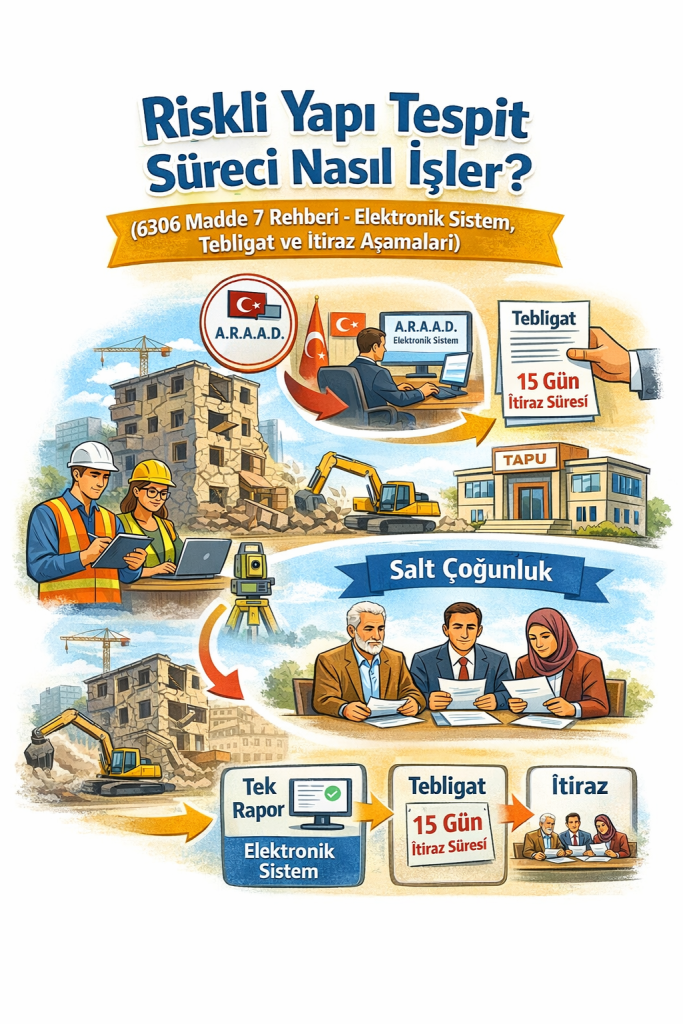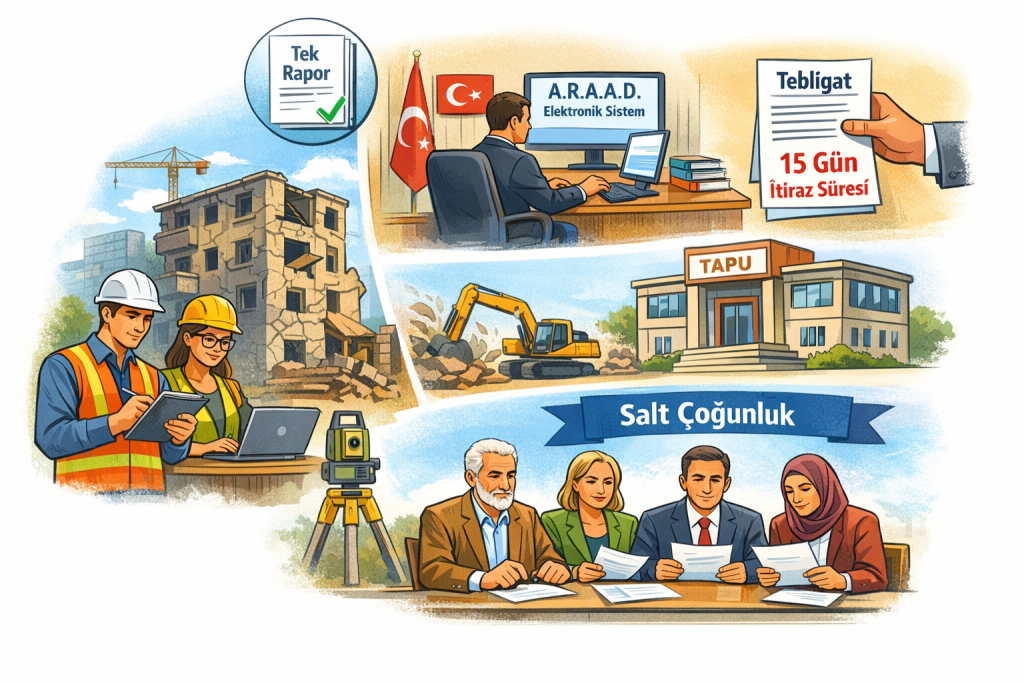
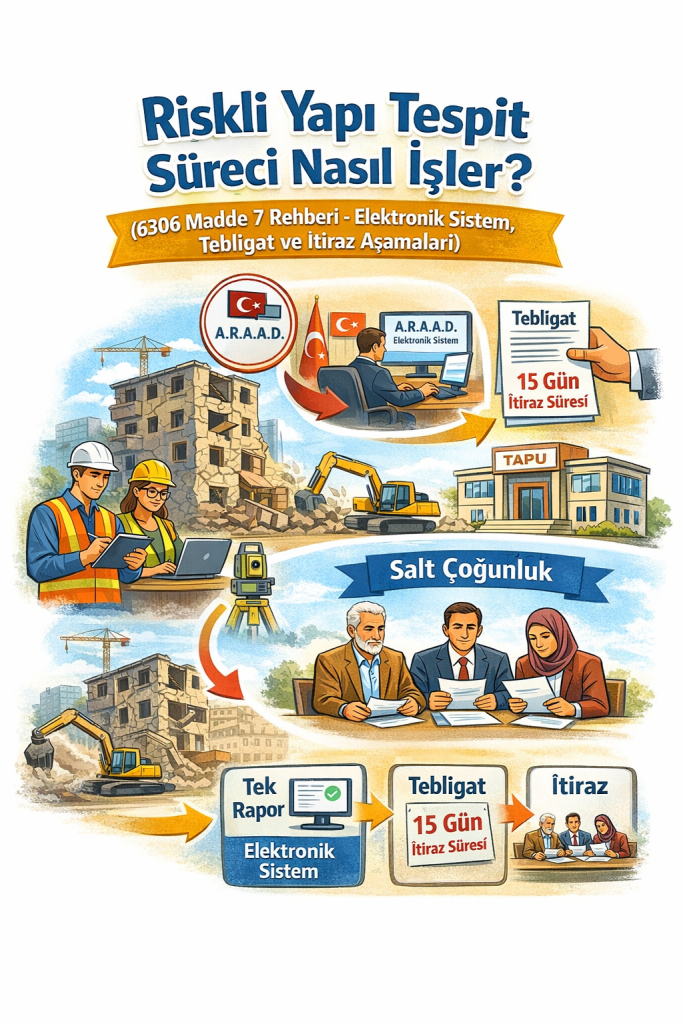
Risky building detection, within the scope of Law No. 6306 and Article 7 of the Implementation Regulation; consists of critical stages such as the owners’ application, electronic software process, annotation in the land registry, a 15-day right to object, and technical committee examination. Conducting the process contrary to procedure may lead to serious consequences in terms of property rights.
1. Risky Building Detection Procedure and Use of Electronic Software
In accordance with Article 7 of the Implementation Regulation of Law No. 6306, the detection of risky buildings is primarily carried out by institutions and organizations licensed by the Ministry, at the expense of the building owners or their legal representatives. As stated in the decisions of the Council of State Administrative Litigation Chamber (2019/1187 E.) and the 6th Chamber of the Council of State (2019/17988 E.), this process is conducted through the electronic software system named “A.R.A.A.D.“. If the owners do not have the detection carried out within the specified period, the detections are carried out or arranged ex officio by the Ministry or the Administration. The 6th Chamber of the Council of State (2019/17988 E.) emphasized the importance of procedures for deleting the record in terms of property rights and administrative processes, in cases where the detection is not carried out within two months after a building record is created via the electronic software system.
2. Notification of Detection Reports to the Land Registry and Service Procedures
The prepared risky structure detection reports are examined by the relevant directorate, and if no deficiencies are found, the risky structures are reported to the relevant land registry office to be recorded in the declarations section of the land registry. As stated in the decisions of the Istanbul Regional Administrative Court 4th Administrative Litigation Chamber (2017/1392 E.) and the Council of State 6th Chamber (2019/2536 E.), these annotations recorded in the land registry; are notified to the real and personal right holders in accordance with Notification Law No. 7201. The notification clearly states that an objection can be made against the risky structure detection within fifteen days from the date of notification. In the decision of the Istanbul Regional Administrative Court 4th Administrative Litigation Chamber numbered 2017/1059 E., it is observed that the procedure of delivering the notification to the headman (muhtar) was also applied in the process.
3. Objection Process and Technical Committee Evaluation
Against the risky structure detection, owners or their legal representatives may object within fifteen days by submitting a petition to the Directorate located where the structure is. The decisions of the Council of State 6th Chamber (2019/16858 E.) and the Istanbul Regional Administrative Court 4th Administrative Litigation Chamber (2017/1392 E.) have confirmed that, as a rule, only one risky structure detection report can be prepared for each structure, and this limitation aims to prevent the process from being prolonged by multiple reports. Objections are examined and decided upon by technical committees consisting of four faculty members assigned from universities and three individuals working at the Ministry. The Council of State 6th Chamber (2020/5347 E.) stated that if the technical committee finds deficiencies in the report, it can return the report to the licensed institution for correction, but the final decision will be made by the technical committee.
4. Special Rules Regarding Structures Under Construction and Cultural Assets
In accordance with Article 7, paragraph 1 of the Regulation, structures under construction and not inhabited, as well as structures whose structural integrity has been compromised due to dilapidation or static reasons, cannot be subject to risky structure determination. The 6th Chamber of the Council of State (2019/16858 E. ) found it lawful to exclude such structures from the scope of Law No. 6306. Furthermore, in the decisions of the İzmir Regional Administrative Court 4th Administrative Litigation Chamber (2019/1500 E. ) and the Council of State 6th Chamber (2020/2160 E. ), it was emphasized that in cases where the immovable property is an ancient monument or a registered cultural asset, the opinion or permission of the Regional Board for the Protection of Cultural Assets must be obtained, and that the special protection statuses of these structures are taken into account in risky structure processes.
5. Information Obtained from Secondary Sources
In judicial decisions classified as secondary sources, the following additional contexts regarding the application of Article 7 have been presented:
Right to Object: The 13th Chamber of the Council of State (2022/1577 E. ) and the 6th Chamber of the Council of State (2020/5348 E. ) emphasized that the right to object is granted only to building owners or their legal representatives, and that tenants or personal rights holders do not have the right to object to the determination process.
Technical Committee Structure: The İzmir Regional Administrative Court 3rd Administrative Litigation Chamber (2019/1201 E. ) stated that technical committees are formed with the participation of four members from universities and three members from the Ministry and that objections are definitively resolved by these committees.
Notification and Finalization: The Court of Jurisdictional Disputes (2023/51 E.), confirmed that the annotations entered in the land registry were duly served to the relevant parties in a manner that would initiate the fifteen-day objection period, and that in the absence of an objection, the determination became final, proceeding to the demolition phase.
Result: The presented court decisions demonstrate that the procedures for risky structure identification, notification, and objection, regulated under Article 7 of the Implementation Regulation of Law No. 6306, are applied within the framework of technical committee supervision and specific time limitations (15 days for objection, single report principle), while observing the balance between property rights and public interest. The responses do not include specific implementation details regarding entry with law enforcement in case of obstruction.
Frequently Asked Questions
Riskli yapı tespiti yapılırken maliklerden izin alınmadan binaya girilebilir mi?

Kanun ve yönetmelikte kolluk zoruyla girişe dair açık düzenleme bulunmamaktadır. Ancak uygulamada idari işlemlerin yerine getirilmesi için idare gerekli tedbirleri alabilir.
Kiracı riskli yapı raporuna itiraz edebilir mi?
Hayır. İtiraz hakkı yalnızca maliklere veya kanuni temsilcilerine aittir.
15 günlük itiraz süresi kaçırılırsa ne olur?
Tespit kesinleşir ve yıkım sürecine geçilebilir. Süre hak düşürücü niteliktedir.
Why is Expert Legal Support Specifically Needed in Istanbul – Tuzla?
2M Hukuk Law Office actively pursues lawsuits and administrative dispute resolution processes, particularly in urban transformation, risky building, land registry annotation, and demolition processes in the Istanbul Anatolian Side and Tuzla region.
Why is the Process More Critical in Istanbul?
Accelerated procedures due to high earthquake risk
Dense construction and land share disputes
Disputes regarding the majority decision of floor owners
Irrecoverable loss of rights due to missing the objection period
Necessity of parallel execution of land registry procedures and administrative judicial processes
In the risky building process;
✔ Electronic system errors
✔ Irregular notification
✔ Incomplete technical examination
✔ Unauthorized report issuance
matters such as these can be subject to an annulment lawsuit.
Therefore, it is of critical importance for property owners entering the risky building process, especially in the Istanbul – Tuzla region, to obtain expert legal support from the beginning of the process for the protection of their property rights.