
1) Purpose, scope, and limits of “risky building detection”
ARTICLE 7 aims to standardize the detection by regulating that risky building detection will be carried out according to the principles of Annex-2 and using an electronic software program developed/determined by the Presidency. (Reg. art. 7/1)
By explicitly listing the types of structures for which detection can be made, structures that are “usable on their own, covered, and accessible to people” and serve human activities or the protection of animals/goods are included in the scope. (Reg. art. 7/1)
In contrast, structures under construction and not inhabited and structures whose static integrity has been compromised due to abandonment or other reasons cannot be subject to risky building detection. (Reg. art. 7/1) This distinction indicates that in practice, the path of “risky building detection” will be applied not to every problematic building, but to the functional and assessable building stock described by the regulation. (Reg. art. 7/1)
2) Who carries out risky building detection and how is the application made?
As a rule, the risk assessment of hazardous buildings is carried out primarily by the owners or their legal representatives at their own expense. (Reg. Art. 7/2-a) By making it mandatory for the assessment request to be made through the electronic software system, the application procedure has been linked to the digital environment. (Reg. Art. 7/2-a) If no floor easement/condominium ownership has been established and there is a land share deed, the risk assessment of the existing building is carried out by the **land share owner who owns the building**. (Reg. Art. 7/2-a) If the building on the plot belongs to someone else and this is specified in the land registry, the assessment is carried out by the **party in whose favor an annotation has been made**. (Reg. Art. 7/2-a) This regulation clarifies **eligibility for application** based on the actual building ownership/annotation relationship as an owner. (Reg. Art. 7/2-a)
3) The Administration’s/Presidency’s Ex Officio Assessment Authority and Expense Regime
The Presidency or the Administration may make the determination of a risky structure ex officio, or it may request the owners to have the determination made by giving them a deadline. (Reg. art.7/2-b) If the determination is not made within the given period, the determination process is carried out or commissioned by the Presidency or the Administration. (Reg. art.7/2-b) The Presidency also has the authority to request from the Administration to determine risky structures in specified areas by giving a deadline. (Reg. art.7/2-b) Owners are responsible for the costs of the determination made or commissioned by the Presidency/Administration due to not being carried out by the owners, in proportion to their shares. (Reg. art.7/2-b) The costs are paid within one month following the notification made to the relevant party. (Reg. art.7/2-b)
Costs not paid on time are pursued and collected, if the determination was made by the Presidency, through the relevant tax office; if made by the Administration, by the Administration, in accordance with the provisions of Law No. 6183. (Reg. art.7/2-b)
4) Entry and determination by law enforcement in case the determination is obstructed
In cases where the determination is obstructed by actions such as not allowing entry to the structure/independent section, locking/not opening doors, threats, coercion, and violence, the path for determination by law enforcement has been opened in accordance with Article 3/1 of the Law. (Reg. art.7/2-c) In this case, the Presidency/Administration requests written permission and sufficient law enforcement personnel from the local administrative authority. (Reg. art.7/2-c) Based on the written permission of the local administrative authority, an ex officio determination is made or commissioned by opening or having the closed doors/areas opened. (Reg. art.7/2-c)
In practice, this provision is a strong administrative tool that prevents the process from getting stuck due to an “access barrier”. (Reg. art.7/2-c)
5) The principle of “one report per structure” and its exceptions
As a rule, only one risky building detection report can be issued for each building. (Reg. art. 7/3)
The exceptions to this rule are; the need for a new report upon an objection or a court decision, the determination that the report was prepared contrary to the truth, and the occurrence of a concrete incident other than intentional intervention that could affect the building’s risk status. (Reg. art. 7/3) Licensed institutions/organizations are obliged to check via the electronic software system whether a report has been previously issued for the relevant building upon a detection request. (Reg. art. 7/3) If, after a building record is created via the electronic system, the detection is not made within two months, the system record is deleted upon the request of any of the owners. (Reg. art. 7/3)
If the detection is not made within six months, the system record is deleted ex officio by the Presidency. (Reg. art. 7/3)
The risky building detection report must contain the building’s address and building code from the National Address Database. (Reg. art. 7/3)
6) Submission of the report, examination, annotation in the land registry, and the announcement system serving as notification
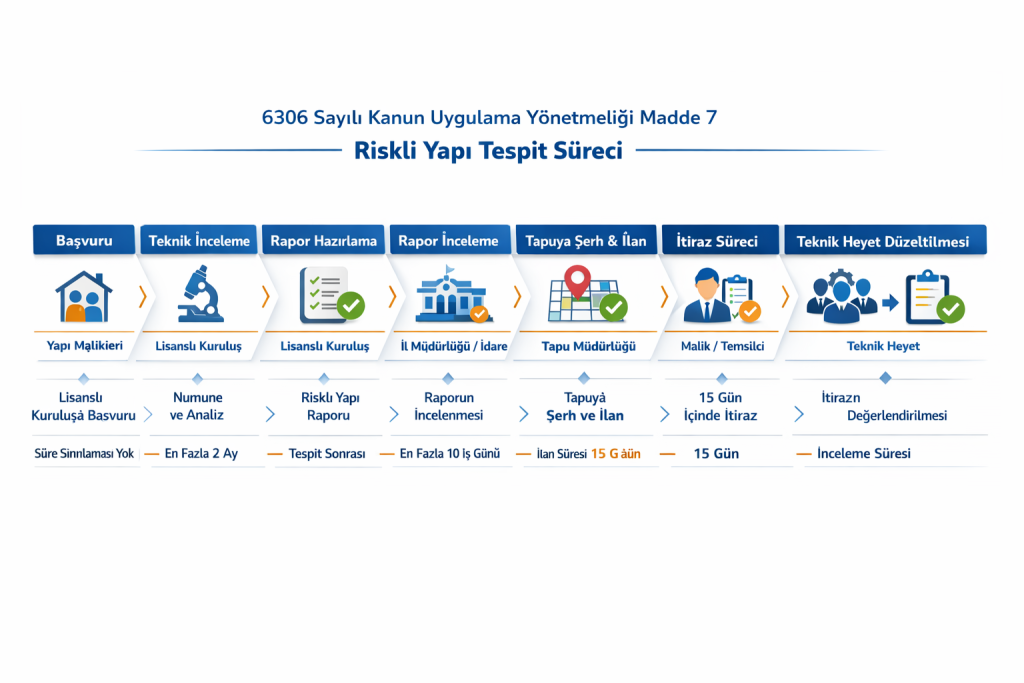
Risky structure detection reports are sent via electronic system by the Administration or licensed institution/organization that carried out the detection, to the Directorate in the province where the structure is located (or to the Administration if authority has been delegated). (Reg. Art. 7/4)
The reports are examined within the framework of the procedures and principles determined by the Presidency, and if there are deficiencies, they are returned to the institution that prepared the report for correction. (Reg. Art. 7/4) If there are no deficiencies, the risky structure information is reported to the land registry office to be recorded in the declarations section of the land register within a maximum of ten business days. (Reg. Art. 7/4) Furthermore, a report is prepared as per Annex-6, and for the purpose of serving as a substitute for notification to rights holders (in rem and personal), posting on the structure, e-Government notification, and 15-day public announcement at the headman’s office are made. (Reg. Art. 7/4) The last day of the announcement made at the headman’s office is considered the date of deemed notification to rights holders (in rem and personal). (Reg. Art. 7/4) Risky structures are also announced on the Presidency’s website for a period of 15 days. (Reg. Art. 7/4) This system aims to speed up the process by introducing the combination of “announcement + e-Government + posting” in place of classic notification. (Reg. Art. 7/4)
7) Objection to risky structure detection: period, authority, and eligibility review
Owners or legal representatives can object to the risky structure detection by petition within 15 days from the last day of the headman’s office announcement. (Reg. Art. 7/5) The objection is made to the Directorate in the location of the structure, or to the Administration if authority has been delegated. (Reg. Art. 7/5) The Directorate/Administration checks whether the objection was made within the specified period and whether the objector is the owner/legal representative. (Reg. Art. 7/5) Objections not made within the specified period, or not made by the owner, or if the owner has passed away, not made by the heirs, will not be processed. (Reg. Art. 7/5)
8) Submission of the file to the authorized body if there is no technical committee
If a technical committee to evaluate the objection has not been established in the province where the structure is located, the objection petition and reports are sent to the Directorate in the province where the authorized technical committee for that province is located. (Reg. art.7/6)
This provision ensures that the objection mechanism functions in provinces with insufficient technical review capacity. (Reg. art.7/6)
9) Correction of the land registry record if the determination changes due to an objection or a court decision
If the risky building determination changes as a result of an objection or a court decision, the situation is reported to the relevant land registry office. (Reg. art.7/7) This notification leads to critical consequences for the updating/cancellation of the risky building record in the land registry’s declarations section. (Reg. art.7/7)
10) Structures subject to protection legislation: Connection to Law No. 2863
The determination of risky structures for buildings covered by Law No. 2863 is made upon the request of the property owners. (Reg. art.7/8) After the determination becomes final, the situation is reported to the relevant regional board for the protection of cultural assets, and the implementation is carried out according to the board’s decision. (Reg. art.7/8) This regulation establishes a priority/harmony mechanism between urban transformation legislation and the cultural heritage protection regime. (Reg. art.7/8)
11) Completion of deficiencies: 30-day rule and additional time
When all technical inspection deficiencies identified by the Directorate/Administration/technical committee are reported to the institution preparing the report, these deficiencies must be rectified within 30 days. (Reg. art. 7/9)
Upon the justified request of the licensed institution/organization within 30 days, additional time may be granted for the rectification of the deficiencies. (Reg. art. 7/9) This provision aims to prevent the process from being prolonged while improving report quality. (Reg. art. 7/9)
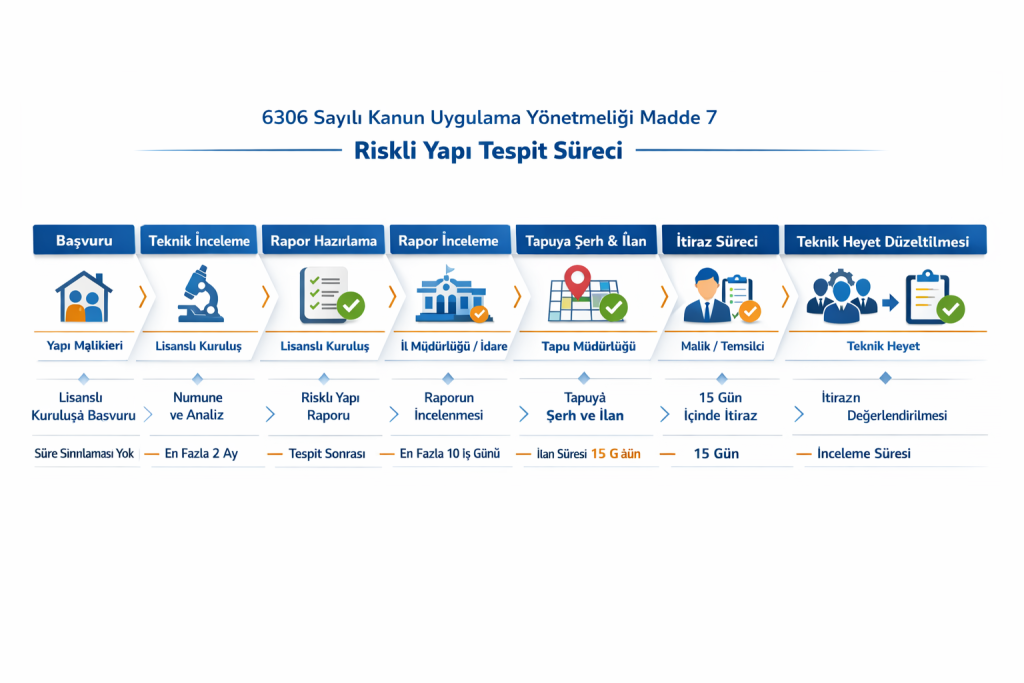
Law No. 6306 Implementation Regulation Article 7
Risky Building Detection Process (Interested Parties – Institutions – Timelines)
| 🔎 PHASE | 👤 RELATED PERSON / INSTITUTION | 🏢 PROCESS / AUTHORITY | ⏱️ DURATION |
|---|---|---|---|
| 🏘️ Application | Building owners / legal representative | Application to a licensed institution for risky building detection (via electronic system) | No time limit |
| 🧪 Technical inspection | Licensed institution / organization | Sampling from the building, static analysis, risk analysis according to Annex-2 | Detection must be made within 2 months at the latest |
| 📄 Risky building report | Licensed institution / organization | Preparation of the risky building detection report and submission to the Directorate via the electronic system | Immediately after detection |
| 🔍 Report review | Provincial Directorate / Administration | Procedural and technical review of the report | After review |
| 🏛️ Notification to Land Registry | Provincial Directorate / Administration | Sending risky building information to the land registry directorate | Within 10 business days at the latest |
| 📍 Annotation in Land Registry | Land Registry Directorate | Processing the “risky building” annotation in the declarations section of the land registry | After notification |
| 📢 Announcement instead of notification | Provincial Directorate / Administration | Posting on the building + e-Government notification + headman’s office announcement | 15-day announcement period |
| ⚖️ Right to object | Owner / legal representative | Objection to risky building detection with a petition | 15 days (starting from the last day of the headman’s office announcement) |
| 🧑🔬 Technical committee review | Technical committee (university + Ministry representatives) | Technical review of the objection | Duration not specified |
| 🔄 Correction of land registry record | Provincial Directorate / Land Registry Directorate | Updating the risky building record with an objection or court decision | After decision |
Why Is Expert Lawyer Support Necessary?
Legal disputes are technical processes that require not only legislative knowledge but also practical experience, jurisprudential knowledge, and strategic process management. Especially in complex legal areas such as urban transformation, real estate, maritime law, condominium law, and commercial disputes, procedural errors can lead to irrecoverable loss of rights and significant economic damages.
Therefore, obtaining expert lawyer support from the outset of legal processes is critically important for the effective protection of rights and the proper management of the process.
Expert lawyer support plays a decisive role especially in the following matters:
Early identification of legal risks and development of preventive strategies
Prevention of procedural errors that may lead to loss of rights
Proper management of the evidence and documentation process
Execution of administrative and judicial applications in accordance with the law
Preparation of contracts in a way that protects client interests
Effective protection of compensation and receivables rights
Resolution of disputes by the fastest and most accurate method
As 2M Hukuk Law Office, while operating from Istanbul, we provide comprehensive legal consultancy and representation services to our clients, especially in the Tuzla, Kartal, Maltepe, Pendik, and Gebze regions; primarily in areas such as condominium law, urban transformation, maritime commercial law, real estate law, individual applications to the Constitutional Court/ECtHR, and commercial disputes.
Through our academic studies, book publications, and regular legal analyses, we aim to protect our clients’ rights in the strongest possible way by bringing together theory and practice.