1. Occurrence of Damage and Liability Analysis
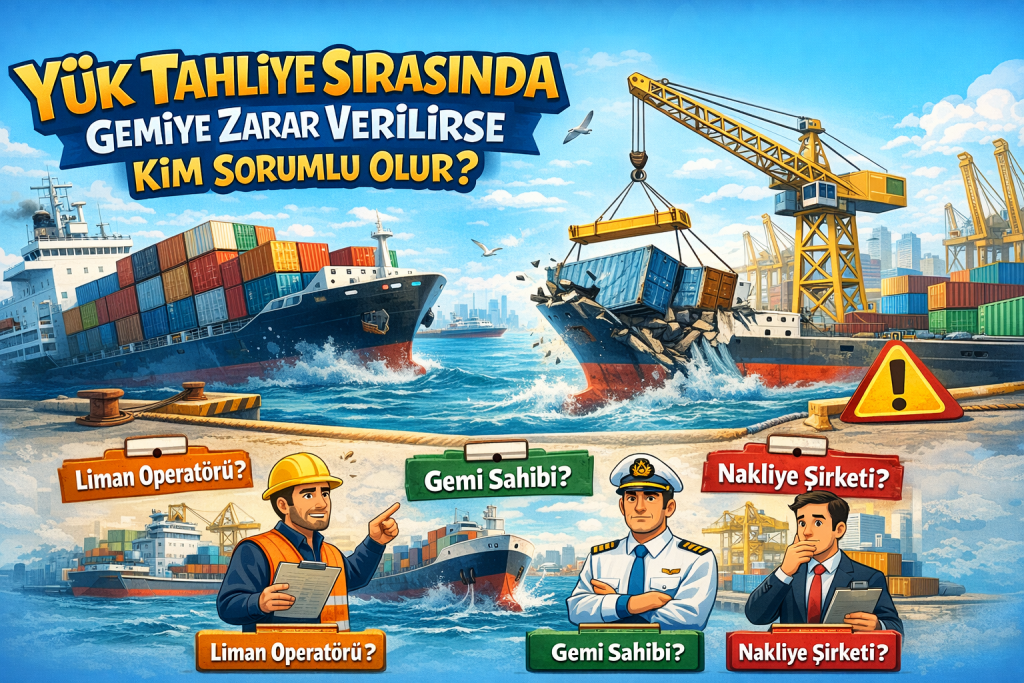
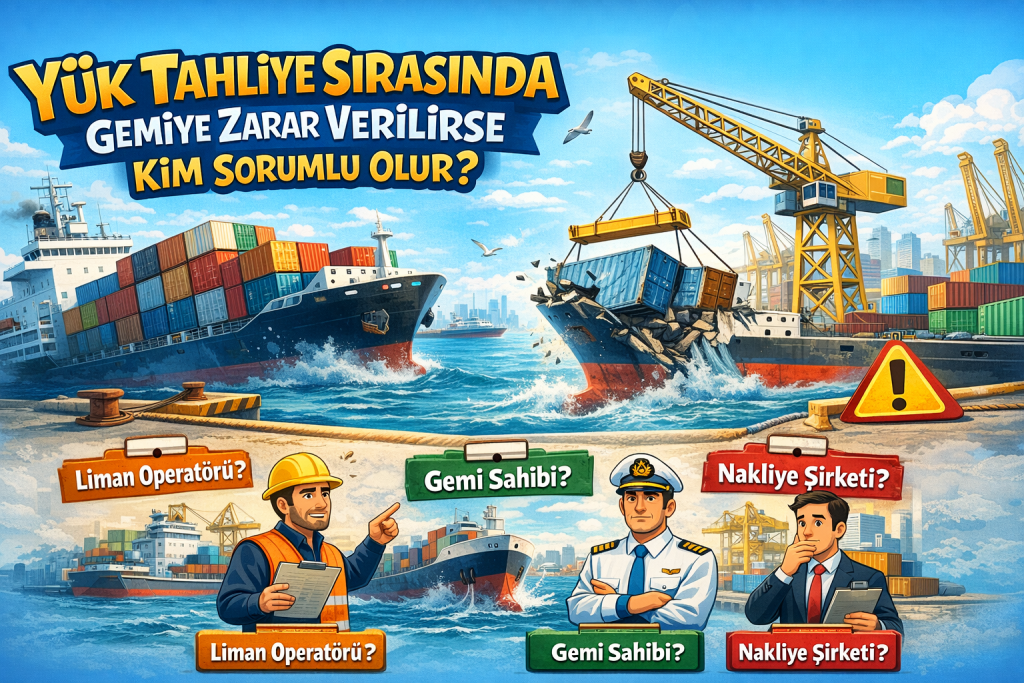
In damages occurring as a result of the cargo rapidly hitting the tank top or hatch covers during the discharge of cargo from the ship, liability is distributed among the port operator, the contracting company undertaking the discharge (stevedor), and the ship’s personnel according to their fault ratios.
Responsibility of the Port Operator: In the decision of the 11th Civil Chamber of the Supreme Court of Appeals, numbered 2014/9068 E. K, the port operator was held responsible for the damage caused to the tank top as a result of the rolled sheet cargo rapidly hitting the ground during discharge, in accordance with BK art. 100 (new TBK art. 116) for the actions of its auxiliary persons and subcontractors.
Responsibility of the Subcontractor and Contracting Company: Companies that actually carry out the discharge operation can be found “primarily and fully at fault” due to erroneous actions during the operation (e.g., cargo wire striking, chain breakage, or use of improper equipment) (Supreme Court of Appeals 11th Civil Chamber, 2017/4097 E. K).
Obligation of Supervision and Due Care of Ship Personnel: In accordance with Articles 1091 and 1178 of the TCC, the master is obliged to supervise loading and unloading operations. In the decision of the 11th Civil Chamber of the Court of Appeals, numbered 2014/9068 E. K, ship personnel who failed to show due care during discharge were found 10% at fault. Similarly, even if a FIOS (Free In and Out Stowed) clause exists, the master’s duty of supervision and obligation to oversee workers continues (11th Civil Chamber of the Court of Appeals, 2013/8167 E. K).
2. Legal Nature of Damages and the Maritime Lien Dispute
In the examined decisions, such damages to the vessel were generally characterized as a “compensation claim” or “tort/breach of contract claim,” and not directly defined as a “maritime lien.”
3. Legal Recourse: Who Can Sue Whom, Where?
Due to damages occurring on the vessel, the following legal avenues can be pursued:
Shipowner/Bareboat Charterer vs. Port Operator/Stevedore: The shipowner can file a compensation lawsuit or an action for annulment of objection to enforcement proceedings against the port operator or stevedoring company that damaged their vessel during discharge, in the Civil Court of Commerce (acting as a Specialized Maritime Court) (11th Civil Chamber of the Court of Appeals, 2014/4749 E. K; 2022/2389 E. K).
Insurance Company vs. Responsible Parties: The insurance company that paid the damage may file a recourse lawsuit against the port operator or subcontractor, based on the rights of its insured, in accordance with Article 1472 of the TCC (subrogation) (Supreme Court 11th Civil Chamber, 2021/3052 P. Ka).
Shipowner vs. Ship Captain: The shipowner may seek recourse from the captain for damages incurred due to the captain’s personal fault or negligence in supervision (TCC Art. 1089).
Competent Court: These lawsuits are generally heard in Commercial Courts of First Instance acting as Maritime Specialist Courts. However, in some cases (for example, a collision between a port crane and a ship’s crane) the dispute may be considered of general commercial nature and directed to general Commercial Courts of First Instance (Secondary Source: Istanbul 17th Commercial Court of First Instance, 2022/255 P.
4. Concrete Examples from Court Decisions
Hold Ceiling Plate Damage: In the damage resulting from the rolled steel sheet rapidly hitting the ground during discharge, the port operator was held responsible, and the ship’s personnel were assigned 10% fault (Supreme Court 11th Civil Chamber, 2014/9068 P.
Hold Floor Plate Damage: In the incident where goods falling due to a chain breaking during profile iron discharge damaged the hold floor plate, primary fault was assigned to the subcontractor (Supreme Court 11th Civil Chamber, 2017/4097 P. K).
Hatch Cover Damage: Due to damage caused to hatch covers numbered 3 and 4 as a result of erroneous actions by stevedore workers, the stevedore company was ordered to pay compensation (Supreme Court 11th Civil Chamber, 2014/4749 P. K).
Crane and Hull Damage: In the incident where the fuel tank was punctured as a result of the shore crane’s grab colliding with the ship’s aft bulkhead, the port operator was found liable within the scope of “strict liability” according to Article 71 of the Turkish Code of Obligations (TBK) (Supreme Court 11th Civil Chamber, 2022/7315 P. Ka).
5. Additional Context from Secondary Sources
Master’s Duty of Supervision: In its decisions, the Istanbul 17th Commercial Court of First Instance (2021/441 KP. and 2022/376 K P.) emphasized that the master’s notification of errors during discharge through “letters of protest” was accepted as evidence of fulfilling the duty of care, and in such cases, the carrier could be relieved of liability.
Limitations of Liability: In some contracting agreements, limitations of liability such as “a certain multiple of the worker’s daily earnings” can be stipulated for damages caused by workers to the vessel, and these provisions can also be invoked against the insurer (Istanbul Regional Court of Justice 43rd Civil Chamber, 2021/85 P. K).
Frequently Asked Questions
Tahliye sırasında yükün ambar tabanına veya kapaklara çarpması halinde kim sorumlu tutulur?
Tahliye sırasında meydana gelen hasarlarda sorumluluk; liman işletmecisi, tahliyeyi fiilen yapan stevedor (alt işveren) ve gemi personeli arasında kusur oranına göre paylaştırılır. Yargıtay uygulamasında, hatalı tahliye manevraları nedeniyle çoğu zaman asli kusur stevedor veya liman işletmesine yüklenmekte, kaptanın nezaret görevini ihmal etmesi halinde ise gemi personeline tali kusur verilebilmektedir.
FIO veya FIOS kaydı varsa kaptan ve taşıyan sorumluluktan kurtulur mu?
Hayır. FIO veya FIOS kaydı bulunsa dahi, kaptanın yükleme ve boşaltmaya nezaret etme yükümlülüğü devam eder. Yargıtay kararlarında, kaptanın tahliye sırasında gerekli uyarıları yapmaması veya operasyonu denetlememesi halinde kusurlu sayıldığı açıkça kabul edilmektedir. Bu nedenle FIOS kaydı, taşıyanın sorumluluğunu otomatik olarak ortadan kaldırmaz.
Tahliye sırasında gemiye verilen zarar “gemi alacağı” sayılır mı?
Uygulamada bu tür hasarlar çoğunlukla genel tazminat alacağı veya haksız fiil/sözleşmeye aykırılık alacağı olarak nitelendirilmektedir. Yargı kararlarında, yükün gemiye verdiği zararların doğrudan “gemi alacağı” olduğu yönünde yerleşik bir kabul bulunmamaktadır. Ancak hasarın niteliğine ve olayın özelliklerine göre bu tartışma her somut olayda yeniden değerlendirilmelidir.
Why is Expert Lawyer Support Necessary?
Damages caused to a ship during discharge have a much more complex legal structure than a classic damage lawsuit. In such disputes, it is not only the existence of the damage; by whom, at what stage, and within whose actual sphere of control the damage occurred that is crucial. The multilateral liability relationships between the port operator, stevedore, sub-contractor, captain, and shipowner can lead to the complete loss of the case if the wrong parties are sued.
Issues such as the determination of fault ratios, whether the captain’s duty of supervision was violated, and whether protest letters were issued timely and properly; must be evaluated in light of expert reports and established Supreme Court precedents. A single procedural error at this point can lead to the rejection of the compensation claim or the full liability being placed on the shipowner.
Furthermore, in such cases, correctly determining the competent and authorized court, whether the case will be heard as a Specialized Maritime Court or as a general commercial case, is of great importance. Lawsuits filed in the wrong court lead to lengthy proceedings and significant loss of time.
Therefore, in disputes related to damages caused to a ship during discharge, the support of an expert lawyer who is proficient in maritime commercial law and Supreme Court practice, is indispensable for both directing liability to the correct parties and effectively collecting compensation.