
1. Legal Basis and Nature of Maritime Claim
Pursuant to Article 1352/1-c of the Turkish Commercial Code (TCC) No. 6102; the salvage of a ship or goods on board, salvage operations related to a ship or goods posing a threat of environmental damage, and special compensation claimed as a result of these operations are considered as “maritime claims”. These activities not only involve the protection of property but also include the prevention of environmental risks such as oil spills. In court decisions (e.g.: Istanbul 17th Commercial Court – 2014/1419 K), it is emphasized that the remuneration for salvage services, pursuant to TCC Art. 1320/1-c, grants a “maritime lien” and that this claim creates a statutory lien on the ship.
2. Collection and Security Methods Available to the Creditor
A. Provisional Attachment and Demand for Security To secure the collection of the claim arising from salvage operations, the most frequently resorted method is the provisional attachment/arrest of the ship.
Case Study: In one case, the plaintiff institution requested a provisional attachment for USD 9,000,000, and the court issued an attachment order for USD 1,560,000, which was later converted to a letter of guarantee (Istanbul 17th Commercial Court – 2014/1419
Conditions: Pursuant to TCC Art. 1362, the creditor must prove that the claim is a maritime claim and present evidence (approximate proof) that will satisfy the court regarding its monetary value (Istanbul Regional Court of Appeal 12th Civil Chamber – 2021/181 K
B. Statutory Lien and Right of Retention
In accordance with Articles 1315 and 1321 of the TCC, the salvage fee creditor has a “statutory lien” over the salved vessel and a “right of retention” over the salved goods.
Establishment of the Lien: Courts may decide to establish a statutory lien on the vessel, limited to the determined debt amount and its ancillaries (Istanbul 17th Commercial Court – 2014/723 ).
Priority: This right can be asserted against anyone in possession of the vessel, and being a right acquired without registration, it takes precedence over many other claims (Supreme Court 17th Civil Chamber – 2010/3790 K).
C. Claim Lawsuit and Annulment of Objection
The creditor may directly file a claim lawsuit for the determination and collection of the salvage fee, or, in case of an objection to the enforcement proceeding they initiated, may file an action for annulment of objection.
Determination of the Fee: The Court conducts an expert examination based on the criteria of TCC Article 1305 (or former TCC Article 1226) (salved value, degree of danger, effort expended, success rate).
Collection Judgment: It is decided that the determined amount shall be collected with the highest interest applied by state banks on USD, in accordance with Article 4/a of Law No. 3095, effective from the date of the incident or the lawsuit (Istanbul 17th Commercial Court – 2021/446 ).
3. Responsible Parties and Scope of Collection
Shipowner and Operator: According to TCC Art. 1306, the primary debtor for salvage remuneration is the shipowner. However, the operator can also be held liable according to TCC Art. 1321/5.
Consignee: According to TCC Art. 1307/1, if the consignee knows that salvage remuneration will be paid when taking delivery of the goods, they will be liable for the part attributable to them (Istanbul 17th Commercial Court – 2014/1419 K).
Joint and Several Liability: In some cases, it is ruled that the operator and the cargo owner are jointly and severally liable for the claim (Istanbul 17th Commercial Court – 2023/436 ).
4. Forced Execution and Liquidation
The creditor can use the court judgment they obtained to initiate enforcement proceedings based on a judgment via “liquidation of movable pledge” (TCC Art. 1380, EBL Art. 150/h). Holders of maritime claims receive a preferential share from the proceeds of the ship’s sale. In the ranking list, salvage claims are generally listed as first-degree statutory lien creditors (Istanbul 17th Commercial Court – 2016/289
5. Secondary Sources and Additional Context According to information obtained from secondary sources;
The competent court in disputes arising from salvage operations is exclusively Maritime Specialized Courts (such as Istanbul 17th Commercial Court). Cases filed in an incompetent court are rejected on procedural grounds (Istanbul Anatolian 9th Commercial Court – 2016/745
In cases where the salvage fee is claimed from the insurer by way of recourse, it is a condition that the salvage operation must have been reported to official authorities and proven with concrete evidence (logbook entries, port documents); otherwise, claims may be rejected on the grounds that the burden of proof has not been met (Istanbul Regional Administrative Court 13th Civil Chamber-2019/154 K)
In cases involving environmental pollution risk, public institutions (e.g., Ministry of Environment), based on the principle of strict liability according to Article 28 of the Environmental Law, can collect intervention costs and compensation from guarantees obtained by detaining the ship (Istanbul 17th Commercial Court-2020/2)
In cases of malfunctions caused by shipyard fault, it is possible to file a recourse action against the shipyard for the paid salvage fee (Istanbul Anatolian 1st Commercial Court-2023/569 )
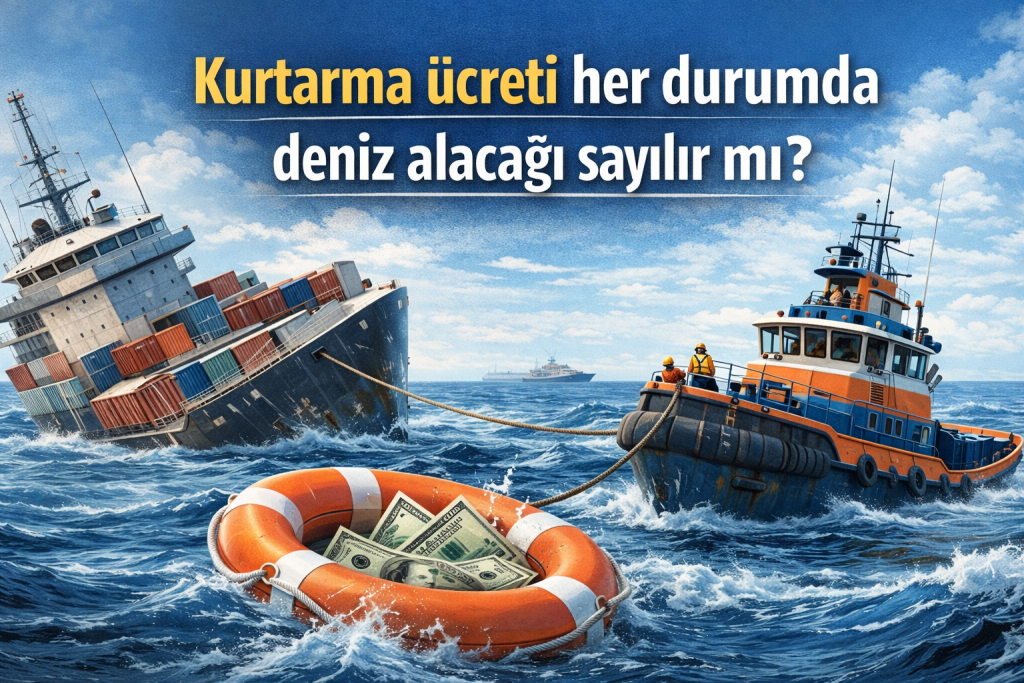
Kurtarma ücreti her durumda deniz alacağı sayılır mı?

Evet. Gemi veya gemideki eşyanın kurtarılması ile çevre kirliliği tehdidini önlemeye yönelik kurtarma faaliyetlerinden doğan alacaklar deniz alacağıdır. Bu kapsam, yalnızca malvarlığını değil çevresel riskleri de içerir.
Gemi ihtiyati haciz için hangi şartlar aranır?
Alacağın deniz alacağı olduğunu ortaya koymak ve yaklaşık ispat seviyesinde delil sunmak gerekir. Mahkeme, talep edilen tutarı dengeleyerek hacze karar verebilir ve uygulamada sıkça teminata kaydırma yoluna gidilir.
Why is Expert Lawyer Support Necessary in Ship Salvage and Maritime Claim Cases?
Maritime claims arising from ship salvage operations, unlike classic commercial claims, are subject to special procedures, strict rules of evidence, and strong security mechanisms. Incorrect legal qualification, insufficient evidence, or erroneous court selection can lead to the rejection of precautionary attachment, the inability to effectively exercise the statutory lien right, and irreparable loss of rights. For this reason, it is imperative that the case is structured appropriately from the very beginning, in accordance with practice.
Especially regarding Istanbul and Istanbul ports (Ambarlı, Haydarpaşa, Tuzla, Pendik, etc.); the established practices of Maritime Specialization Courts, the type and amount of security, the transfer of attachment to security, and the processes carried out with port authorities and insurers require practical expertise rather than theoretical knowledge. Even a minor procedural error in these areas can result in the failure to collect a strong receivable.
Therefore, in ship salvage and maritime claim cases, expert legal support is not a preference but a necessity. 2M Hukuk Law Firm, with its experience centered in Istanbul and its ports, manages the process from provisional attachment to statutory lien, from transfer to security to compulsory enforcement, in a collection-oriented and holistic manner, aiming for the actual recovery of the receivable.