Introduction
Salvage operations in maritime trade are special legal transactions that cannot be considered as ordinary service relationships due to their high risk, high value, and public safety dimensions. Therefore, the compensation (salvage remuneration) that can be claimed in return for salvage operations has not been left to the free will of the parties or to fixed tariffs; it is regulated with detailed criteria in the Turkish Commercial Code (TCC).
In practice, the most common dispute focuses on whether an incident is an escort (towing) service or a salvage operation, and if it is accepted as a salvage operation, on what principles the amount of compensation to be claimed will be determined. This article will set forth the legal criteria used in determining salvage compensation, and then these criteria will be applied and evaluated through a concrete court decision.
I. Legal Nature of Salvage Remuneration
Salvage remuneration is not compensation for damages in the classic sense. Likewise, it is not a claim that automatically arises based on the value of the salvaged assets. Salvage remuneration is a sui generis type of claim recognized in favor of the salvor in return for the salvage of a vessel, cargo, or other property in distress.
According to Article 1298 of the Turkish Commercial Code (TTK), any act performed for the salvage of a vessel or goods endangered in navigable waters is considered a salvage operation. However, the mere existence of a salvage operation is not sufficient; according to Article 1304 of the TTK, it is mandatory to achieve a beneficial result. In other words, if the salvage operation is unsuccessful, as a rule, a salvage fee cannot be claimed.
II. General Legal Criteria for Determining Salvage Remuneration
In cases where there is no pre-agreed salvage fee between the parties, the determination of the fee is left to the discretion of the judge. However, this discretionary power is not unlimited. Article 1305 of the TTK explicitly enumerates the criteria that the judge must consider.
1. Magnitude of the Value Salvaged
The most fundamental criterion in determining the salvage fee is the economic value of the salvaged vessel, cargo, and fuel, if any, after the salvage operation. The salvage fee cannot exceed the total value salvaged and must be proportionate to this value. Therefore, the higher the salvaged value, the more legally appropriate it is for the salvage remuneration to increase accordingly.
2. Reality and Gravity of the Danger
The danger faced by the vessel must not be abstract or hypothetical, but rather real and imminent. Factors such as engine failure, power outage (black-out), loss of maneuverability, grounding, or the risk of an environmental disaster are the main factors that increase the gravity of the danger.
3. Success of the Salvage Operation (Beneficial Result)
For a salvage fee to arise, it is essential that the vessel, cargo, or both are secured as a result of the salvage operation. The degree of benefit obtained directly affects the amount of salvage compensation.
4. Salvor’s Effort, Speed, and Organization
The salvor’s response time, the equipment used, technical capacity, number of personnel, and organizational skills are taken into consideration when determining the salvage fee. This criterion becomes even more decisive in salvage operations conducted in narrow and high-traffic areas such as straits.
5. Risk and Responsibility Undertaken
The risks undertaken by the salvor regarding its own vessel, personnel, and the environment during the salvage operation are also taken into account when determining the fee. The riskier the salvage operation, the greater the compensation that can be claimed.
III. Evaluation of the Specific Case in Light of the Above Criteria
In the specific case examined, an LNG-laden vessel experienced a complete power failure (black-out) during a strait passage; as a result of the main engine and generators becoming inoperable, the vessel became unmaneuverable. This situation had the potential to cause the vessel to drift, run aground, and lead to a serious environmental disaster in a narrow and busy waterway like a strait.
Although the service initially provided to the vessel was an escort service, from the moment the engine breakdown occurred, the vessel was exposed to danger, and from that point on, the service provided changed its legal nature, transforming into a salvage operation. In this respect, the incident constitutes a concrete example of the boundary between escort and salvage.
The Court separately determined the salvaged values. Since the vessel had completed its economic life, its value was assessed on a scrap basis; however, considering the vessel’s special tank structure specific to LNG transportation, the vessel’s value was accepted as 13,000,000 USD. The value of the fuel on board was determined as 1,162,385 USD, and the value of the transported LNG cargo was determined as 33,892,606.94 USD.
Considering these figures, the total salvaged value is approximately 48 million USD. The Court, by evaluating all criteria in Article 1305 of the Turkish Commercial Code (TTK) together, found it equitable that the salvage remuneration for the specific case should be approximately 5% of the salvaged values. This percentage was adopted not as a fixed and general rule, but by taking into account the risk of the incident, the extent of environmental danger, and the success of the salvage operation. A writing suggestion.
Conclusion
The amount of compensation that can be claimed in salvage operations is not determined by the effort expended or the number of vehicles used, but rather is based on the salvaged value, the severity of the danger, and the beneficial outcome achieved. The specific case examined clearly demonstrates how the criteria stipulated in Article 1305 of the Turkish Commercial Code (TTK) are concretized in practice.
This decision emphasizes the importance of the proportionality principle and the case-by-case assessment in salvage law; it also reveals that escort services can turn into salvage operations under certain conditions, and consequently, significant amounts of salvage compensation can be claimed.
Frequently Asked Questions
Gemi Refakat (cer) hizmeti hangi aşamada kurtarma faaliyetine dönüşür?
Refakat hizmeti, geminin kumanda altında olduğu ve olağan seyir güvenliği kapsamında verilen destektir. Ancak gemide makine arızası, black-out, manevra kaybı veya çevresel felaket riski doğması hâlinde gemi artık fiilen tehlike altına girer. Bu andan itibaren verilen müdahale, hukuki niteliğini değiştirir ve kurtarma faaliyeti olarak değerlendirilir. Bu dönüşüm, özellikle İstanbul Boğazı gibi dar ve yoğun trafik alanlarında çok daha kolay gerçekleşir.
Gemi kurtarma ücretinin belirlenmesinde yüzde veya sabit bir oran var mıdır?
Hayır. Kurtarma ücretinin belirlenmesinde sabit bir yüzde veya tarife uygulanmaz. Türk Ticaret Kanunu m.1305 uyarınca hâkim; kurtarılan değer, tehlikenin ağırlığı, kurtarma faaliyetinin başarısı, kurtaranın çabası ve üstlenilen riskleri birlikte değerlendirir. Bir somut olayda olduğu gibi %5 oranı, genel bir kural değil; yalnızca o olaya özgü hakkaniyet değerlendirmesinin sonucudur.
Gemi kurtarma ücreti yalnızca gemi sahibi tarafından mı ödenir?
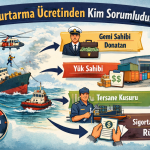
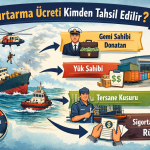
Hayır. Kurtarma faaliyeti sonucunda gemi, yük ve yakıt birlikte kurtarılmışsa, sorumluluk kurtarılan değerler oranında paylaştırılır. Gemi sahibi, gemi ve bunker payından; yük sahibi ise kurtarılan yük payı bakımından sorumludur. Bu sorumluluk sözleşmeden değil, doğrudan kanundan doğar.
Why is Expert Legal Support Necessary? (Istanbul – Kocaeli Ports Perspective)
Disputes arising from salvage operations are among the most technical and highest financial risk areas of maritime commercial law. Particularly Istanbul Port, Haydarpaşa Port, Ambarlı Ports, Tuzla Shipyards Region, and Derince Port, Evyap Port, Yarımca Port, Dilovası and Gebze port areas located in Kocaeli Gulf, are among the regions where such disputes occur most frequently.
In incidents occurring in these regions;
Proper distinction between assistance and salvage,
Determining the salvage remuneration based on which values and at what rate,
Apportionment of liability between the shipowner and the cargo owner,
Correct interpretation of expert reports from a technical and legal perspective,
Joint and strategic conduct of negative declaratory actions and performance actions related to salvage claims
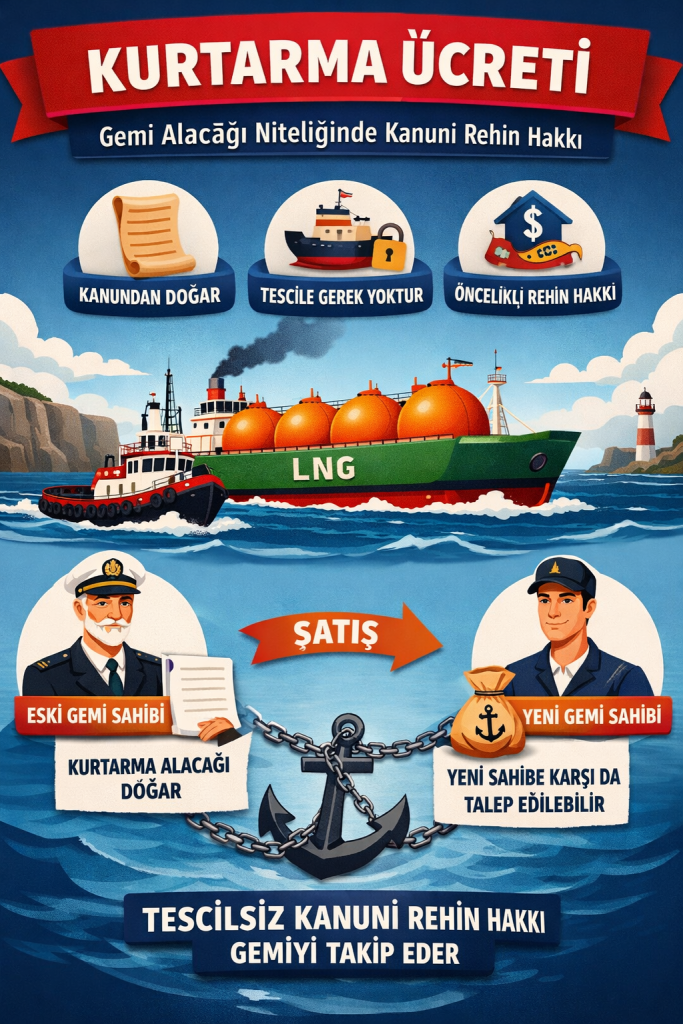
is of vital importance. In case of incorrect legal qualification, shipowners may face salvage remuneration amounting to millions of dollars; cargo owners may become subject to claim demands they never foresaw. Furthermore, since salvage remuneration, which constitutes a maritime claim and a legal lien, follows the vessel even if it is sold, irrecoverable losses of rights may arise if the processes of precautionary attachment, letters of guarantee, and ranking of claims are not managed professionally.
Therefore, in salvage disputes arising in the ports of Istanbul and Kocaeli, the support of a specialist lawyer is mandatory, one who is proficient in maritime commercial law, the application of the Turkish Commercial Code (TCC), and established court precedents, and capable of evaluating expert reports with technical depth.
In this context, 2M Law Firm, with its Istanbul-based structure, provides strategic, result-oriented, and practice-savvy legal support for shipowners, bareboat charterers, cargo interests, and insurance companies in salvage, towage, ship claims, and statutory lien disputes arising in the ports of the Bosphorus, Marmara Sea, and Gulf of Kocaeli.