
Legal Basis: Law No. 6306 Article 6/8 | Implementation Regulation Article 8/7
Your building has been identified as a risky structure, but instead of demolishing it and starting over, you want to save the existing structure. This is an understandable choice, both financially and emotionally. Decades spent in homes, the building’s location, potential loss of area due to zoning changes, or simply the feeling of “I want to keep my home as it is” — there can be many valid reasons behind this choice. So, is there a right to reinforcement, what conditions are required, and what happens if the conditions are not met? Article 6/8 of Law No. 6306 and Article 8/7 of the Implementation Regulation answer all these questions. (Law Art. 6/8 — Reg. Art. 8/7)
Why is the Reinforcement Option Important?
Reinforcement is a critical legal tool that demonstrates that demolition is not the only mandatory option in the risky building process. The Constitutional Court has also ruled in this direction: It has been ruled that Law No. 6306 does not foresee demolition as the sole solution and that this opportunity is granted to those who wish to reinforce their risky buildings located outside risky areas and reserve building areas. (Constitutional Court App. 2012/87, Dec. 2014/41)
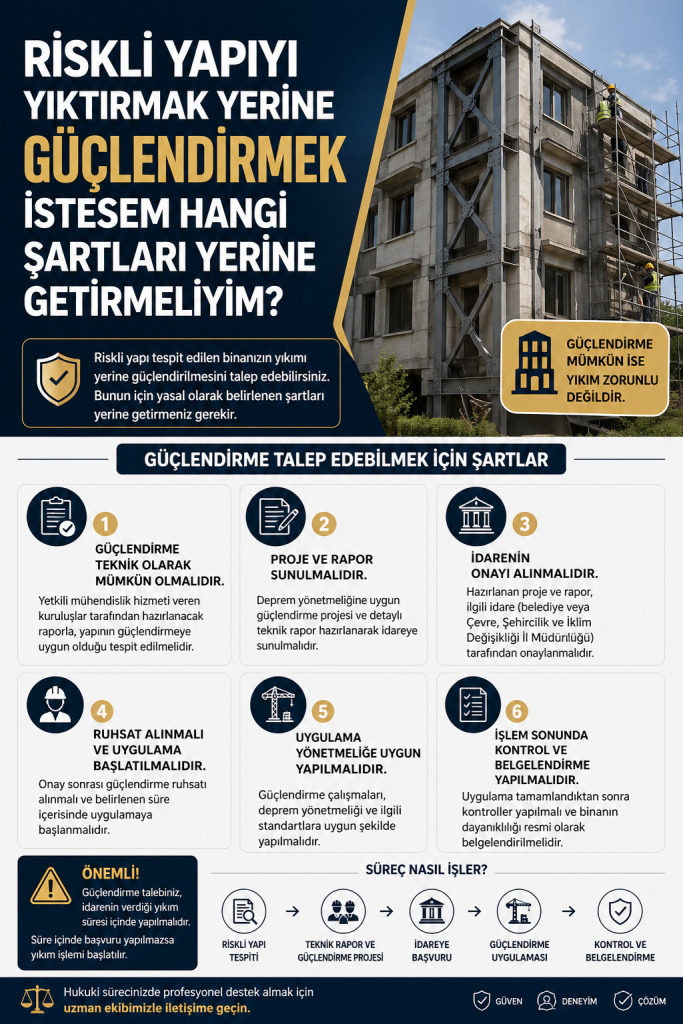
The fundamental provision of the Regulation regarding reinforcement is as follows: If reinforcement is requested instead of demolishing the risky building, four conditions must be met concurrently within the demolition period given to the owners. (Law Art. 6/8 — Reg. Art. 8/7)
Basic Rule: Not Every Building Can Be Reinforced
Reinforcement is not automatically an option for every risky building. The Law and Regulation have foreseen the reinforcement option only for the following buildings: Risky buildings located outside risky areas and reserve building areas. In cases where a parcel is declared a risky area or reserve building area, the reinforcement option generally cannot be used; in these areas, the Administration’s transformation decision is decisive. (Law Art. 6/8)
Furthermore, reinforcement is not technically feasible for every building. This option is closed for buildings where reinforcement is not possible due to a very high damage level, extremely low concrete quality, or ground problems. Feasibility must first be technically proven.
First Condition: Technical Suitability Determination
For strengthening to be carried out, it must first be determined by an authorized person or institution that it is technically feasible. (Law Art. 6/8 — Reg. Art. 8/7)
This determination is carried out by licensed civil engineers or building inspection organizations, through seismic safety performance analysis of the structure, core sampling or similar technical examinations, and assessment of the existing static system. The resulting technical report must clearly demonstrate that strengthening is feasible. An abstract statement is not sufficient; a concrete document at the level of a technical opinion or expert report is mandatory.
The 6th Chamber of the Council of State, in one of its decisions, clearly stated that the failure of owners to apply for the preparation of a strengthening project, and the failure to prove that strengthening is technically feasible, would lead to the rejection of the strengthening request. (6th Chamber of the Council of State, Case No. 2019/10532, Decision No. 2020/4078)
According to general acceptance, based on their building permit, on average, structures that are no older than 40-50 years, whose concrete quality has not fallen below a certain threshold, and whose load-bearing system does not have damage that cannot be rectified by repair are considered suitable for technical strengthening. Furthermore, the strengthening cost not exceeding 40% of the reconstruction cost is adopted as a reasonable limit in practice.
Second Condition: Strengthening Decision by a 4/5 Qualified Majority
After technical feasibility is determined, the condominium owners must make a strengthening decision in accordance with the procedure specified in the second paragraph of Article 19 of the Condominium Law. (Condominium Law Art. 19/2 — Law Art. 6/8 — Reg. Art. 8/7)
The majority stipulated by law is not a simple majority, but a qualified majority: written consent of four-fifths (4/5) of all floor owners is required. This ratio must be met separately for both land share and number of owners. In other words, in an apartment building with 10 flats, 8 owners must give written approval for a strengthening decision; if this voting threshold is not met, the strengthening decision will not be valid.
The reason why this threshold is set higher than the majority required for a demolition-reconstruction decision is that strengthening constitutes a comprehensive intervention in the common areas of the building and binds all owners.
If the 4/5 majority cannot be achieved, two options are available. First, it is possible to have the court determine, with a technical report, that the strengthening of the building is mandatory; if the court makes this determination, it can order the implementation of the strengthening decision without requiring a 4/5 majority. (Article 19/2 of the Condominium Law) Second, an attempt can be made to obtain the consent of the objecting minority owner through a notary. If neither of these options works, a strengthening decision cannot be made, and the demolition process continues.
The decision to strengthen also has a binding nature for all owners. Even owners who did not participate in the decision are obliged to pay for the expenses within the scope of strengthening, in proportion to their land shares. A lawsuit can be filed for the annulment of the decision; however, if a strengthening permit has been obtained and work has begun, it becomes increasingly difficult for the court to issue an injunction.
Third Condition: Preparation of the Strengthening Project
After a strengthening decision is made with a 4/5 majority, it is mandatory to sign a strengthening contract with an expert civil engineering company and to have the strengthening project prepared. (Art. 6/8 of the Law — Art. 8/7 of the Regulation)
The strengthening project must include at least the following elements: the building’s current static condition and damage analysis, the strengthening method (column jacketing, shear wall addition, carbon fiber application, steel jacketing, etc.), the expected seismic performance after strengthening and compliance with the performance target stipulated by the regulation, implementation phases, and duration estimate. The project must be prepared by organizations licensed by the Ministry or authorized civil engineering firms that have completed their office registration.
As of 2026, strengthening project costs vary between 150,000 TL and 400,000 TL, depending on the building’s size and complexity. Implementation costs, for a medium-sized structure, can be approximately one-fifth of the demolition-reconstruction cost per apartment.
Fourth Condition: Obtaining a Strengthening Permit within the Framework of Zoning Regulations
After the strengthening project is completed, it is mandatory to obtain a strengthening permit from the relevant municipality. (Law Art. 6/8 — Regulation Art. 8/7)
Any intervention affecting the structural system — column jacketing, shear wall addition, carbon fiber wrapping, steel jacketing — requires a strengthening permit from the municipality. Strengthening operations carried out without a permit may fall under the status of illegal construction, may not be accepted in future requests for the removal of property annotations, and may also lead to administrative fines.
During the permit application, the following documents are usually requested: strengthening project (including static calculations), technical conformity report, minutes of the homeowners’ association decision for strengthening, signed strengthening agreement.
Fifth Stage: Completion of Reinforcement Work and Removal of Title Deed Annotation
After the reinforcement permit is obtained, the reinforcement work must be actually completed within the period determined by the issuing Administration. (Reg. Art. 8/7)
This period varies according to the size of the structure, the method to be applied, and the discretion of the issuing Administration. Reinforcement, which can be completed within 3-6 months in modern applications such as the carbon fiber method, may extend up to 6-8 months in the traditional column jacketing method. After the reinforcement work is completed, an on-site inspection is carried out by the relevant directorate, and if deemed appropriate, an application is made to the Urban Transformation Directorate to remove the risky structure annotation in the title deed record. The Directorate conducts the necessary examinations and notifies the relevant land registry directorate with a request for the removal of the title deed annotation. (Law Art. 3/2 — Reg. Art. 7/7)
All Conditions Must Be Met Within the Demolition Period
This is the most frequently overlooked point: all five stages mentioned above —technical suitability determination, 4/5 decision, project design, permit, and completion of reinforcement within the period specified in the permit— must have been initiated and reached the permit stage within the 60-90 day initial demolition period given to owners for the demolition of the risky structure. (Law Art. 5/3 — Reg. Art. 8/3a)
In practice, it is difficult to complete all conditions within this period. However, considering court decisions and ministry statements, it is revealed that obtaining the license within the demolition period actually initiates the strengthening process and can halt the demolition operation. After the license is obtained, the Administration sets a separate period for the completion of the strengthening work; meaning there are two different time frames for obtaining the license and completing the strengthening.
In the relevant decisions of the Council of State, it has been accepted that if owners complete the strengthening conditions and obtain a strengthening license while a lawsuit against the risky structure determination is ongoing, the legal status of the risky structure will cease, and the legal consequence based on the risky structure process will be eliminated. These decisions clearly demonstrate the decisive role of the strengthening license in halting the demolition process.
Advantages and Disadvantages of Strengthening
The practical advantages of choosing strengthening compared to demolition-reconstruction are: protection of the building from potential loss of area due to zoning changes, uninterrupted continuation of current rental income or residential use, the possibility of strengthening the structure without evacuation in some applications, taking much less time compared to the demolition-reconstruction process, and the cost per apartment being significantly lower than reconstruction.
However, there are also disadvantages to consider. The 4/5 majority threshold is high, and the ability of a single owner block to significantly influence the decision makes the strengthening decision difficult. If the building is old and severely damaged, the cost of strengthening may approach or even exceed the cost of rebuilding. It is also possible for the building to be identified as a risky structure again after strengthening; in this case, the process starts over. State supports (rent assistance, interest support) may not be applied as comprehensively during the strengthening process as they are during the demolition-eviction process.
Strengthening Loan Under Law No. 6306, Article 6/8
Article 6/8 of Law No. 6306 stipulates that strengthening loans can be provided from the Special Account for Transformation Projects for structures located outside risky areas and reserve building areas, which are technically determined to be eligible for strengthening. (Art. 6/8) This loan is granted by the Presidency within the framework of procedures and principles determined by the President. For a strengthening project to benefit from this loan, it must be established by a technical report that the structure is eligible to be evaluated within this scope, and an application must be made to the relevant directorate. Before applying for a strengthening loan, it is recommended that you contact the Urban Transformation Directorate or visit www.kentseldonusum.gov.tr to learn about the current conditions.
Common Mistakes
The most common mistake in the strengthening process is initiating efforts to meet the conditions long after the demolition period has begun. The technical assessment report, the 4/5 decision, and the strengthening project are all time-consuming stages; applications made after the deadline will not be accepted. (Art. 5/3 — Reg. Art. 8/3a)
Another critical mistake is attempting to initiate the strengthening process by taking a simple majority decision (i.e., 50+1 or simple majority of land share) instead of a 4/5 majority. Decisions made in this way are not considered strengthening decisions. The compliance of the strengthening process with the high-standard strengthening majority is being scrutinized. (Condominium Law Art. 19/2)
Strengthening works started without obtaining a permit are also among the common problems. This situation creates an obstacle for both administrative sanctions and future applications for removal of the land registry annotation. (Regulation Art. 8/7)
Finally, proceeding directly to a 4/5 decision without proving the technical feasibility of strengthening is a common but erroneous approach. Courts meticulously scrutinize this sequence.
Practical Warnings
Time is limited; act as soon as the demolition notice arrives. Technical assessment, homeowners’ meeting, and project stages are consecutive tasks; you do not have the luxury of using this time inefficiently to obtain a permit before the 60-90 day demolition period expires. (Law Art. 5/3 — Regulation Art. 8/3a)
Pay attention to the selection of the firm that will prepare the project. Since the strengthening project will form the basis for the permit at the municipality, the technical competence of the firm preparing the project and its familiarity with municipal processes are decisive. Get quotes from multiple firms and compare them.
The strengthening decision is binding on all owners, and all owners are responsible for the strengthening expenses in proportion to their land shares. An owner who rejects the decision must also pay the costs. This point requires participants in the homeowners’ meeting to be informed in advance.
Know in advance that after reinforcement, the structure must pass a performance test and there is a possibility that it may be found risky again. Selecting an experienced company is critical for the reinforcement work to be carried out properly.
Why is Expert Lawyer Support Necessary?
The reinforcement process is a stage where technical and legal dimensions are intertwined, short-term, and it is extremely difficult to reverse mistakes. As 2M Hukuk Law Office, the most common problem we encounter in reinforcement requests during the urban transformation consultancy process we provide throughout Istanbul, especially in Tuzla, is that the process is initiated too late and decisions are attempted to be made with lower majorities instead of a 4/5 majority.
An urban transformation lawyer guides through the following critical points in the reinforcement process: Calling the board of apartment owners to a meeting, properly determining the agenda, and legally validly taking the decision within the framework of Article 19/2 of the Condominium Law (KMK) is a highly technical process; a procedural error invalidates the decision. Filing a lawsuit for the determination of the reinforcement obligation via court in cases where a 4/5 majority cannot be achieved is among the lawsuits we handle as a Tuzla lawyer and Istanbul urban transformation lawyer. If the reinforcement permit is rejected by the municipality or if the process goes wrong, protecting your rights by managing an annulment lawsuit and a request for stay of execution (YD) also requires legal support.
A comprehensive contract law evaluation regarding the contractor’s obligations, duration, quality standards, and sanctions to be applied in case of non-compliance during the preparation of the strengthening contract is also among the services we offer within the scope of urban transformation consultancy. As 2M Law and Consultancy Office, we are by your side at every stage of this process.
Conclusion
Article 6/8 of Law No. 6306 and Article 8/7 of its Implementing Regulation offer property owners with risky structures the option of strengthening instead of demolition. To utilize this option, five interdependent conditions must be met within the demolition period: determining that strengthening is technically feasible, obtaining a strengthening decision with a 4/5 qualified majority of apartment owners, having the strengthening project prepared, obtaining a license within the framework of zoning regulations, and applying to the relevant directorate for the completion of strengthening within the period specified in the license and the removal of the annotation on the title deed. This option cannot be used in risky areas and reserve building areas. Managing the process correctly is the way to protect both your property rights and your life safety simultaneously. (Law Art. 6/8 — Reg. Art. 8/7)
This article has been prepared based on Law No. 6306 (Art. 6/8) and its Implementing Regulation (Art. 8/7), as well as current legal sources accessible as of April 2026. Since each specific situation may vary, it is recommended to seek support from an expert urban transformation lawyer for legal processes.