
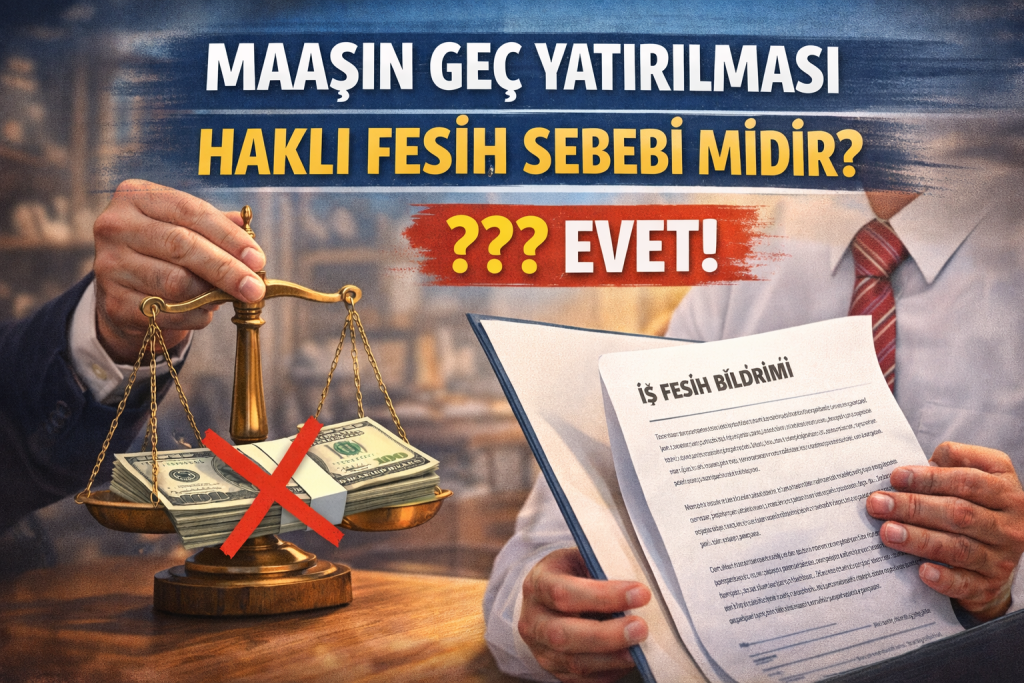
1. General Legal Framework and Wage Payment Obligation
In Supreme Court decisions, the wage, which is the remuneration for the worker’s labor, is defined as the most important right for the worker and the most fundamental obligation for the employer. Pursuant to the fourth paragraph of Article 32 of Labor Law No. 4857, it has been stipulated that wages must be paid at least once a month. In case of non-payment or delayed payment of wages, the worker has the right to terminate the employment contract for just cause in accordance with subparagraph (II)/(e) of Article 24 of Law No. 4857 (Supreme Court 22nd Civil Chamber, 11.12.2014, 2013/25165 P., 2014/35294 D.; Supreme Court 22nd Civil Chamber, 07.12.2015, 2014/20017 P., 2015/33808 D.).
2. Delay Period and the Effect of a “Few Days'” Delay
In judicial precedents, timely and full payment of wages is accepted as fundamental. While there are differing evaluations as to whether a delay of a few days is sufficient for a just cause termination, the Supreme Court’s current approach mandates timely payment:
Duration of Delay: The 22nd Civil Chamber of the Court of Cassation, in one of its decisions, found even an 11-day delay sufficient for justified termination; it emphasized that there was no additional period that arbitrarily extended the payment time of wages (Court of Cassation 22nd Civil Chamber, 07.12.2015, 2014/20017 E., 2015/33808 K.).
Violation of Protocol: Even depositing wages 1-2 days late, despite the protocol between the employer and the union, has been considered a valid reason for justified termination (Court of Cassation 9th Civil Chamber, 07.11.2017, 2015/15816 E., 2017/17656 K.).
20-Day Period Distinction: The 20-day period regulated in Article 34 of the Labor Law is related to the employee’s right to “refrain from performing work”. The Court of Cassation states that this period is not a provision that extends the wage payment period and that there is no need to wait for this period in terminations made pursuant to Article 24/II-e (Court of Cassation 9th Civil Chamber, 2007/29698 E., 2008/28429 K.; Court of Cassation 7th Civil Chamber, 01.04.2014, 2013/25339 E., 2014/7206 K.). However, some first-instance court decisions also contain interpretations that exceeding the 20-day period grants the right to immediate termination (Bakırköy 2nd Civil Court of Commerce, 30.03.2023, 2022/155 E., 2023/266 K.).
3. Status of Continuous and Irregular Payments
The continuous late payment of wages or their partial deposit is a factor that strengthens the conditions for justified termination in favor of the employee:
Workplace Practice: The fact that wages being consistently paid late and irregularly has become a “workplace practice” does not negate the employee’s right to a just cause for termination; on the contrary, the continuity of this situation makes the termination justified (Court of Cassation, 22nd Civil Chamber, 30.04.2014, 2013/9849 E., 2014/10720 K.).
Economic Hardship: The employee having to make their own payments with interest or falling into economic hardship due to wages being consistently paid late has been accepted as a just cause for termination (Court of Cassation, 22nd Civil Chamber, 19.12.2017, 2017/16117 E., 2017/29183 K.; Court of Cassation, 9th Civil Chamber, 20.01.2016, 2014/27940 E., 2016/1402 K.).
Partial Payments: The payment of wages in installments rather than in full also provides an opportunity for just cause termination under Article 24/II-e of the Labor Law (Court of Cassation, 7th Civil Chamber, 08.09.2015, 2014/19536 E., 2015/14196 K.).
4. Provisions and Exceptions Protecting Against Late Payments
There is no general provision in the Labor Law that directly protects employers who pay wages late. On the contrary, Article 32/4 of the Labor Law mandates that wages must be paid at least once a month. However, some special situations and limitations exist:
Rule of Honesty/Good Faith: If the employee uses the wage delay merely as an excuse (e.g., if they have agreed with another workplace before the termination date), this situation may be deemed contrary to the rule of honesty under Article 2 of the Civil Code, and the justification for termination may be rejected (Court of Cassation, 9th Civil Chamber, 20.01.2016, 2014/27940 E., 2016/1402 K.).
Short-Time Work Practice (Secondary Source): If short-time work is implemented at the workplace due to compelling reasons, payments commence after the one-week period specified in Articles 24/III and 40 of the Labor Law. In this situation, a process different from general wage payment rules may apply (Supreme Court 9th Civil Chamber, 28.04.2014, 2014/10854 E., 2014/13444 K. – Secondary Source: Supreme Court 9th Civil Chamber, 26.12.2013, 2011/46038 E., 2013/35065 K.).
Force Majeure Defense: Although employers may claim economic crisis as a force majeure, judicial decisions indicate that the employer’s financial difficulty does not restrict the employee’s right to rightful termination (Supreme Court 7th Civil Chamber, 06.06.2013, 2013/3541 E., 2013/10669 K.).
5. Additional Contexts Obtained from Secondary Sources
Football Player Contracts: Under the Turkish Code of Obligations (TBK), the non-payment of due wage receivables despite the given period has been considered a situation where the continuation of the service relationship cannot be expected within the framework of the rule of good faith, and it has been deemed a valid reason for termination (Supreme Court 9th Civil Chamber, 14.10.2025, 2025/4527 E., 2025/7838 K.).
Wage in a Broad Sense: The concept of “wage” that gives rise to the right of rightful termination includes not only the basic salary but also the untimely payment of additional payments such as overtime, weekly holiday, public holiday wages, bonuses, and premiums (Supreme Court General Assembly of Civil Chambers, 17.02.2010, 2010/85 E., 2010/94 K.; Supreme Court General Assembly of Civil Chambers, 08.03.2017, 2015/2154 E., 2017/427 K.).
Conclusion: An employee can terminate the contract for a just cause in accordance with Labor Law 24/II-e if their wages (in a broad sense) are not paid on time. The Supreme Court may consider even delays of a few days (especially 11 days or 1-2 days contrary to the protocol) sufficient for a just termination. Continuous and irregular payments, on the other hand, are factors that solidify the justness of the termination. Although there is no provision in the Labor Law protecting the employer from these delays, the termination must be made in accordance with the rule of honesty.
Frequently Asked Questions
Maaşın geç yatırılması haklı fesih sebebi midir?
Evet. İş Kanunu’na göre ücretin zamanında ödenmemesi halinde işçi, sözleşmesini haklı nedenle feshedebilir ve kıdem tazminatına hak kazanabilir.
Kaç gün gecikme olursa haklı fesih olur?
Yargıtay kararlarında birkaç günlük gecikmeler dahi (örneğin 1-2 gün veya 11 gün) haklı fesih için yeterli kabul edilebilmektedir.
Maaş sürekli geç yatıyorsa ne olur?
Ücretin sürekli geç veya parça parça ödenmesi, işçi açısından haklı fesih hakkını daha da güçlendirir ve dava halinde işçi lehine değerlendirilir.
Why is Expert Lawyer Support Necessary?
Although late payment of wages is generally considered a just cause for termination, the evaluation may differ in each concrete case. Specifically;
The duration and continuity of the delay,
Employer’s defenses (claim of force majeure, etc.),
Under what conditions the employee terminated,
Whether the rule of honesty was observed,
Issues such as the status of fringe benefits included in wages (bonuses, overtime, etc.) are of critical importance during the litigation process.
An incorrect or incomplete termination process may cause the employee to lose their severance pay. Therefore, seeking support from an Istanbul lawyer or Tuzla lawyer from the outset of the process is of great importance to avoid loss of rights.
Working with expert teams such as the experienced 2M Hukuk Law Office in this field ensures both the correct management of the termination process and the establishment of a strong legal basis in potential lawsuits.