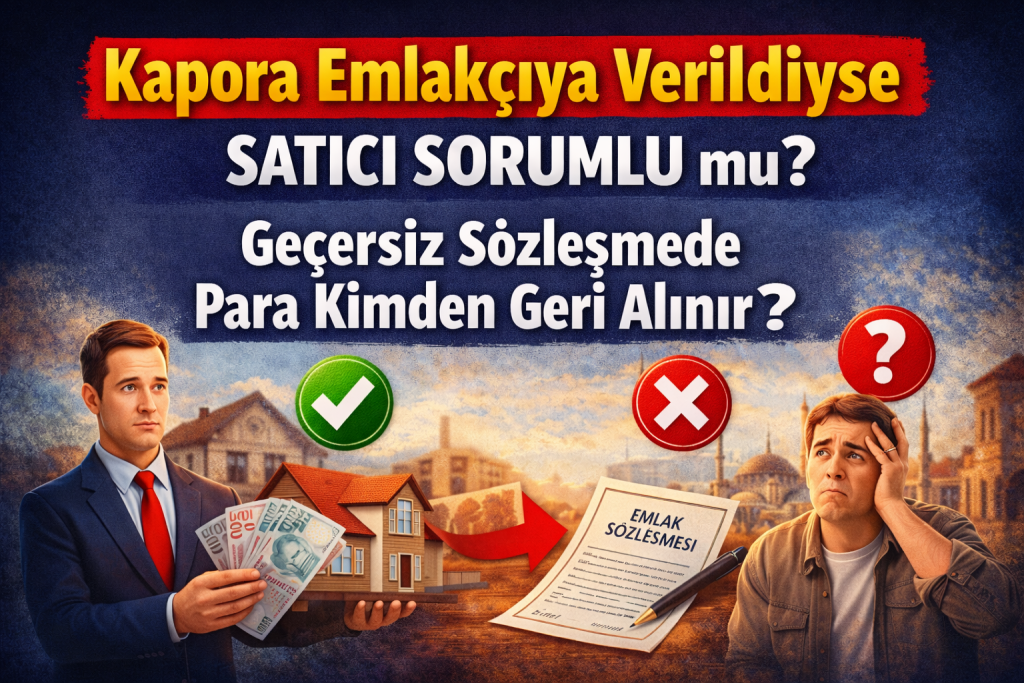
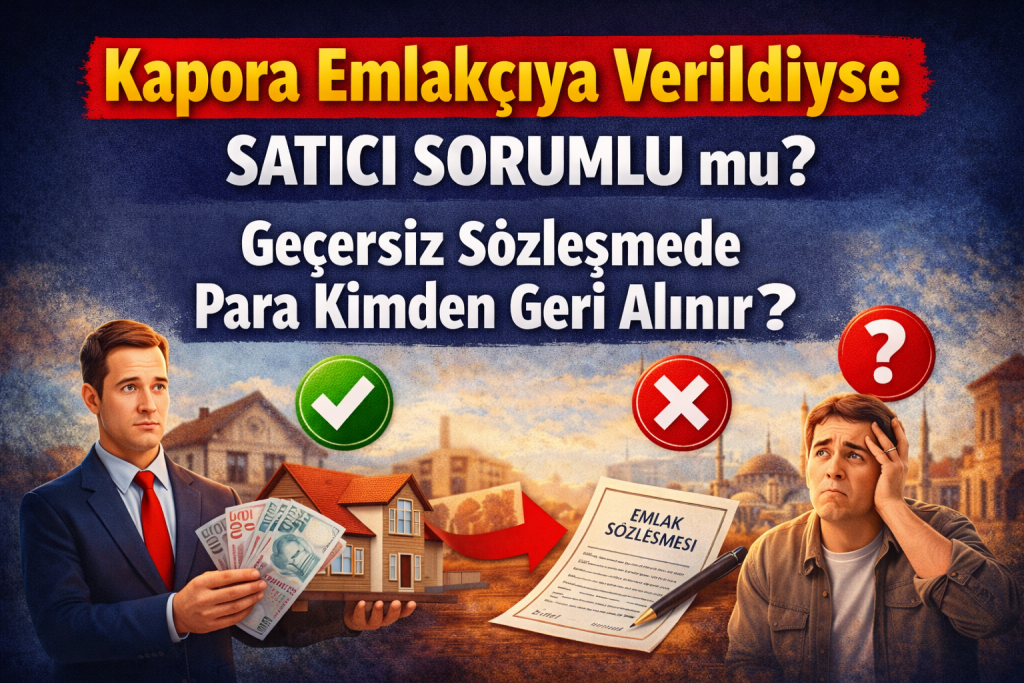
1. Basic Approach to Invalid Contracts and the Seller’s Responsibility for Refund
In the decision of the 3rd Civil Chamber of the Court of Cassation dated 10.11.2016, numbered 2015/16368 E. and 2016/12689 K.; it was stated that the contract for the sale of real estate was invalid because it was not drawn up in an official form, and that this invalidity also covered the provisions regarding the earnest money included in the contract. According to this decision, it has been clearly ruled that even if the earnest money was paid to the real estate agent, the seller is responsible for its return. The Court, in its decision dated 31.01.2018, rendered in compliance with the reversal order, ruled for the collection of the earnest money from the defendant seller, and the 3rd Civil Chamber of the Court of Cassation, with its decision dated 10.10.2018, numbered 2018/3077 E. and 2018/9834 K., confirmed this ruling, stating that the seller is responsible under the provisions of unjust enrichment.
In a similar approach in the current decision of the 3rd Civil Chamber of the Supreme Court of Appeals, dated 11.09.2025, with file no. 2025/483 E. and decision no. 2025/4022 K.; it has been found procedurally and legally appropriate to hold the seller responsible for the refund of this advance payment made due to the invalid contract, in cases where the down payment was deposited into the real estate agent’s account with the seller’s consent.
2. Retention of the Down Payment by the Real Estate Agent and Exceptions to the Seller’s Liability
In some judicial decisions, the seller’s liability is denied in cases where the down payment did not reach the seller and remained with the real estate agent:
In the decision of the Istanbul Regional Court of Justice 14th Civil Chamber, dated 09.05.2019, with file no. 2018/1381 E. and decision no. 2019/678 K.; if it is undisputed that the down payment was sent to the intermediary company (real estate agent) and the money is with this company, the lawsuit filed against the seller was dismissed on the grounds that there was no payment held by the seller.
In the decision of the Istanbul Anadolu 4th Civil Court of Commerce, dated 15.02.2018, with file no. 2015/984 E. and decision no. 2018/127 K.; it was stated that in cases where the down payment was made to the real estate agent as a trustee, there was no amount the seller was obliged to return, and that the refund could only be demanded from the real estate agent.
In the decision of the 3rd Civil Chamber of the Supreme Court of Appeals, dated 01.03.2010, with file no. 2009/19193 E. and decision no. 2010/3224 K.; it was emphasized that the seller has no responsibility for refund in cases where the down payment was not received by the seller but given to the real estate agent.
3. Assessment Regarding Representation Relationship and Standing
In the decision of the 13th Civil Chamber of the Supreme Court dated 23.12.2010, numbered 2010/9870 E. and 2010/18009 K.; it was stated that in cases where the real estate agent signed a contract on behalf of the seller and received a down payment within this scope, the lawsuit should be directed not against the real estate agent acting as a representative, but against the actual seller (owner) with whom the contractual relationship was established on their own behalf and account.
4. Invalidity of the Withdrawal Penalty
The failure to conclude the immovable property sale contract in the official form (Turkish Civil Code art. 706, Turkish Code of Obligations art. 237, Title Deed Law art. 26) also invalidates the provisions regarding the withdrawal penalty, which is an ancillary provision of the contract:
In the decision of the 3rd Civil Chamber of the Supreme Court dated 03.12.2012, numbered 2012/20123 E. and 2012/24842 K.; it was stated that since the main contract was invalid, the withdrawal penalty, which is an ancillary provision, was also invalid, and the seller could not claim this compensation, but was obligated to return the down payment received.
In the decision of the 13th Civil Chamber of the Supreme Court dated 21.04.2010, numbered 2009/15618 E. and 2010/5395 K.; it was emphasized that due to the invalid contract, the parties could reclaim what they had given according to the provisions on unjust enrichment, the seller was obliged to return the down payment received, and the penalty clause was invalid.
5. Secondary Sources and General Principles (Secondary Information)
Decisions that qualify as secondary sources provide the following additional contexts regarding the scope of the restitution obligation in invalid immovable property sale contracts:
In the decisions of the Supreme Court 3rd Civil Chamber (2022/5945 E., 2023/1681 K.) and Istanbul Anatolian 6th Commercial Court of First Instance (2021/384 E., 2022/138 K.), it has been stated that contracts made without complying with the official form will not produce legal effect, and in this context, the withdrawal penalty or earnest money paid can be requested back from the seller under the provisions of unjust enrichment.
In the decision of the Supreme Court 13th Civil Chamber (2014/14864 E., 2015/913 K.), it has been stated that if the nature of the money given in the contract cannot be understood, it will be considered earnest money and must be returned in case of invalidity.
In the decision of the Supreme Court 11th Civil Chamber (2021/8264 E., 2023/2448 K.), it has been affirmed that even if the immovable property does not belong to the seller, the earnest money paid under an invalid contract must be returned according to the rules of unjust enrichment.
In its decision to resolve the dispute, the Supreme Court 3rd Civil Chamber (2023/3943 E., 2024/3632 K.) stated that the principle “everyone is obliged to return what they have received” in invalid contracts also covers additional fees such as organizational fees, and that the opposite situation would mean recognizing the validity of an invalid contract.
In the decision of the Bakırköy 7th Commercial Court of First Instance (2022/552 E., 2022/995 K.), it has been implied that if the earnest money is deposited with the seller’s authorized representative or into other accounts directed by them, the seller’s responsibility to refund will arise.
In the decision of the Istanbul Anatolian 1st Civil Court of Commerce (2025/92 E., 2025/572 K.), it was ruled that the “agreement deposit” paid in construction contracts in return for land share, which are not made in official form, is in the nature of an earnest payment and its refund can be demanded from the seller (landowner) according to unjust enrichment.
Conclusion: The established jurisprudence of the 3rd Civil Chamber of the Court of Cassation considers the payment of a deposit to the real estate agent due to an invalid contract as a factor that does not negate the seller’s responsibility and places the obligation of refund on the seller according to the provisions of unjust enrichment. However, in specific cases where the money never reached the seller or the real estate agent acted as a trustee, it is observed that lower courts and some regional courts of appeal do not hold the seller responsible. Withdrawal compensation, on the other hand, is considered invalid in any case due to the invalidity of the main contract.
Frequently Asked Questions
Kapora emlakçıya verildiyse satıcıdan geri alınabilir mi?

Evet, çoğu Yargıtay kararına göre kapora emlakçıya ödenmiş olsa bile, satıcının bilgisi ve onayı varsa iade sorumluluğu satıcıya ait olabilir.
Hangi durumlarda satıcı sorumlu olmaz?
Eğer kapora tamamen emlakçıda kalmış ve satıcıya hiç ulaşmamışsa veya emlakçı “yediemin” sıfatıyla hareket etmişse, bazı mahkeme kararlarında satıcının sorumluluğu kabul edilmemektedir.
Geçersiz sözleşmede cayma tazminatı talep edilebilir mi?
Hayır. Taşınmaz satış sözleşmesi resmi şekilde yapılmadıysa geçersiz sayılır ve buna bağlı kapora, cezai şart ve cayma tazminatı hükümleri de geçersiz olur.
Why is Expert Legal Support Necessary?
In real estate buying and selling processes, from whom and how the deposit will be recovered, whether the contract is valid, and whether the responsibility belongs to the seller or the real estate agent, completely depends on the details of the specific case. Therefore, it is of great importance to seek support from an Istanbul real estate lawyer or a buying and selling lawyer for the correct management of the process.
Specifically;
Correct determination of which party the deposit should be claimed from
Analysis of the legal nature of the real estate agent-seller relationship
Proper structuring of the unjust enrichment lawsuit
Critical issues such as preventing the dismissal of a case due to the wrong party require professional legal knowledge.
At this point, working with the experienced 2M Law Firm ensures the process is conducted quickly and correctly. Additionally, from a local support perspective, working with a Tuzla lawyer, Kurtköy lawyer, Pendik lawyer or Bayramoğlu lawyer contributes to the effective on-site follow-up of the process.