
Legal Basis: Law No. 6306 Article 3/1 | Implementation Regulation Article 9
Your building has been identified as a risky structure, and you want to object to this decision. What happens after you submit your petition? Who examines your objection, who appoints these individuals, and how is their independence guaranteed? How can you communicate with the committee that made the decision, and how will the decision be communicated to you? Article 3/1 of Law No. 6306 and Article 9 of the Implementation Regulation answer all these questions in detail. This article comprehensively addresses the legal basis, formation, members, operating principles, decision-making method, and impartiality guarantees of the technical committee, in line with the current 2026 legislation. (L. Art. 3/1 — R. Art. 9)
Legal Basis of the Technical Committee
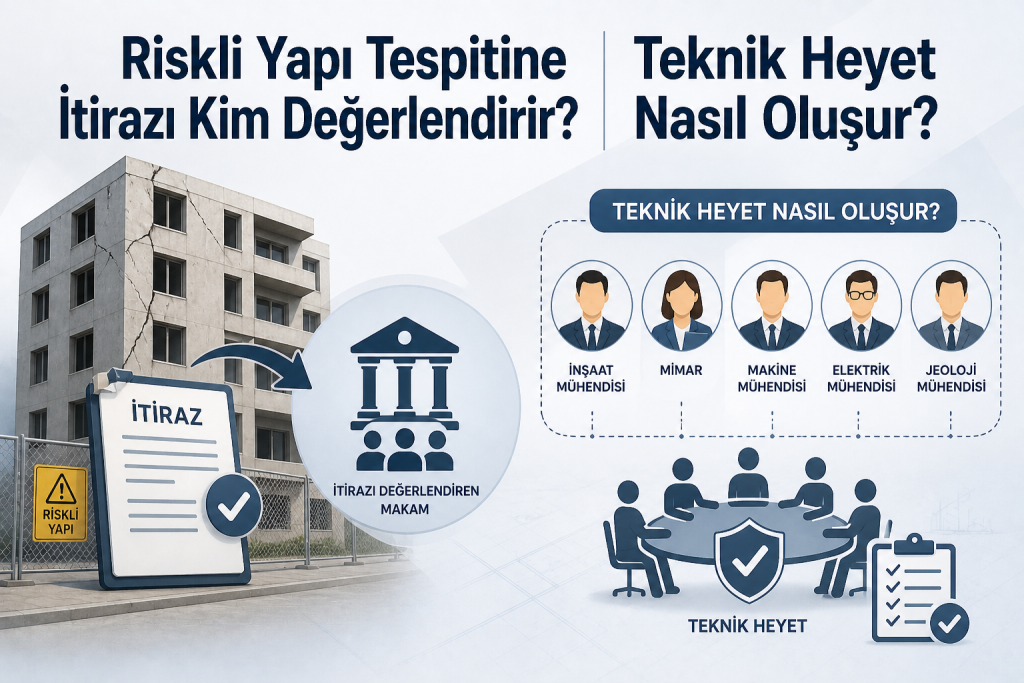
Article 3/1 of Law No. 6306 entrusted the examination of objections made against risky building determinations to specially established technical committees. According to the provision of the Law, these objections are examined and decided by technical committees formed at the request of the Presidency, with the participation of four faculty members from relevant professional disciplines to be assigned by universities and three individuals working at the Ministry/Presidency. (L. Art. 3/1)
Article 9 of the Regulation concretizes this general framework by detailing the establishment of the technical committee, member selection, term of office, and operating principles. (R. Art. 9)
Establishment of the Technical Committee: Who, Where, When Establishes It?
Article 9/1 of the Regulation clearly specifies how the technical committee will be formed: Sufficient technical committees are established by the Presidency, as needed, in locations deemed necessary, to evaluate objections made against risky building determinations. (R. Art. 9/1)
It is necessary to underline three critical elements of this regulation. The first element is that the technical committee is established by the Presidency; in other words, the organizing actor of the administrative and technical process is the Urban Transformation Presidency. The second element is that the committee is established “as needed” and “in locations deemed necessary”; this phrase means that it is not mandatory to have a technical committee in every province. If a technical committee has not been established in a province, objections from that province are sent by the Directorate to the Directorate in the province where an authorized technical committee is located. (R. Art. 7/6) The third element is the phrase “sufficient”; the Presidency can establish more than one committee depending on the volume of objections.
Composition of the Technical Committee: 7 Members, 2 Sources
The regulation has determined that the technical committee will consist of seven members. These seven members come from two different sources. (Law Art. 3/1 — Reg. Art. 9)
Four people from university faculty members: They are determined by university rectors from among those who hold at least a doctor faculty member position in relevant professional fields from higher education institutions, in accordance with the Regulation on Promotion and Appointment to Faculty Membership. This condition ensures the academic qualifications of the members; individuals with a master’s degree or at the research assistant level cannot be appointed.
Three people from Ministry/Presidency technical personnel: Three members appointed from the technical personnel working within the Urban Transformation Presidency fulfill the public oversight function of the committee. In risky areas and reserve building areas, civil engineers, geological engineers, and geophysical engineers may be included in the technical committee.
Alternate members are also determined for each committee. If the principal member cannot attend the meeting, the alternate member assumes the duty; thereby, the continuity of the committee’s work is ensured.
Term of Office for Members and Reappointment
Technical committee members are determined and appointed by university rectors upon the request of the Presidency. When their term of office expires, members may be reappointed. Existing members continue their duties until new members are appointed; this arrangement is a practical guarantee to prevent disruptions that may occur due to a lack of a committee during objection processes. (Reg. Art. 9)
The circumstances under which membership will automatically terminate are also explicitly regulated in the Regulation: Except for absences due to annual leave, sick leave, and justified leave, the membership of a technical committee member who fails to attend eight meetings in a year or three consecutive meetings will automatically terminate. A new member is appointed to replace the member whose membership has terminated. (Reg. Art. 9/8)
Administrative and Technical Services: The Directorate’s Role
The fact that the technical committee is an independent decision-making body does not mean that it can operate independently of administrative support services. Article 10/2 of the Regulation clarifies this distinction: The administrative and technical services of the technical committee are carried out by the Directorate in the province where the technical committee is located. The agenda of the technical committee is prepared by the Directorate. (Reg. Art. 10/2)
This regulation means that the Directorate assumes the secretariat function of the committee. The authority to set the agenda belongs to the Directorate; however, the Directorate has no influence or jurisdiction over the committee’s decisions.
Meeting Schedule and Call Procedure
The technical committee, taking into account the number of files to be reviewed and extraordinary circumstances, meets at least once a month. This minimum meeting requirement ensures that objections are resolved within a reasonable timeframe. (Reg. Art. 10/3)
Outside of the regular meeting schedule, the Directorate may invite the technical committee to an extraordinary meeting if deemed necessary. The location, date, time, and agenda items of the meeting are communicated to the members by the Directorate at least seven days in advance. (Reg. Art. 10/3)
Meeting and Decision Quorum
The technical committee convenes with the participation of at least five members and makes decisions by a majority of the members present at the meeting. In case of a tie in votes, the view sided with by the President shall be deemed to have the majority. (Reg. Art. 10/4)
There are two distinct rules to consider regarding the quorum for meeting and decision. The meeting quorum is 5: it is mandatory for a 7-member committee to convene with at least 5 members; a meeting held with 4 members is not legally valid. The decision quorum is the majority of the participating members: 3 votes are sufficient for a decision in a meeting with 5 members, 4 votes in a meeting with 6 members, and 4 votes in a meeting with 7 members. In case of a tie in votes, the view sided with by the President is valid; while this rule is a theoretical regulation, its practical application is rarely encountered.
Scope of Technical Committee’s Review: Not Bound by the Grounds of Objection
The scope of the technical committee’s review is not limited to the grounds asserted by the owner in their petition. This is an extremely critical characteristic for both rights holders and legal professionals managing the objection process. (Reg. Art. 10/7)
Article 10/7 of the Regulation is clear: The technical committee examines whether the risky structure determination report has been prepared in accordance with all its technical elements and the Principles for the Determination of Risky Structures specified in Annex-2, regardless of the grounds for objection stated in the objection petition. (Reg. Art. 10/7)
The practical outcomes of this regulation may lead to different results for both the owner and the administration. The positive outcome for the owner is that a technical deficiency you did not raise in your petition may also be identified by the committee, and your objection may be accepted on this ground. The negative outcome is that even if the reasons you put forward in your petition are not accepted, the committee may identify problems in other elements of the report or, conversely, may more comprehensively confirm that the structure is indeed risky.
Authority for On-site Inspection
The technical committee, if deemed necessary, may personally inspect the structure subject to the objection on-site or request the Directorate to conduct an on-site inspection of the structure. (Reg. Art. 10/7)
This authority is discretionary; an on-site inspection is not mandatory for every objection. On-site inspections are typically resorted to in cases that are technically contentious or where there are serious question marks regarding the reliability of the data in the report.
However, even if an on-site inspection is decided, the final decision on whether the structure is risky is made based on its condition and characteristics as of the date the risky structure determination was made. This principle is important because even if there have been changes to the structure during the objection process, the committee reverts to and takes into account its condition as of the initial determination date. (Reg. Art. 10/7)
Expert Participation: Obtaining Opinions Without Voting Rights
The technical committee, if deemed necessary, may invite experts from other public institutions and organizations to meetings to obtain their opinions. These experts are not granted voting rights. (Reg. Art. 10/5)
It is possible to invite earthquake research centers, ground survey institutions, or organizations specialized in seismic hazards within this scope. This regulation keeps open the possibility of obtaining additional technical opinions on specialized matters where the expertise of the seven members of the technical committee may be insufficient.
Guarantee of Impartiality: Prohibition of Participation in Meetings in Case of Conflict of Interest
The regulation provides for a conflict of interest rule to ensure the impartiality of the technical committee’s decisions. A member whose blood relatives or in-laws up to the third degree are involved in the agenda item, or who has any interest whatsoever in the agenda item, cannot participate in the technical committee meeting or cast a vote. (Reg. Art. 10/6)
This rule covers three distinct situations: First, the member having a personal interest in the structure subject to objection — such as the member or a close family member owning rights in that structure. Second, blood relatives or in-laws up to the third degree being involved with the structure subject to objection. Third, the member having any other interest relationship with the structure subject to objection — such as having prepared a report for that structure in the past or having established a commitment relationship.
An alternate member is assigned to replace the member who does not attend the meeting for this reason.
Formulation of Decisions with Written Justification
Decisions made by the technical committee are written, stating their technical justifications, and are signed by the chairman and members. (Reg. Art. 10/7)
The necessity of a reasoned decision is critically important both for the objecting owner to understand the basis of the decision and for the court to be able to exercise oversight if the decision is challenged in court. Decisions without grounds or with insufficient grounds can constitute a ground for annulment according to administrative court jurisprudence.
Notification of Decisions: To Whom, What Information?
The Regulation clearly stipulates who will be informed of the decisions made by the technical committee. All decisions are communicated to the Ministry and to the Administration that carried out or commissioned the assessment. However, only the final decision is communicated to the objecting owner. (Reg. Art. 10/7)
This distinction yields a significant practical outcome: The objecting owner cannot learn about the technical committee’s interim evaluations, deliberation minutes, or dissenting opinions of different members; they only learn the final outcome, such as “objection accepted/rejected,” and its legal justification.
If the risk status of the structure changes according to the technical committee’s decision — that is, if the objection is accepted and the structure is found to be non-risky — this decision is also sent to the Presidency and communicated to the land registry office, and the annotation is removed. (Reg. Art. 10/7 — Law Art. 3/2)
Objection by More Than One Owner for the Same Structure
In multi-owner structures, multiple owners sometimes file objections independently of each other. The Regulation clearly addresses this situation: The technical committee does not conduct a re-examination based on an objection filed by another owner against a risky structure determination report that has already been decided upon. (Reg. Art. 10/7)
The meaning of this provision is: If an owner has objected and the committee has rendered its decision, an objection made by another owner for the same report will not be processed. The technical committee’s decision is binding for all owners; a separate assessment is not made for each owner.
Objection Process in Provinces Without a Technical Committee
If a technical committee to evaluate the objection has not been formed in the province where the risky structure is located, the objection petitions and reports related to the objected finding shall be sent by the Directorate in the location of the risky structure to the Directorate in the province where the technical committee authorized for that province is located. (Reg. Art. 7/6)
This regulation closes a legal loophole that could arise if a technical committee is not established in provinces with small populations or a low number of objections. The objection application is made to the Directorate in the province where the structure is located under all circumstances; the file’s submission to the Directorate in the authorized province is carried out through administrative channels.
Judicial Remedy Against Technical Committee Decision
The technical committee’s decision of refusal is an administrative act and is subject to judicial review. An annulment lawsuit can be filed in the Administrative Court within 30 days from the notification of the refusal decision. (Law Art. 6/9 — Adm. Proc. Law Art. 7)
Requesting a stay of execution (YD) decision in the lawsuit is critically important. Annulment lawsuits filed without obtaining a YD decision cannot prevent demolition from occurring while the case is ongoing. (Adm. Proc. Law Art. 27)
Summary Table: Key Characteristics of the Technical Committee
| Feature | Regulation |
|---|---|
| Establishing Authority | Urban Transformation Presidency |
| Total number of members | 7 (4 universities + 3 Ministries/Presidencies) |
| University member qualification | At least a faculty member with a doctorate |
| Quorum for meeting | At least 5 members |
| Quorum for decision | Majority of participants |
| In case of a tie vote | The President’s opinion is valid |
| Meeting frequency | At least 1 per month (regular), + extraordinary |
| Meeting announcement | At least 7 days in advance |
| Scope of review | All technical elements (not bound by justification) |
| On-site inspection | Discretionary (committee decides) |
| Form of the decision | Reasoned, written, signed |
| Notified to the owner | Only the final decision |
| Termination of membership | Failure to attend 8 meetings in 1 year or 3 consecutive meetings |
| Conflict of interest | Prohibition of participation and voting |
Practical Warnings
Do not write the objection petition without justification. Although the technical committee is not bound by the reason for objection, a petition based on concrete and technical grounds guides the committee’s review process. Concrete claims regarding the core sampling method, structural measurement errors, or calculation methods should be included in the petition. (Art. 10/7)
Be aware that a single objection is sufficient for the same structure. If multiple owners object to the same report, only the first objection will be evaluated; subsequent objections will not be processed. Preparing a joint objection petition by coordinating among owners prevents both delays and potential contradictions. (Art. 10/7)
Take into account that the objection process may slow down. The technical committee meets at least once a month; it is important that your file is submitted completely and on time for your application to be included in the next agenda. Applications with incomplete documents may postpone the file to the next meeting.
Follow the 30-day lawsuit period against the rejection decision. An annulment lawsuit must be filed within 30 days from the notification of the final rejection decision to you. This period is preclusive. (Law Art. 6/9 — APL Art. 7)
Why is Expert Lawyer Support Necessary?
The technical committee process is an administrative stage that has both technical and legal dimensions and requires meticulous preparation. As 2M Hukuk Law Office, in the process of providing urban transformation consultancy throughout Istanbul, especially in Tuzla, we observe the following difficulties in technical committee objections:
Petitions are often prepared without a technical basis. Since it is not known that the technical committee is not bound by its justification and has examined all technical elements of the report, it cannot be assessed which technical headings the objection should focus on. An urban transformation lawyer, working in coordination with construction engineers, prepares the petition robustly, both legally and technically.
In the annulment lawsuit to be filed against the technical committee’s rejection decision, the request for a stay of execution must be submitted within a very short timeframe and with correct technical justifications. As an Istanbul urban transformation lawyer, we provide effective representation both in petition preparation and during the court process.
In cases where multiple owners file an objection for the same structure, since the content and timing of the first objection bind all other owners, this coordination being carried out under the management of an urban transformation lawyer prevents loss of rights. 2M Hukuk Avukatlık Ofisi, serving as a Tuzla lawyer, is by your side throughout Istanbul, at every stage from risky structure detection objections to the technical committee process and annulment lawsuits.
Conclusion
The technical committee that evaluates objections to risky building determinations, in accordance with Article 3/1 of Law No. 6306 and Article 9 of the Implementation Regulation, is a 7-person board consisting of 4 university faculty members with doctorates and 3 technical personnel from the Ministry/Presidency. The committee is established by the Urban Transformation Presidency as needed; its administrative services are carried out by the provincial Directorate. It convenes with at least 5 members and makes decisions by a majority of those present. It examines all technical elements of the report regardless of the grounds for objection; decisions are prepared in writing and with justification. An annulment lawsuit against a rejection decision can be filed in the administrative court within 30 days from the date of notification. (Law Art. 3/1 — Reg. Art. 9)
This article has been prepared based on Law No. 6306 (Art. 3/1) and the Implementation Regulation (Art. 9, Art. 10), as well as the Regulation amendment published in the Official Gazette dated February 4, 2026, and numbered 33158. Since each specific situation may vary, it is recommended to seek support from an expert urban transformation lawyer for legal processes.