1. LEGISLATION INFORMATION NOTE
According to Article 24 of the Condominium Law (KMK) No. 634; institutions such as hospitals, dispensaries, clinics, polyclinics, and pharmaceutical laboratories cannot be established in an independent section of the main property registered as a residence, workplace, or commercial place; agreements of apartment owners to the contrary are void. However, consulting rooms that are not in the nature of dispensaries, clinics, or polyclinics are exempt from this provision. As an important point; if a consulting room takes on the characteristics of a “clinic” or “polyclinic” with elements such as multiple specialties or inpatient units, its opening in residential areas is absolutely prohibited according to KMK Art. 24/1, even with the permission of the apartment owners. According to KMK Art. 28, the management plan is a contractual provision that regulates the style of management and the manner of use, and is binding on all apartment owners. In accordance with Article 13 of the Regulation on Private Healthcare Institutions Providing Outpatient Diagnosis and Treatment, compliance with the Condominium Law is checked during the administrative licensing stage.
2. GENERAL LEGAL FRAMEWORK AND THE EXCEPTION FOR CONSULTING ROOMS
In judicial decisions, a dual distinction is observed regarding the opening of doctors’ consulting rooms in residences. According to KMK Art. 24/1, consulting rooms are not listed among absolutely prohibited institutions like hospitals and clinics, and are excluded from this prohibition. As stated in the decision of the 4th Chamber of the Council of State dated 13.02.2025, no. 2023/9323 E. – 2025/1050 K., consulting rooms that are not in the nature of a dispensary, clinic, or polyclinic are not among the institutions prohibited from being established in independent sections designated as residential.
As emphasized in the decision of the Supreme Court’s General Assembly of Civil Chambers dated 21.12.2005, numbered 2005/695 E. – 2005/759 K., in established practice, the opening of a doctor’s office in an independent unit designated as a residence is not considered a “workplace” within the scope of Article 24/2 of the Condominium Law (KMK), and therefore, as a rule, the existence of a unanimous decision by all unit owners is not required.
3. BINDING NATURE OF RESTRICTIONS IN THE MANAGEMENT PLAN
Although the opening of a medical office is not absolutely prohibited by law, the provisions in the management plan are binding on all unit owners, in accordance with Article 28 of the Condominium Law (KMK). According to the decision of the 18th Civil Chamber of the Supreme Court dated 26.01.2006, numbered 2005/11244 E. – 2006/234 K., if there is a provision in the management plan stating that residences shall only be used as dwellings and not for other purposes, a unanimous decision of the unit owners (or an amendment to the management plan) is mandatory for opening a doctor’s office.
Similarly, in the decision of the 18th Civil Chamber of the Supreme Court dated 27.04.2009, numbered 2008/12276 E. – 2009/4336 K., if the management plan contains a provision stating that a unit “cannot be used for purposes other than those specified in the land registry without a unanimous decision of the board of unit owners,” unanimity is required for the use of a residential unit as a medical office. In the decision of the Istanbul Regional Court of Justice, 35th Civil Chamber, dated 05.07.2017, numbered 2017/1191 E. – 2017/1196 K., it was also confirmed that explicitly prohibiting the use of a unit as a medical office in the management plan is not against the law and that this prohibition must be complied with.
4. UNANIMITY REQUIREMENT OF UNIT OWNERS AND LICENSE CANCELLATION
Some judicial decisions directly require the unanimous consent of the flat owners as a condition for opening a private practice:
2nd Chamber of the Council of State (28.02.2023, 2022/3857 E. – 2023/784 K.): Found the rejection of the request for a dental private practice operating license to be lawful, on the grounds that unanimous consent was not given by the flat owners.
4th Chamber of the Council of State (17.12.2024, 2024/633 E. – 2024/7495 K.): Ruled for the cancellation of the license because there was no unanimous decision from the flat owners to open a dental private practice in the apartment registered as a residence in the land registry.
18th Civil Chamber of the Court of Cassation (27.10.2014, 2014/16155 E. – 2014/14774 K.): Stated that a private practice has the nature of a workplace and cannot be opened in a residential unit without the unanimous consent of all flat owners, in accordance with Article 24/2 of the Condominium Law (KMK).
5. DISTINCTION BETWEEN CLINIC AND POLYCLINIC
If the scope of a private practice expands and acquires the characteristic of a clinic or polyclinic, this situation falls under the absolute prohibition in accordance with Article 24/1 of the Condominium Law (KMK). In the decision of the 18th Civil Chamber of the Court of Cassation dated 21.10.2010, numbered 2010/8338 E. – 2010/13558 K., it was emphasized that if the independent section is used as a “clinic,” this use is not possible even with the unanimous decision of the flat owners, and it must be converted back to a residential unit. In the decision of the 20th Civil Chamber of the Court of Cassation dated 17.01.2018, numbered 2017/1150 E. – 2018/222 K., it was also confirmed that a polyclinic cannot be established in a residential unit.
6. SECONDARY SOURCES AND ADDITIONAL CONTEXT
Decisions that constitute secondary sources include the following additional points regarding the matter:
Council of State 4th Chamber (20.03.2025, 2024/860 E. – 2025/1889 9 K.): While outlining the general framework of KMK art.24, it stated that private practices are within the scope of legal exception provided they do not have the nature of a clinic, but the unanimity requirement continues for commercial activities such as markets.
Constitutional Court (17/7/2014): Noted that the regulation in KMK art.24, which makes the use of residences as workplaces dependent on the consent of the floor owners, does not violate the right to property, and that a clear exception is provided in the law for private practices.
Court of Appeals 5th Civil Chamber (26.03.2024, 2024/842 E. – 2024/3733 K.): In a dispute concerning a dental practice, rendered a procedural decision due to the case becoming moot; however, reported that the parties developed arguments based on KMK art.24 and management plan restrictions.
CONCLUSION AND ANALYSIS For doctors to open private practices in residences;
The place to be opened must be an independent “private practice” and not a “clinic” or “polyclinic” (KMK art.24/1),
There must be no provision in the property’s Management Plan prohibiting the use of residences as private practices (KMK art.28),
If there is a restrictive provision in the management plan such as “for residential use only” or “unanimous decision is required,” then the consent of all floor owners by unanimity is required.
If there is no prohibitory provision in the management plan, according to some precedents of the Court of Cassation, clinics can be opened without requiring unanimity, as they do not fall under the definition of “workplace” in Article 24/2 of the Condominium Law (KMK); however, recent Council of State decisions frequently require the consent of the condominium owners at the administrative licensing stage.
Frequently Asked Questions
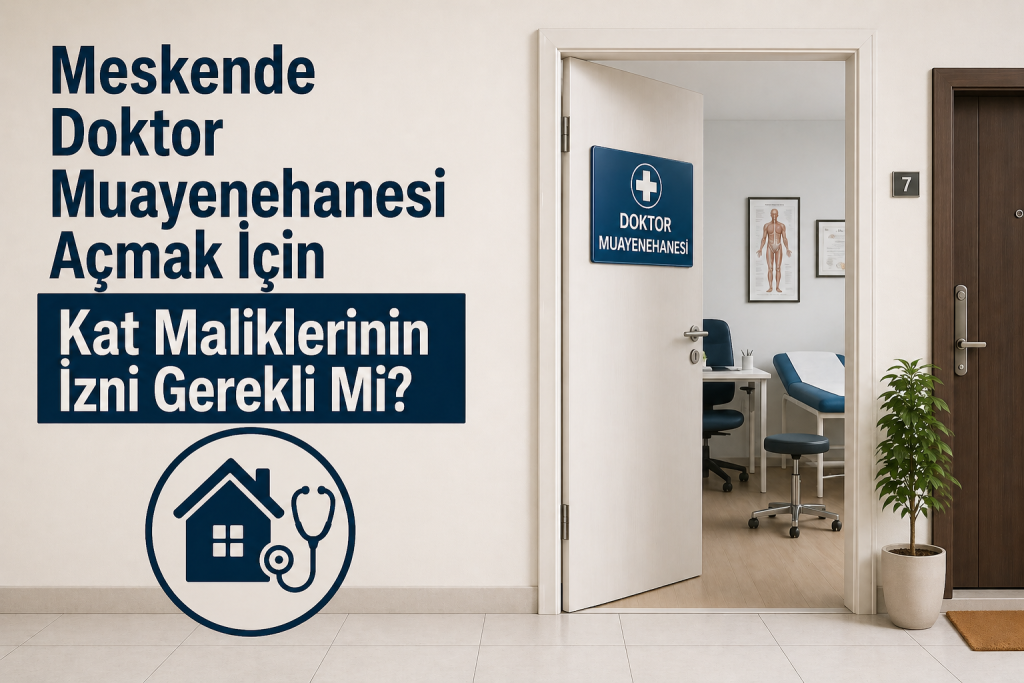
Doktor, tapuda mesken olarak kayıtlı bir dairede muayenehane açabilir mi? Kat maliklerinin iznine ihtiyaç var mı?

Kural olarak evet, açılabilir — ancak bazı önemli koşullar mevcuttur. KMK’nın 24. maddesi poliklinik, klinik ve hastane gibi müesseseleri meskenlerde kesin olarak yasaklamış; ancak muayenehaneleri bu yasağın dışında tutmuştur. Danıştay 4. Dairesi’nin 2025 tarihli kararı da bu ayrımı teyit etmektedir. Yargıtay Hukuk Genel Kurulu’nun yerleşik içtihadına göre ise muayenehaneler “işyeri” sayılmadığından kural olarak kat maliklerinin oybirliği aranmaz. Bununla birlikte belirleyici olan yönetim planıdır: yönetim planında “sadece mesken olarak kullanılır” gibi bir hüküm bulunuyorsa tüm kat maliklerinin oybirliği zorunlu hale gelir. İstanbul avukat veya Tuzla avukat olarak görev yapan kat mülkiyeti uzmanı avukatlar, yönetim planı analizi yaparak doktorların hak kaybı yaşamadan süreci yönetmesine destek olmaktadır.
Yönetim planında yasak yoksa muayenehane ruhsatı kesin alınabilir mi? Danıştay ne diyor?
Yönetim planında açık bir yasak bulunmasa dahi idari ruhsat süreci ayrı bir risk barındırmaktadır. Danıştay 2. Dairesi (2023) ve Danıştay 4. Dairesi’nin 2024 tarihli kararlarında, kat maliklerinin oybirliği muvafakati bulunmadığı gerekçesiyle diş hekimliği muayenehanesi ruhsat taleplerinin reddedilmesi ve açılmış ruhsatların iptali hukuka uygun bulunmuştur. Yani Yargıtay içtihadı ile Danıştay’ın idari denetim yaklaşımı arasında önemli bir gerilim söz konusudur: mahkeme sürecinde oybirliği aranmayabilirken, belediye ruhsat aşamasında kat malikleri muvafakatnamesi talep edilebilmektedir.
Muayenehane ile poliklinik arasındaki fark neden bu kadar önemli? Sınırı kim belirler?
Bu iki kavram arasındaki fark, tamamen farklı hukuki sonuçlar doğurduğundan kritik önem taşır. Muayenehane, KMK’daki yasak kapsamı dışındayken poliklinik veya klinik vasfı taşıyan bir yer meskende hiçbir koşulda açılamaz; kat maliklerinin tamamı rıza gösterse dahi bu yasak aşılamaz. Yargıtay 18. Hukuk Dairesi, klinik olarak kullanılan bir yerin kat malikleri oybirliğiyle dahi mesken nitelikli bölümde faaliyette bulunamayacağına, tahliye ve eski hale getirme kararı verileceğine hükmetmiştir. Faaliyetin muayenehane mi yoksa poliklinik mi olduğu ise uzman doktor bilirkişi aracılığıyla tespit edilmektedir. Birden fazla uzmanlık dalı, yataklı ünite veya geniş kadro gibi unsurlar muayenehaneyi “poliklinik” sınırına taşıyabilir
Why is Expert Lawyer Support Necessary?
Opening a doctor’s office in a residential dwelling is a multi-layered legal process that requires correctly understanding the delicate balances between the provisions of the Condominium Law, management plan restrictions, the administrative licensing precedents of the Council of State, and the decisions of the Court of Cassation. A wrong step — overlooking the management plan, misjudging the nature of the activity, or skipping the condominium owners’ process — can lead to severe consequences such as license denial, license cancellation, or an eviction lawsuit. The condominium law specialist lawyers of 2M Hukuk Law Office, operating as Istanbul lawyers and Tuzla lawyers, provide effective legal support to doctors and condominium owners in management plan review, condominium owners’ board processes, municipal license applications, and potential eviction lawsuits. Obtaining advice from an expert lawyer at the very beginning of the process is the safest way to prevent irreversible loss of rights.