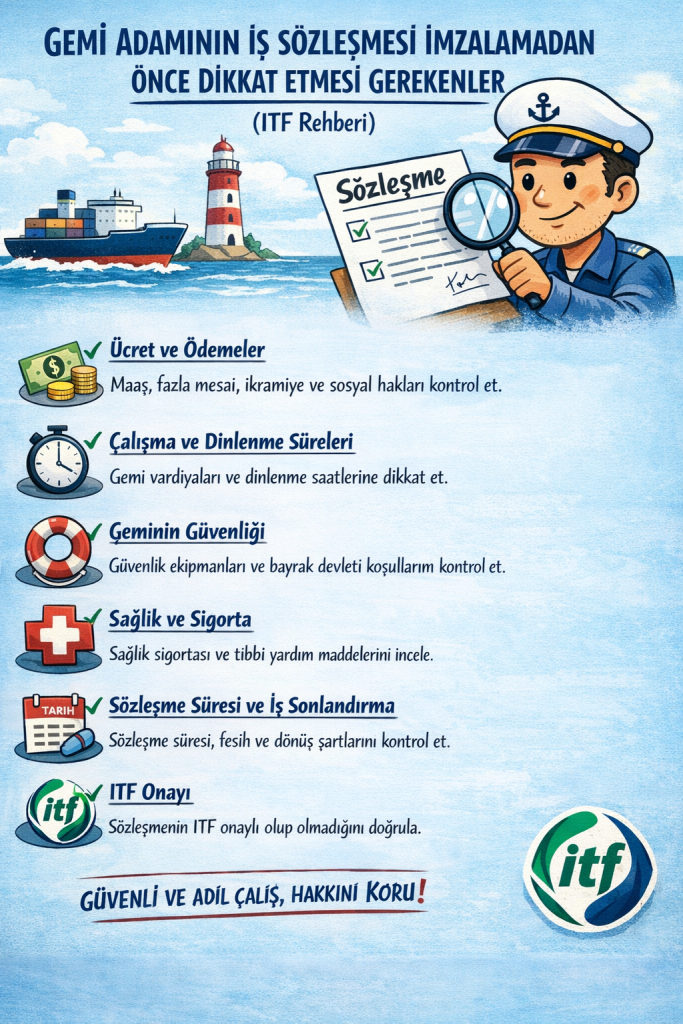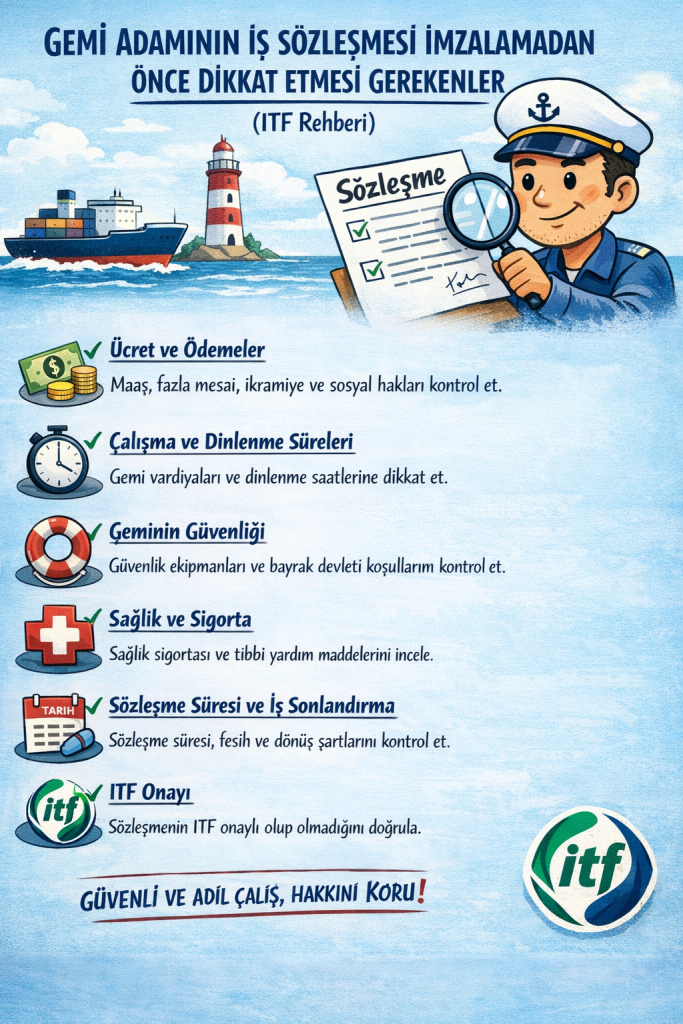
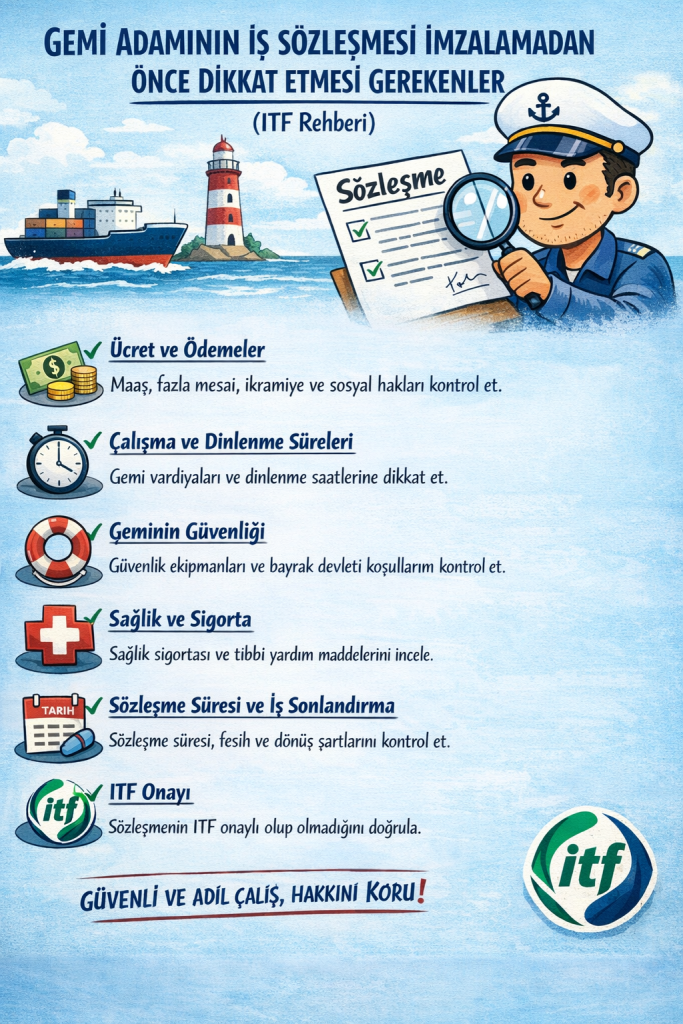
Working at sea is a field that carries significant legal and professional risks despite its high income potential. Therefore, for a seafarer, the most critical step is the review conducted before signing the employment contract.
According to international standards, the most effective way to secure appropriate employment conditions at sea is to sign an employment contract prepared in accordance with an International Transport Workers’ Federation (ITF) approved Collective Bargaining Agreement (CBA).
If this is not possible, ITF’s recommendations must be strictly followed.
Do Not Start Working Without a Written Contract
Among the most common rights violations in the maritime sector is being employed without a written contract. A written employment contract is the most fundamental document that concretely outlines a seafarer’s wages, working hours, leave, insurance, and other rights. Verbal agreements or situations dismissed with “it will be arranged later” create difficulties in proving claims in future disputes and often result in outcomes unfavorable to the seafarer. Therefore, under no circumstances should one start working on a ship without a written and signed employment contract.
Do Not Sign Blank or Vague Contracts
Contracts presented by employers may sometimes contain blank fields, provisions that can be filled in later, or clauses that are not clearly understood. Such contracts carry the risk of being altered or interpreted differently without the seafarer’s knowledge. A legally signed contract is considered binding regardless of its content. Therefore, no contract containing provisions that you do not understand, are unclear, or can be filled in later should be signed. If necessary, the contract should be thoroughly examined, and points that are not understood should be clarified in writing.
Collective Bargaining Agreement (CBA) Check
On many international vessels, individual employment contracts are actually drawn up in conjunction with a Collective Bargaining Agreement (CBA). Therefore, it must be checked whether the contract to be signed refers to a CBA. If such a reference exists, the seafarer must review this CBA and learn their rights in detail. Because most often, wages, overtime, leave, compensation, and social rights are essentially regulated within the CBA. Therefore, not only the individual contract but also the associated CBA must be read, and a copy should be kept.
Contract Duration Must Be Clear
One of the most critical elements of an employment contract is that its duration must be clearly and explicitly defined. Indefinite-term or open-ended contracts make it uncertain how long the seafarer will work and under what conditions they can leave. Furthermore, provisions that give the employer the authority to unilaterally extend or change the contract duration can lead to serious rights violations. Such clauses put the seafarer in a weak position against the employer. Therefore, the contract duration must be clearly stated, and it must be explicitly specified that changes can only be made with mutual consent.
Wages and Working Hours Must Be Clearly Stated
It is the seafarer’s most fundamental right for the basic wage and working hours to be clearly stated in the contract. The amount of the wage, the currency in which it will be paid, the payment period, and working hours must be explicitly specified. According to international standards, the weekly working period is generally limited to 48 hours. If this limit is exceeded, overtime provisions come into play. Contracts that do not clearly state wages and working hours lead to problems such as underpayment or excessive work in the future.
Overtime Conditions Must Be Clear
Overtime is quite common in the maritime industry. Therefore, the contract must clearly regulate the conditions under which overtime will be worked and how it will be paid. Overtime pay should be calculated at a specific multiple of the normal hourly wage. According to international standards, this rate should be at least 1.25 times the normal rate. Contracts that do not explicitly state overtime provisions can result in seafarers not being paid for intensive work.
Paid Leave Rights Must Be Clearly Stated
One of the most important rights of seafarers is the right to paid leave. The contract must clearly specify the monthly and annual leave periods. According to international standards, the annual paid leave period must be at least 30 days, and this period is usually calculated as 2.5 days for each month. The absence of leave rights in the contract or their vague definition can lead to a violation of the seafarer’s right to rest.
Wage Components Must Be Shown Separately
Instead of showing the wage as a single total figure in the contract, basic wage, overtime, and other payments must be specified separately. If this distinction is not made, the employer may try to present overtime payments as part of the basic wage, which leads to significant loss of rights. A transparent and detailed wage structure protects the seafarer’s rights in potential disputes.
Travel and Repatriation Expenses Are the Responsibility of the Employer
According to international maritime practices, the costs of joining the vessel and repatriation at the end of the contract are the responsibility of the employer. However, in some contracts, attempts are made to impose these costs on the seafarer. Such provisions are contrary to law and international standards. Contracts that subject seafarers to such financial obligations should never be signed.
Salary Deduction and Withholding are Prohibited
The contract should not contain provisions allowing for the withholding or delay of a portion of the wage. The seafarer’s wage must be paid in full and on time at the end of each month. Wage deduction or delay is one of the most common problems in the maritime sector. Therefore, contracts that do not include clear and protective provisions on this matter carry serious risks.
Compensation and Additional Rights Must Be Clearly Regulated
In cases such as illness, work accident, death, loss of the ship, or early termination of the contract, the seafarer’s rights must be clearly stated in the contract. Since such situations are always possible due to the nature of the maritime profession, prior regulation is of vital importance. If these matters are not included in the contract, a separate written guarantee should also be obtained.
Right to Union Cannot Be Restricted
Seafarers’ rights to join a union, communicate with a union, and be represented are protected by international law. Contract provisions that limit or prohibit these rights are invalid. Despite this, such clauses can be encountered in practice. Therefore, no contract restricting union rights should be signed.
Termination Conditions and Notice Period Must Be Checked
How the contract will end, under what circumstances termination can be made, and notice periods must be clearly stated. Ambiguous termination provisions can cause the seafarer to suddenly become unemployed or suffer a loss of rights. Therefore, termination conditions should be examined in detail, and unclear provisions should not be accepted.
Document Retention is of Vital Importance
One of the most common mistakes made by seafarers is not keeping contracts and other documents. However, employment contracts, payslips, and correspondence are the most important evidence in a potential claim process. The retention of these documents is of great importance even after employment on the ship has ended. This is because many disputes arise after the work is completed.
Why is Expert Lawyer Support Essential?
Maritime contracts are much more complex and international in scope than classic employment contracts. Especially:
Flag of convenience ships
ITF coverage
International legal practices
Issues such as arbitration and foreign courts require serious expertise.
Therefore, to avoid loss of rights, working with an expert maritime law attorney from the beginning of the process is critically important. Especially the professional support received during the contract review phase prevents significant damages that may arise in the future.