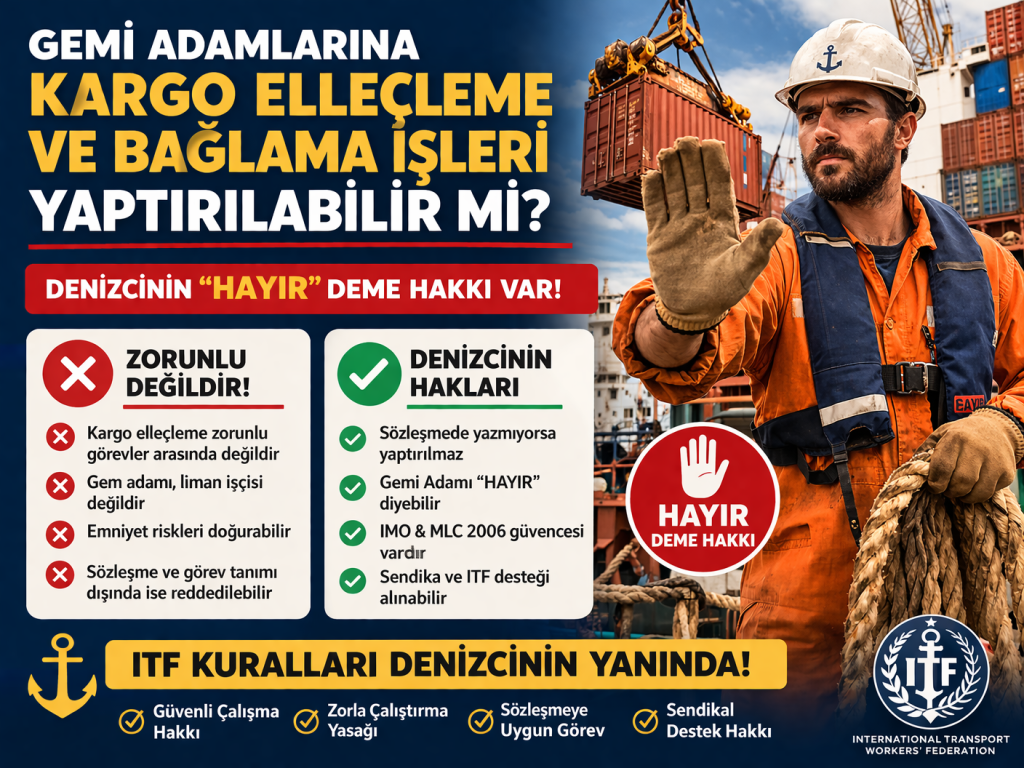
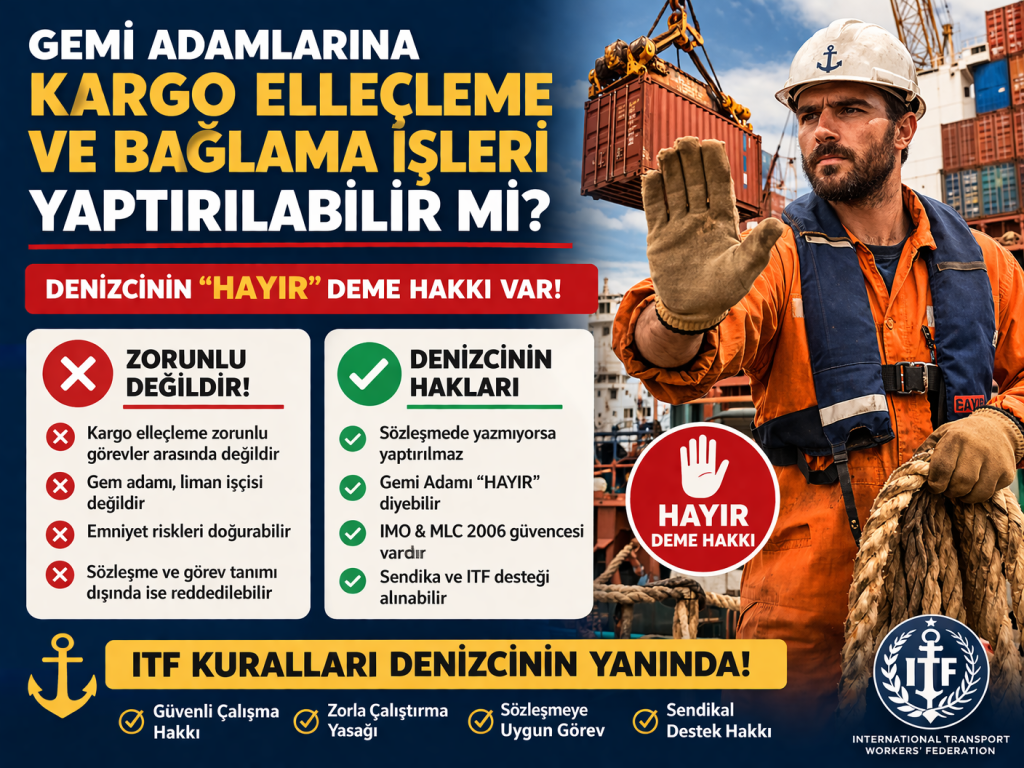
In maritime practice, seafarers may occasionally be asked to perform cargo handling, container lashing, and unlashing tasks that fall outside their primary duties. However, these tasks are not ordinary auxiliary duties; they are high-risk activities directly related to occupational safety, professional expertise, and international labor standards. Therefore, asking seafarers to perform such tasks cannot be seen merely as a practical division of labor. The issue must be seriously evaluated in terms of seafarer safety, fatigue, duty limitations, and international protection mechanisms. The ITF’s approach on this point is also clear: seafarers should not be asked to perform cargo handling.
Why are cargo handling and lashing not a seafarer’s duty?
Cargo handling is a technical and hazardous field of work encompassing the placement, securing, unlashing, and other physical operations related to port operations. The lashing process, especially the securing of containers on the ship’s deck using heavy lashing bars and turnbuckles, involves serious physical risks. These tasks should only be carried out by trained port workers who know the job and work with appropriate equipment. Because it requires not only physical strength, but also knowledge of load balance, equipment safety, working area, signaling, team coordination, and intervention in sudden risks. If a seafarer is untrained or inadequately equipped in this area, it directly makes the job dangerous.
Why does the lashing process require special expertise?
Lashing ensures the safe securing of containers or other cargo units on board a ship. If this operation is not performed correctly, not only the worker but the entire ship is put at risk. Poorly lashed cargo can lead to stability problems, shifting, capsizing, deck accidents, and more severe maritime casualties. Therefore, lashing is a specialized task performed by port workers following specific procedures and using appropriate equipment. As emphasized by the ITF, port workers do not perform this task alone but in pairs. The reason for this is not only the heavy and dangerous nature of the work but also the need for mutual control and support in emergencies.Furthermore, the operation should only be performed when the ship is safely moored in port; lashing or unlashing while the ship is underway or at sea is unacceptable.
Under what circumstances is a seafarer expected to explicitly say “no”?
If a seafarer is asked to perform cargo stowage, securing, container lashing, or unlashing, they have the right to object. Similarly, if unlashing containers is requested before entering port, or if the seafarer is asked to be directly involved in this work instead of port workers, the seafarer must refuse. The “no” here is not merely a personal preference but a legal and professional stance against unsafe work. This is because the requested task is outside the seafarer’s normal duties and is also risky from a safety perspective. Therefore, compliance with such orders cannot be presented as an obligation.
Why is this work dangerous?
Cargo lashing and unlashing operations are carried out with heavy metal equipment, in confined working spaces, and often under time pressure. Considering the position of containers, cargo height, weather conditions, slippery surfaces, and the weight of the equipment, these operations carry a serious risk of injury and death. Lashing equipment loosened at the wrong time or improperly secured can create a sudden release; the worker can be trapped, fall, or be struck by moving parts. Furthermore, the fact that the work must be performed as a team means performing it alone or unprepared multiplies the risk. The seafarer not having received special training for this work makes them even more vulnerable. Therefore, the issue is not merely “helping out,” but a direct risk to life and bodily integrity.
Why does seafarers performing this work increase fatigue?
Seafarers already often work under long hours, intense shifts, short port stays, and tight sailing schedules. On many vessels, the existing crew size is even limited in terms of ensuring the vessel’s maintenance and safe operation. Adding heavy tasks such as cargo handling and lashing to this reduces rest periods and increases fatigue. However, port time, from a seafarer’s perspective, is often a limited period during which either mandatory operational duties are carried out or rest is possible. Filling this time with additional heavy physical operations increases the risk of accidents both in port and at sea. Fatigue is one of the most significant safety issues in seafaring, and for this reason, making seafarers perform heavy cargo work outside their primary duties is unacceptable.
Why is a seafarer’s right to rest in port important?
While the ship is in port, the continuous assignment of new tasks to seafarers can effectively eliminate their right to rest. However, a seafarer’s physical and mental recovery is a fundamental requirement for safe navigation and ship operations. Filling every moment in port with work causes the seafarer to become more tired, more careless, and more prone to risks in the subsequent shift. For this reason, the ITF’s approach is that seafarers should not be occupied with cargo lashing and unlashing operations in port, but should rest or take shore leave when necessary. What is intended to be protected here is not just comfort, but directly safety.
Why does seafarers performing these tasks create problems for port workers?
Cargo handling and lashing operations are the specialty of port workers. Seafarers performing these tasks does not only mean an incorrect division of labor; it also results in the narrowing of port workers’ job scope. This situation can mean taking away jobs from qualified port workers. Furthermore, seafarers and port workers performing the same task simultaneously or in an intertwined manner can lead to communication breakdowns and role confusion. Ambiguity in signaling, coordination, and lines of responsibility on site can trigger accidents that could have fatal consequences. Therefore, this issue cannot be evaluated with a “whoever does it” mentality.
Why might ship owners ask seafarers to perform these tasks?
Such requests often stem from a cost-reduction objective. Using dockworkers requires specialized equipment, planning, and fees. In contrast, some shipowners may want to have these tasks performed by the crew already on board to reduce this expense. As the ITF states, some employers prioritize profit over safety and try to erode the protective standards workers have fought for and achieved over the years. In such an approach, the seafarer’s safety, right to rest, and professional boundaries are pushed into the background; the logic of doing more work with less personnel comes to the forefront. Therefore, the issue is not an isolated instruction but is connected to a broader workforce and cost policy.
Does a seafarer have the right to refuse unsafe work?
Yes. A seafarer has the right to refuse unsafe work that puts them in danger. Cargo lashing and unlashing operations are also considered within this scope. If a seafarer is asked to perform a dangerous task for which they lack professional training and safe equipment, refusing it is in line with the law and occupational safety principles. What is being refused here is not work discipline, but an unsafe, out-of-scope, and risky activity. Therefore, it cannot be said that an employer can impose such work indefinitely within a command-and-control relationship.
What do ITF agreements provide in this regard?
Thousands of ships are covered by ITF agreements, and a significant portion of these agreements includes the “Non-Seafarers’ Work Clause”. Such provisions stipulate that cargo handling work should be performed by ITF-affiliated dockworkers whenever possible. This arrangement not only protects the seafarer’s scope of duties but also safeguards the specialized domain of dockworkers. Therefore, if a ship is covered by an ITF agreement, a seafarer’s refusal to perform cargo handling work gains a much clearer contractual basis. In other words, it’s not just a matter of the general safety principle, but also involves a breach of contract.
How to check if the ship is covered by ITF?
Whether a ship is covered by an ITF agreement can be checked through the “Look Up / Search” section of the ITF Seafarers platform. The ITF Seafarers app can also be used for this purpose. This check is important for the seafarer to understand what protections they can benefit from and on what contractual grounds they can act against the employer. If the ship is covered by ITF, a stronger basis emerges for the seafarer to resist being forced into non-duty cargo work.
What should be done if the employer still insists?
If the shipowner or ship management insists that the seafarer perform cargo handling or lashing work, even if the seafarer explicitly says no, the situation must be immediately reported to the ITF. At this stage, it is particularly important to request support without delay. The incident can be reported by contacting the ITF Seafarers Support team. When making a report, details such as the ship’s name, flag, IMO number, the nature of the requested work, when and by whom the instruction was given, should be provided as concretely as possible. This way, the ITF can assess the nature of the incident and provide the necessary support.
Contact address provided:
seafsupport@itf.org.uk
Conclusion
Asking seafarers to perform cargo handling, container lashing, or unlashing is not a simple matter of job sharing. This situation means that high-risk work is being assigned to non-specialized personnel. As a result, the seafarer’s safety is jeopardized, their fatigue increases, their right to rest is violated, and the scope of port workers’ duties is eroded. Therefore, the ITF’s approach is clear and unambiguous: seafarers should not be asked to perform these tasks. If such a request is made, the seafarer has the right to refuse it. If pressure continues after a refusal, the situation must be reported to the ITF without delay.
Frequently Asked Questions
1. Is it unlawful to make a seafarer perform cargo handling?
Yes, as a general rule, this practice is contrary to law and international maritime standards. Cargo handling and especially lashing operations are high-risk activities that require special training. These tasks must be performed only by port workers. If a seafarer does not have the training and equipment for this job, forcing them to do it constitutes a violation of occupational safety rules. Furthermore, on vessels covered by ITF agreements, this situation clearly constitutes a breach of contract.
2. Why is lashing dangerous for seafarers?
During lashing operations, there are serious risks such as heavy equipment, working at heights, confined spaces, and sudden cargo movements. Improper lashing can lead to containers shifting, overturning, or sudden discharges causing injuries to workers. These tasks must be performed as a team and within specific technical rules. A seafarer’s lack of training in this regard exponentially increases the risks.
3. Can lashing be performed while the ship is underway or at sea?
No, this is absolutely unacceptable. Lashing and unlashing operations must only be performed when the vessel is safely berthed in port. Such operations performed while the ship is underway create very serious hazards such as loss of balance, falls, and equipment accidents. Therefore, requesting such work at sea is clearly an unsafe situation.
4. Will a seafarer receive disciplinary action if they refuse such work?
As a rule, no. A seafarer has the right to refuse work that endangers them. Such a refusal is not insubordination; it is the exercise of the right to occupational safety. However, as employer pressure may be involved in practice, this process should be managed carefully and with support, if possible.
5. How is this situation assessed on ships covered by ITF?
Ships covered by an ITF agreement usually include a “Non-Seafarer’s Work Clause”. According to this clause, cargo handling operations should be performed by port workers. Therefore, forcing a seafarer to do this work on an ITF-covered ship directly constitutes a breach of contract and requires ITF intervention.
6. What should I do if I am forced to handle cargo?
First, you should clearly state that this work is not part of your duties and carries a safety risk. If the pressure continues, you should document the situation (correspondence, instructions, witnesses, etc.) and contact the ITF. Early notification ensures that the problem is resolved before it escalates.
7. Why are such tasks risky in terms of fatigue?
Seafarers already work long hours and under an intense shift system. Heavy physical tasks like cargo handling further increase this burden. Fatigue leads to distraction and loss of reflexes. This can lead to serious accidents both in port and during navigation. Therefore, preserving rest periods is vitally important.
8. How does seafarers performing these tasks affect port workers?
This situation narrows the work area of port workers and disrupts professional balance. Moreover, two different groups doing the same job leads to communication problems and a lack of coordination. This also increases the risk of work accidents. Port workers and seafarers are actually part of the same chain, and interference in each other’s work area leads to negative consequences for both sides.
9. Why does the employer want seafarers to do these jobs?
The most fundamental reason is cost reduction. Having ship personnel do these jobs instead of employing port workers is a cheaper method for the employer. However, this approach sidelines safety and work standards. Therefore, such demands often arise from economic motivation.
10. Is an application to the ITF really effective?
Yes, in most cases, it is quite effective. ITF inspectors create significant international pressure on ship owners. This pressure can lead to quick results, especially when the ship is in port. However, in some cases, the ITF process may need to be supported by legal proceedings.
Why Is Expert Lawyer Support Necessary?
Having seafarers handle cargo is not just a matter of tasks outside their duties; it is also a serious legal situation involving a violation of occupational safety, breach of contract, and the risk of a potential work accident. In such events, managing the process correctly is of great importance.
Specifically:
Evaluating instructions given under employer pressure
Determining liability in a potential work accident
Proper collection of evidence
Managing the ITF process and legal process together, however, requires expertise.
At this point, acting with the support of an Istanbul seafarer lawyer and a Tuzla seafarer lawyer prevents loss of rights and ensures the process is conducted more effectively.
2M Hukuk Avukatlık Bürosu, specialized in maritime law, in such situations:
Provides protection against unlawful instructions
Performs liability analysis in potential work accidents
Manages the ITF process and litigation process together. Receiving professional support is critically important to avoid risking your rights and to manage the process correctly.