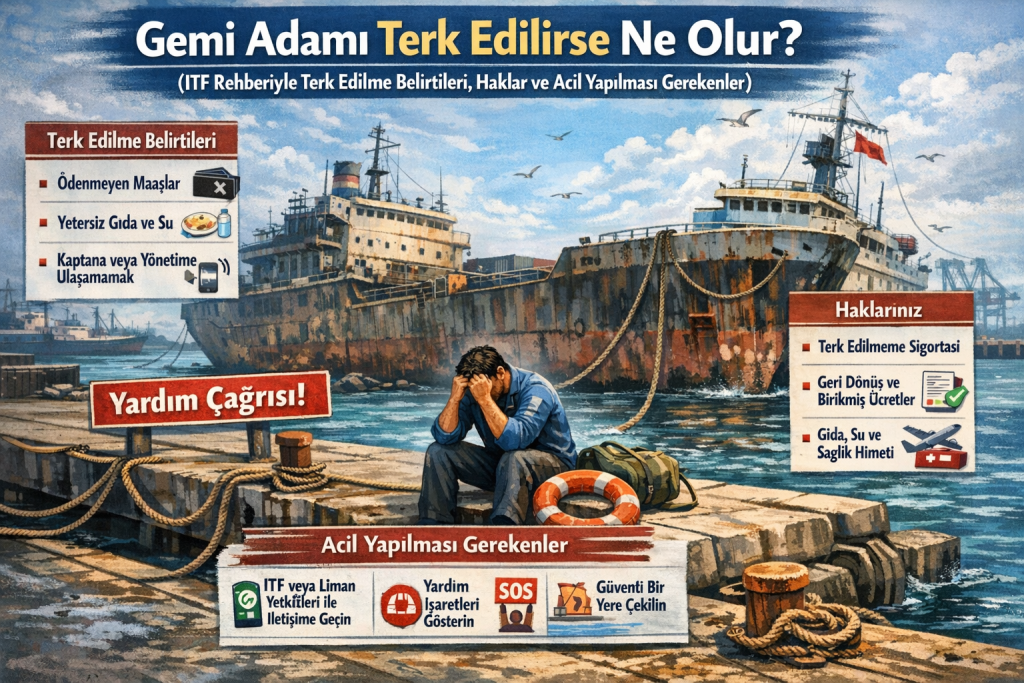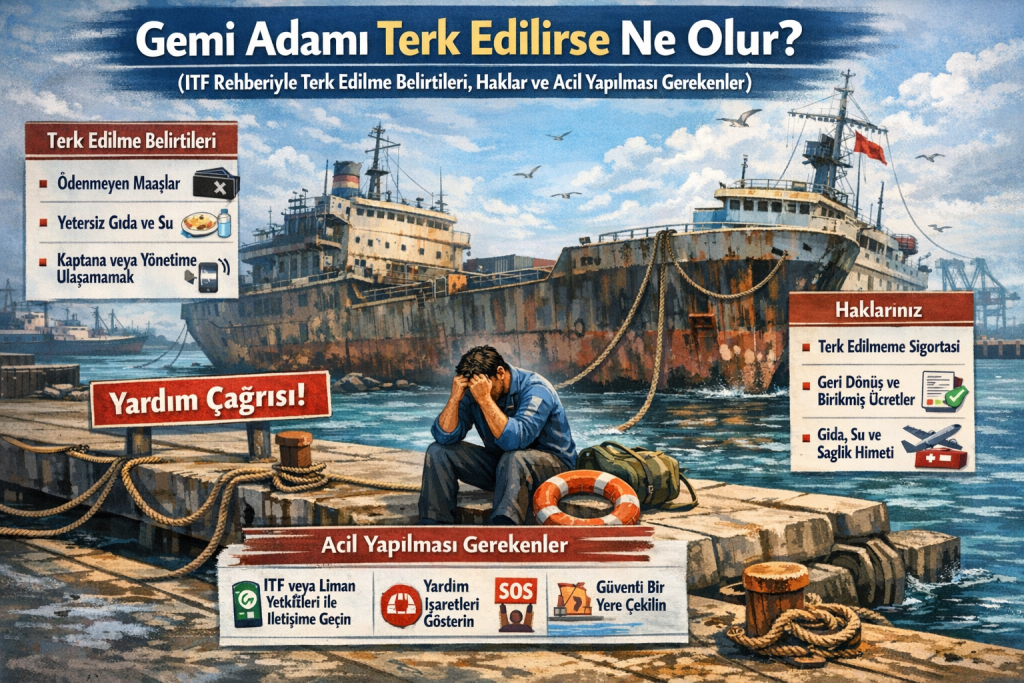
One of the most serious problems in the maritime industry in recent years is the rapid increase in cases of abandonment of seafarers on the ships they work on. This situation can lead to seafarers being stranded in ports, thousands of kilometers away from home, for months without fuel, food, drinking water, and wages. Data from the ITF (International Transport Workers’ Federation) and field practices show that abandonment cases have become not just an individual, but a systematic problem. Therefore, it is vitally important for every seafarer to be very well aware of the risk of abandonment, its signs, and their rights.
How to Identify Seafarer Abandonment?
Abandonment is often not a sudden event, but a process that manifests with specific signs. According to the ITF, abandonment usually stems from two main reasons. The first is the shipowner experiencing serious financial difficulties; the second is some malicious shipowners trying to reduce costs by not paying wages and debts. This risk is much higher especially on older ships approaching the end of their economic life. In some cases, the total value of the ship may be lower than the debts owed to the crew and other creditors.
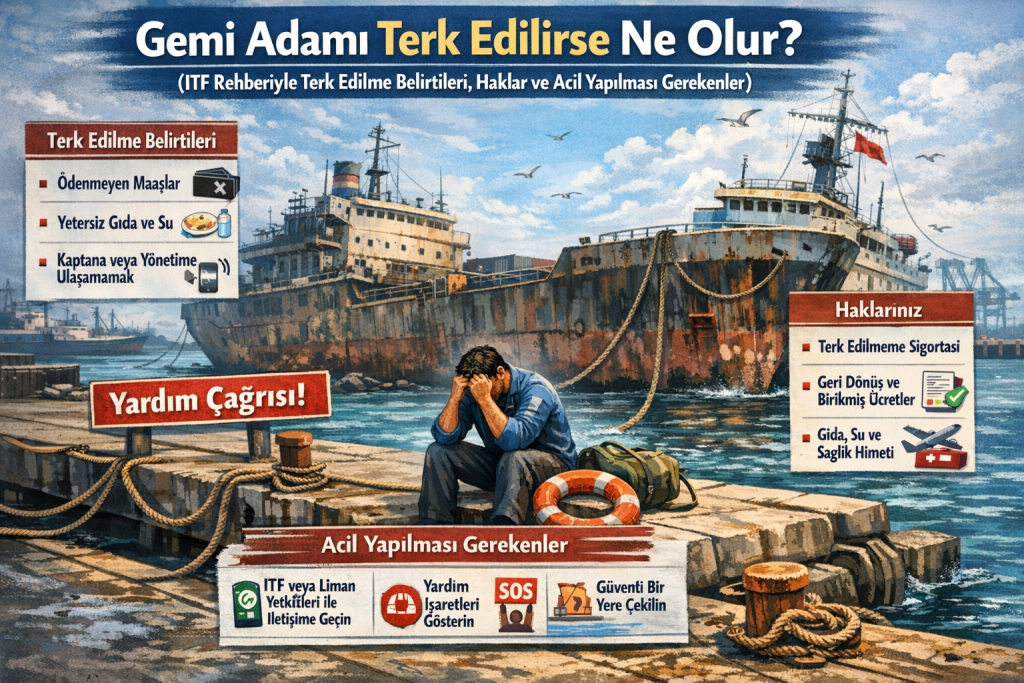
There are specific criteria for a shipowner to be considered as having abandoned a seafarer. If the shipowner fails to cover the seafarer’s repatriation costs to their home country, deprives the crew of necessary care, food, water, and support, or most importantly, fails to pay the contractually stipulated wages for at least two months, this situation is legally considered “abandonment“. At this point, non-payment of wages is not merely a wage issue, but also constitutes a more serious legal violation.
How to Reduce the Risk of Abandonment?
The ITF specifically advises seafarers to conduct comprehensive research before joining a vessel to mitigate this risk. Firstly, as much information as possible should be gathered about the ship and company to be worked for. In particular, it should be investigated whether the ship has had problems in the past, if there have been delays in wage payments, and if the crew has made complaints previously.
The official systems of the ITF can be used for these investigations. To obtain information about a ship and check if it is covered by the ITF, the following address should be used:
👉 https://www.itfseafarers.org
Additionally, records related to a ship’s abandonment history can be checked from the International Labour Organization’s database. At this point, as the ship’s name may have changed, searching by its IMO number, if possible, yields more reliable results. Furthermore, systems displaying ships’ real-time location and route information can also be examined to gain insight into their operational status.
If employment is sought through a crew agency, the reliability of this agency should also be investigated. It is of great importance whether the agency is properly managed, if it checks the financial status of the companies it works with, and its reputation in the industry. The ITF especially recommends using the ITFShipBeSure platform. This platform lists agencies that have been red-listed:
👍 https://www.itfshipbesure.org/
If an agency is on this list, it is an indicator of serious risk, and it is advised not to seek employment through that agency.
New Protection Against Abandonment: The MLC Insurance System
With the regulations that came into force as of January 18, 2017, an important assurance mechanism has been introduced for the protection of seafarers. Under the Maritime Labour Convention (MLC) of 2006, it has become mandatory for ships flying the flag of countries party to the convention to have an insurance system that will be activated in cases of abandonment.
This insurance must be clearly displayed in English on board the ship and must include the name and contact details of the insurance provider. It is extremely important for the seafarer to check whether this information is current and accurate, as these details will be needed to initiate the process in case of abandonment.
The aforementioned insurance system covers the seafarer’s unpaid wages for up to four months and other entitlements. In addition to wages, essential needs such as repatriation costs, food, drinking water, accommodation, necessary fuel, clothing, and medical care are also covered by this assurance. This protection continues from the moment the ship is abandoned until the seafarer’s return home.
However, there is a critical point here: If the application process is delayed, rights may be lost. The ITF specifically issues the following warning: If you delay your application by six months, you may only receive four months’ salary. Therefore, acting in a timely manner is vital.
What to Do if You Are Abandoned?
If you believe the shipowner is not fulfilling their obligations and there is a risk of abandonment, waiting is the biggest mistake. If the shipowner is not communicating or resolving the issue, the insurance company or financial guarantor should be contacted directly. This contact can be made not only by the seafarer but also by their family, an ITF inspector, or a maritime union.
At this point, the ITF makes a very clear call: “Speak up.” Remaining inactive due to fear of the employer will cause the problem to escalate further. Contact with the ITF can be made in complete confidentiality.
The following system can be used to reach ITF inspectors:
👉 https://www.itfseafarers.org/en/look-up
You can also be contacted directly by email:
📧 abandonment@itf.org.uk
Another important point that the ITF particularly emphasizes is this: If you do not contact the ITF, they cannot help you.
International P&I Clubs (Emergency Helplines)
In case of abandonment, not only the ITF but also the vessel’s insurance club (P&I Club) plays an important role. Below are the contact details of the main P&I clubs:
Swedish Club: Swedish.club@swedishclub.com | +46 31 151 328
UK P&I Club: mlc@ukpandi.com | +44 207 283 4646
Skuld: MLC@skuld.com | +47 952 92 200
Britannia: MLC@triley.co.uk | +44 203 280 2473
Steamship Mutual: duty.team@simsl.com | +44 783 178 4051
Gard: mlc@gard.no | +47 905 24 100
London P&I Club: MLC@londonpandi.com | +44 207 772 8000
West of England: MLC@westpandi.com | +44 779 511 6602
NorthStandard: MLCEnquiryTeam@nepia.com | +44 191 232 5221
Shipowners Club: claims@shipownersclub.com | +44 203 829 5858
American Club: mlc@american-club.com | +1 212 847 4590
Japan P&I: claims-dpt@piclub.or.jp | +81 3 3662 7221
Conclusion
The abandonment of seafarers is not just a matter of wages; it is also a serious violation of human rights and occupational safety. Such situations often begin with unpaid wages and escalate into a larger crisis. Therefore, early awareness, accurate information, and rapid intervention are of great importance.
ITF, MLC, and insurance mechanisms offer powerful tools to protect seafarers. However, for these systems to function effectively, seafarers need to be aware, conduct research, and act quickly when necessary.
Frequently Asked Questions
1. What does the abandonment of a seafarer legally mean and under what conditions does it occur?
The abandonment of a seafarer does not only mean the termination of the employment relationship; it means the employer actually severs their ties with the seafarer. Under the Maritime Labour Convention (MLC), this situation is determined by three key criteria: the seafarer not being repatriated to their home country (repatriation not being carried out), the failure to provide necessary living conditions (food, water, care) on board the vessel, and most importantly, the non-payment of wages for at least two months. The fulfillment of one or more of these conditions leads to the seafarer being considered abandoned, and in such a case, international protection mechanisms are activated.
2. When am I considered abandoned if my wages are not paid?
Non-payment of wages does not always directly mean abandonment; however, non-payment of wages for at least two months is considered one of the abandonment criteria under the MLC. Therefore, even if your wages are delayed for a few weeks, you should take the situation seriously. If early intervention is not made, the process can turn into a more serious legal problem. At this point, the ITF particularly recommends applying without delay.
3. What rights do I have in case of abandonment?
An abandoned seafarer has the right to claim not only their wages but also repatriation costs, food, water, accommodation, medical care, and basic living expenses. Furthermore, the insurance system mandated under the MLC comes into play, securing up to four months of wages and entitlements. These rights continue from the moment the vessel is abandoned until the seafarer’s return to their home country.
4. Does the ITF make direct payments to me in case of abandonment?
No, the ITF is not a direct paying institution. The ITF’s role is to ensure payments are made by pressuring the shipowner and relevant parties. Payment is usually made by the shipowner or the insurance system. However, when the ITF process is managed correctly, it is a highly effective tool for collecting receivables.
5. How can I assess the risk of abandonment before joining a vessel?
The most effective way to reduce this risk is to do research. It is crucial to check if the vessel is covered by the ITF, to find out if previous crew members received their payments, and to examine the employer’s history. Additionally, the reliability of the agent should be checked via the ITFShipBeSure platform:
https://www.itfshipbesure.org/
6. What should I do if my salary is delayed after I join the vessel?
First, you should speak with the captain to find out the reason for the delay. If your salary is delayed for more than two weeks, this is an indication of serious risk. In this situation, you should check the status of other crew members and contact the ITF if necessary. Managing the process at an early stage prevents loss of rights.
7. Who should I contact first if I believe I have been abandoned?
The fastest and most effective way is to contact the ITF. You can reach ITF inspectors via the following system:
https://www.itfseafarers.org/en/look-up
You can also apply directly by email:
📧 abandonment@itf.org.uk
Additionally, the vessel’s insurance provider (P&I Club) should be contacted.
8. Can an ITF application be made confidentially?
Yes, applications made with the ITF can usually be handled confidentially. If the seafarer is hesitant about their employer, their identity can be protected during the process. This provides an important safeguard, especially for crew under pressure.
9. Does the insurance system cover all my claims?
The insurance system, which is mandatory under MLC, generally covers a maximum of four months’ wages and certain expenses. For claims extending beyond this period, legal processes may need to be initiated. Therefore, insurance provides a safeguard but may not always cover all damages.
10. Is it necessary to file a lawsuit in case of abandonment?
It is not mandatory to file a lawsuit in every instance; however, initiating legal proceedings provides a significant advantage, especially for high-value claims. Running the ITF process concurrently with a lawsuit significantly increases the likelihood of collecting the claim.
Why is Expert Lawyer Support Necessary?
The abandonment of seafarers and the collection of their wage claims is a complex process that requires the combined assessment of international law, maritime law, and labor law rules. While an ITF application is an important tool, it may not always be sufficient on its own. Especially claims falling outside insurance coverage, situations requiring preliminary injunctions, and ship lien cases necessitate professional legal support.
At this point, conducting the process with the right strategy, supported by an Istanbul seafarer lawyer and a Tuzla seafarer lawyer, both prevents loss of time and increases the likelihood of collecting the claim. The correct collection of evidence, placing applications on a legal basis, and carrying out simultaneous actions is a process that requires expertise.
Specializing in maritime law and seafarer claims, 2M Law Office provides maximum protection to its clients by simultaneously pursuing ITF processes and legal avenues.
Professional preparation of ITF applications
Ship claim cases and provisional attachment procedures
Collection of salary, overtime, and compensation claims
Contact us now to collect your claim as quickly and safely as possible without suffering any loss of rights.