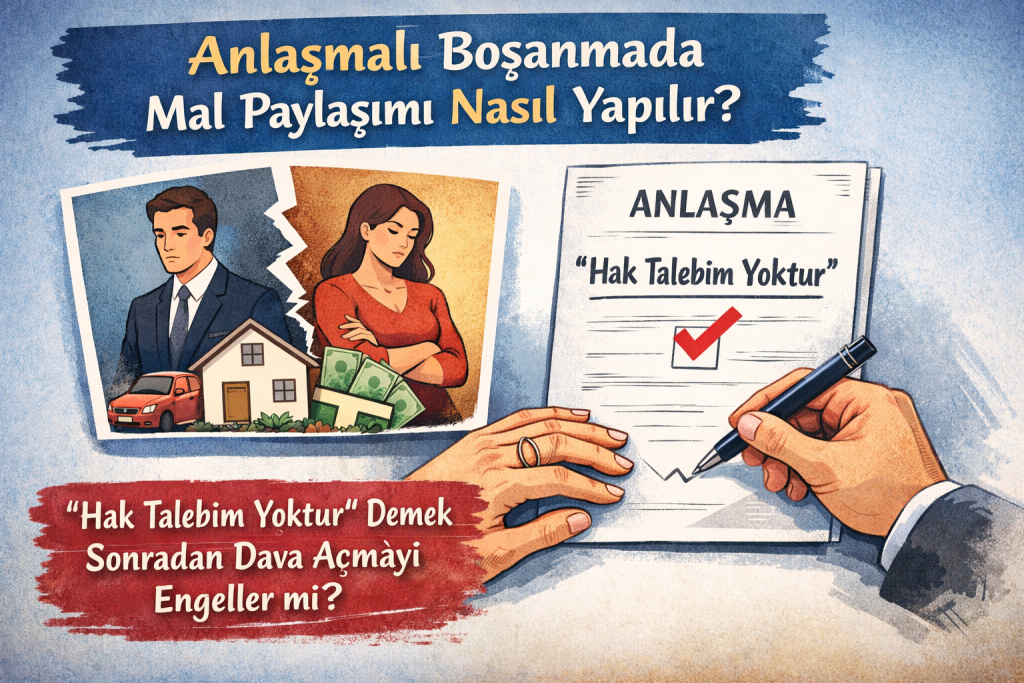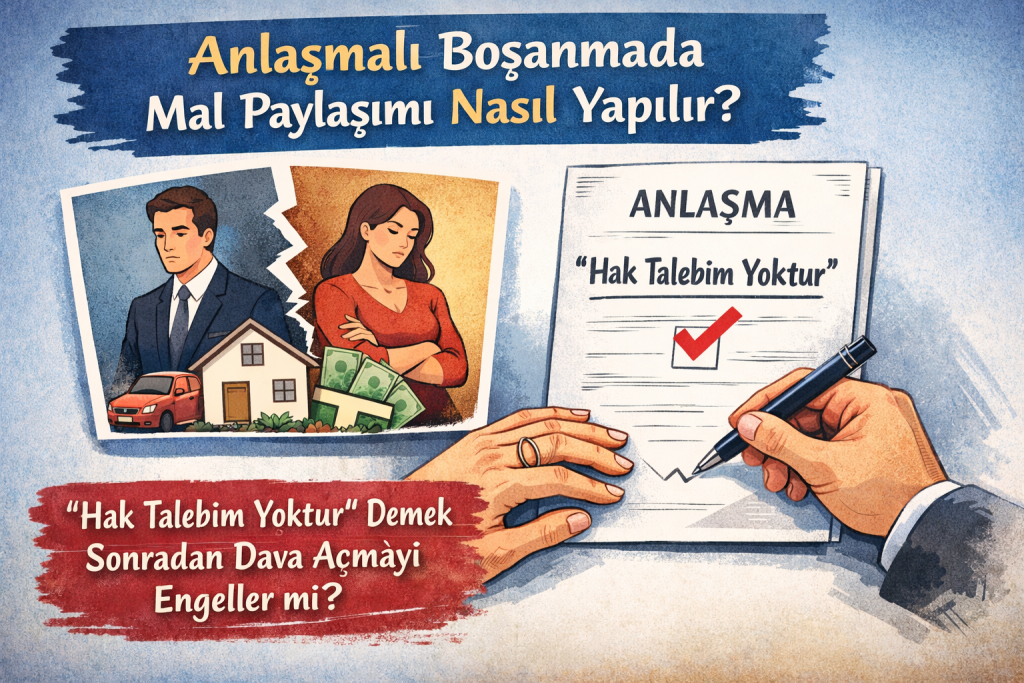
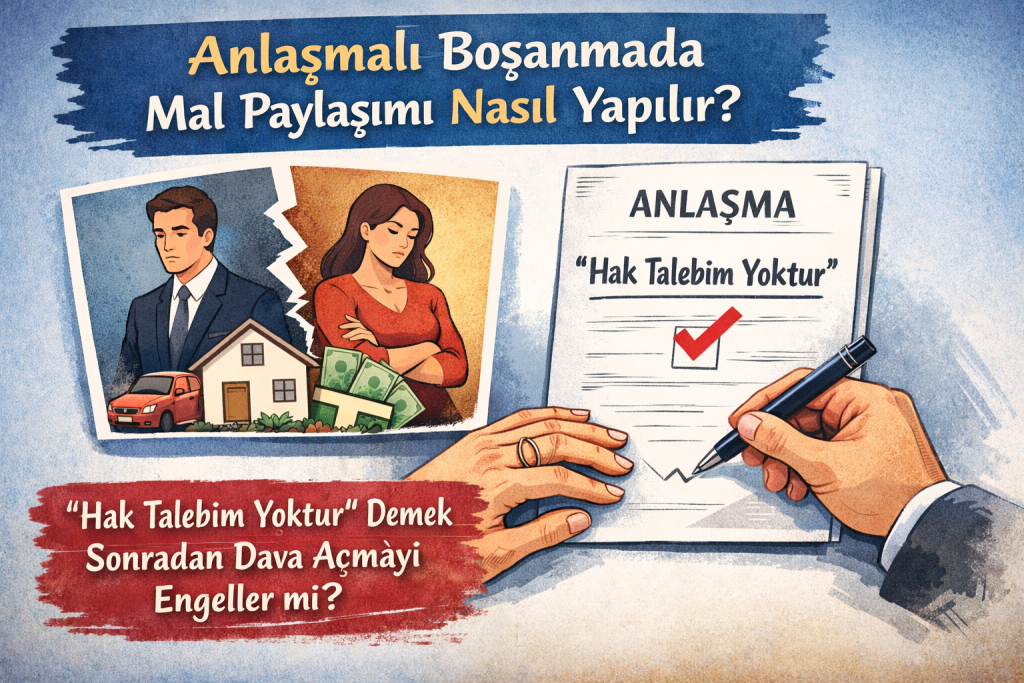
Saying “I have no claims” in an amicable divorce does not always mean renouncing property division. If the liquidation of the matrimonial property regime is not explicitly regulated in the protocol, spouses can later file a lawsuit for a share of acquired property or a contribution share.
1. Legal Nature and Procedure of Property Division in Amicable Divorce
According to Supreme Court decisions, property division (liquidation of the matrimonial property regime) in an amicable divorce is not an accessory (ancillary) matter to the divorce. Therefore, for an amicable divorce decision to be rendered in accordance with Article 166/3 of the Turkish Civil Code (TCC), it is not a mandatory element for the parties to have agreed on the matrimonial property regime. Spouses can carry out the liquidation of the matrimonial property regime along with the divorce process, or they can make these rights the subject of a separate lawsuit within the statute of limitations period (Supreme Court General Assembly-2019/335 K, 8th Civil Chamber-2016/16216 K).
However, if the parties have reached an agreement on property division, the following procedural conditions are required for this agreement to be valid:
Protocol and Approval: The provisions regarding property division must be included in the divorce protocol or recorded as a signed statement in the hearing minutes. The judge’s approval and inclusion of this agreement in the verdict clause is essential for its binding nature (Supreme Court 2nd Civil Chamber-2023/1061, 8th Civil Chamber-2014/9610 K).
Judge’s Intervention: The judge can make necessary changes to the protocol, considering the interests of the parties and children; if these changes are accepted by the parties, divorce and liquidation are ruled (Supreme Court 2nd Civil Chamber-2013/26214 ).
2. Critical Considerations for Property Division
The Supreme Court seeks certain criteria for the validity of property division agreements and to prevent subsequent lawsuits:
Principle of Clarity and Specificity: The agreement text must be “clear enough to leave no room for hesitation.” Abstract, vague, ambiguous, or obscure expressions (e.g., “I have no other financial demands”) do not cover the liquidation of the property regime. Elements subject to liquidation such as real estate, vehicles, company shares, or jewelry must be listed “individually and by name” (Supreme Court General Assembly-2019/335 K, 8th Civil Chamber-2012/3587 K, 8th Civil Chamber-2013/827 K).
Not Subject to Condition: Waivers or acceptances regarding property division cannot be conditional. For instance, making the payment for a real estate property conditional on retirement is considered invalid because it does not definitively end the dispute (Supreme Court 2nd Civil Chamber-2013/26214
Defect in Will and Fraud: The protocol must have been signed with free will. If vitiation of consent, such as deception (fraud), intimidation, or error, is proven, the protocol may be deemed invalid. However, conditions such as treatment for severe depression have not been considered sufficient for vitiation of consent on their own (Court of Cassation 2nd Civil Chamber-2023/1061 , 2nd Civil Chamber-2022/10165 )
Rule of Good Faith: If a party declares in the protocol that they have liquidated the property regime and this declaration is approved by the court, subsequently filing a lawsuit on the same matter is considered “contrary to the rule of good faith” and “abuse of right” (Court of Cassation 2nd Civil Chamber-2023/2541 , 2nd Civil Chamber-2022/10165 )
3. Validity of Waiving Financial Claims (Waiver)
Waiver of financial claims constitutes a final judgment and is binding under certain conditions:
In-Court Admission: The parties’ signed statements in court, such as “we have no claim for contribution share, participation receivable, or property division,” constitute an in-court admission and are binding on the parties (Court of Cassation 2nd Civil Chamber-2022/10165 K 2nd Civil Chamber-2023/4621 K).
Scope Limitation: General statements such as “I have no claim for material and moral compensation” as a rule, only cover the ancillary consequences of divorce; they do not cover rights arising from the property regime (participation receivable, value increase share). For a waiver of the property regime, it is a condition that expressions like “contribution share, participation receivable, or rights arising from the property regime” must be explicitly stated (Court of Cassation 8th Civil Chamber-2013/827, 2nd Civil Chamber-2023/1441.
Waiver of Unborn Rights: Although some court decisions state that, in accordance with the principle “unborn rights cannot be waived,” a future claim for participation (e.g., share in acquired property) cannot be renounced in advance before the divorce becomes final; the prevailing view applied is that such waivers are valid and terminate the right to litigation if the protocol is approved and finalized by the court (Court of Cassation 8th Civil Chamber-2013/9389 Source, 2nd Civil Chamber-2022/9474
Jewellery: The absence of a clear provision regarding jewellery in the protocol or the establishment of vague provisions such as “there is no need for a decision on jewellery” may not prevent a subsequent lawsuit for jewellery claims (Court of Cassation 2nd Civil Chamber-2024/8560 ).
4. Secondary Sources and Additional Context
The following points are included in the decision texts as limited information or special circumstances and are considered secondary sources:
Post-Divorce Agreements: Agreements such as “Post-Divorce Agreements” made before a notary after the divorce becomes final are considered binding for the liquidation of the matrimonial property regime. However, whether general waivers contained in such documents cover specific claims, such as a dowry promissory note, should be thoroughly examined by the court (Court of Cassation 2nd Civil Chamber-2021/5390 Source).
Commercial Assets and Company Shares: General waivers of matrimonial property regimes in divorce protocols may not always automatically cover the transfer of company shares or claims for commercial profit shares. It is particularly emphasized that share transfers must comply with formal requirements, such as a written contract approved by a notary (Turkish Commercial Code Article 520), otherwise these parts of the protocol may be deemed invalid (İstanbul 10. ATM-2022/47 K, İstanbul Anadolu 4. ATM-2023/219 K
Pre-Cadastral Rights: It has been accepted that broad waivers in divorce protocols do not cover title deed cancellation and registration lawsuits based on pre-cadastral reasons and inherited through succession (Yargıtay 1. HD-2021/4524
In conclusion; if property is to be shared in a consensual divorce, it is essential for the legal security of the parties that all movable and immovable assets are specified individually in the protocol, that concepts such as “liquidation of the matrimonial property regime, contribution share, and participation claim” are explicitly used for waiver, and that this protocol is taken as the basis for the court’s judgment.
Frequently Asked Questions
Anlaşmalı boşanmada “hak talebim yoktur” demek sonradan mal paylaşımı davası açmayı engeller mi?

Hayır, her zaman engellemez. Bu ifade tek başına mal paylaşımını kapsamaz. Protokolde mal rejimi açıkça düzenlenmemişse sonradan dava açılabilir. Yargıtay’a göre anlaşmalı boşanma protokolünde yer alan “başkaca maddi ve manevi talebim yoktur” şeklindeki genel ifadeler, mal rejiminin tasfiyesini (mal paylaşımını) otomatik olarak kapsamaz. Çünkü mal paylaşımı, boşanmanın fer’i (ek sonucu) değildir. Eğer protokolde mal paylaşımı açık, net ve tereddütsüz şekilde düzenlenmemişse, taraflar sonradan edinilmiş mallara katılma alacağı davası açabilir. Yani soyut ve genel ifadeler, mal paylaşımı hakkından feragat anlamına gelmez.
Anlaşmalı boşanma protokolünde mal paylaşımı yapılmadıysa sonradan dava açılabilir mi?
Evet, açılabilir. Mal rejiminin tasfiyesi boşanmanın zorunlu bir parçası değildir. Taraflar isterlerse boşanma sırasında mal paylaşımı yapabilir, isterlerse bu konuyu daha sonra ayrı bir dava ile ileri sürebilirler. Ancak önemli bir nokta vardır:
Eğer protokolde mal paylaşımı açık ve kesin şekilde düzenlenmiş veya bu haktan açıkça feragat edilmişse, sonradan dava açılması mümkün olmaz. Buna karşılık, somut olayda olduğu gibi muğlak ve genel ifadeler içeren protokoller, mal paylaşımı davasına engel teşkil etmez.
Eşin malvarlığı hakkında yanlış bilgi verilmesi (hile) mal paylaşımı davasını yeniden açma hakkı verir mi?
Evet, verir. Eğer bir eş, malvarlığına ilişkin gerçek dışı bilgi vererek diğer eşin iradesini sakatlamışsa, bu durum “hile” olarak kabul edilir.
Bu durumda: Yapılan protokol geçersiz sayılır. Feragat hükümleri uygulanmaz.
Taraf, yeniden mal rejimi tasfiyesi (katılma alacağı) davası açabilir
Yargıtay, somut olayda davalının şirket hisselerini daha önce devretmesine rağmen aksi yönde beyanda bulunmasını hile olarak kabul etmiş ve davacının dava açma hakkını korumuştur.
“Mal talebim yoktur” yazan protokol varken sonradan mal paylaşımı davası açılabilir mi?
Evet, açılabilir. Somut olayda taraflar anlaşmalı boşanmış ve protokolde yalnızca “mal talebim yoktur” şeklinde genel bir ifade yer almıştır. Ancak bu ifade, evlilik içinde edinilen taşınmazın paylaşımını açık ve ayrıntılı şekilde düzenlemediği için Yargıtay, bu tür genel ibarelerin mal rejimi tasfiyesini kapsamayacağını kabul etmiştir.
Bu nedenle davacının, taşınmazın edinilmesine katkı sağladığını ileri sürerek sonradan katkı payı alacağı davası açabileceğine hükmedilmiştir.
Boşanırken “mal talebim yoktur” dedim ama eşimin adına alınan ev için sonradan dava açabilir miyim?
Evet, açabilirsiniz. Somut olayda eşler boşanırken protokole sadece “mal talebim yoktur” yazmış, ancak evlilik içinde alınan konutun kime ait olacağı veya nasıl paylaşılacağı açıkça düzenlenmemiştir. Daha sonra kadın eş, bu evin alınmasına kendi kazancı ve ailesinden gelen para ile katkı sağladığını ileri sürerek dava açmıştır.
Yargıtay, protokolde sadece genel bir ifade bulunmasının yeterli olmadığını, mal paylaşımına ilişkin açık ve ayrıntılı düzenleme yapılmadıkça bu haktan vazgeçilmiş sayılmayacağını belirterek davanın incelenmesi gerektiğine karar vermiştir.
Anlaşmalı boşanma protokolünde feragat (haklardan vazgeçme) şarta bağlı olabilir mi?
Hayır, olamaz. Somut olayda taraflar, boşanma sonrası mal rejimine ilişkin bir protokol imzalamış; bu protokolde davalı eş, sahip olduğu şirket hisselerinin ileride satılması halinde belirli bir ödeme yapacağını taahhüt etmiştir. Ancak daha sonra bu hisselerin protokol tarihinden önce devredilmiş olduğu ortaya çıkmış ve davacının bu durumu bilmeden protokolü imzaladığı anlaşılmıştır. Yargıtay, bu durumda feragat beyanının hem şarta bağlı olması hem de hile ile sakatlanmış olması nedeniyle geçerli kabul edilemeyeceğini belirtmiştir. Feragat beyanının geçerli olabilmesi için açık, kesin ve şartsız olması gerekir. Bu nedenle somut olayda, davacının mal rejiminden kaynaklanan haklarını talep etmesinin önünde bir engel bulunmadığı kabul edilmiştir.
Eşin malvarlığı hakkında gerçeğe aykırı beyanda bulunması (hile) boşanma sonrası yapılan protokolü geçersiz kılar mı?
Evet, kılabilir. Somut olayda davalı eş, 04.10.2018 tarihli protokolde şirket hisselerinin ileride satılması halinde davacıya ödeme yapacağını taahhüt etmiş; ancak gerçekte bu hisselerin protokol tarihinden yaklaşık 1 yıl önce devredilmiş olduğu anlaşılmıştır.
Yargıtay 2. Hukuk Dairesi 2023/1061 E., 2023/2206 K. kararında, davalının bu gerçeği bilmesine rağmen aksi yönde beyanda bulunarak davacıyı sözleşme yapmaya yönlendirdiği, yani kasten aldatma (hile) bulunduğu kabul edilmiştir. Bu nedenle Yargıtay, davacının iradesinin sakatlandığını ve bu protokolün hile nedeniyle geçersiz olduğunu belirterek, mal rejiminden kaynaklanan hakların yeniden talep edilebileceğine hükmetmiştir.
Anlaşmalı boşanmada açıkça “katkı payı talebim yoktur” diyen eşin, uzun süre sonra mal paylaşımı davası açması dürüstlük kuralına aykırı mıdır?
Evet, somut olaya göre aykırı sayılabilir. Somut olayda taraflar anlaşmalı boşanma sırasında duruşmada açıkça “katkı payı talebimiz yoktur” şeklinde beyan vermiş ve bu beyan mahkeme huzurunda imza altına alınmıştır. Boşanma kararı da bu irade doğrultusunda kesinleşmiştir.
Buna rağmen davacı eş, uzun süre sessiz kaldıktan sonra ve zamanaşımı süresinin dolmasına çok kısa bir süre kala katkı payı alacağı davası açmıştır.
Yargıtay 2. Hukuk Dairesi 2022/10165 E., 2024/2453 K. kararında, bu davranışın dürüstlük kuralına ve ahde vefa ilkesine aykırı olduğu değerlendirilmiştir. Yargıtay, tarafların boşanma sırasında mal rejimini tasfiye ettiklerinin kabul edilmesi gerektiğini ve sonradan açılan davanın bu yönüyle hakkın kötüye kullanılması niteliğinde olduğunu belirtmiştir. Sonuç olarak, boşanma sırasında açık irade beyanı ile haklardan vazgeçilmişse ve uzun süre sonra bu beyanla çelişen şekilde dava açılıyorsa, bu durum dürüstlük kuralına aykırı kabul edilebilir.
Anlaşmalı boşanma duruşmasında “mal ve katkı payı talebim yoktur” demek mahkeme içi ikrar sayılır mı ve sonradan dava açmayı engeller mi?
Evet, sayılır ve çoğu durumda dava açmayı engeller. Somut olayda taraflar, boşanma duruşmasında mahkeme huzurunda “nafaka, tazminat ve katkı payı talebimiz yoktur” şeklinde açık beyanda bulunmuş ve bu beyan duruşma tutanağına geçirilerek imza altına alınmıştır. Yargıtay 2. Hukuk Dairesi 2022/10165 E., 2024/2453 K. kararında, bu beyanın mahkeme içi ikrar niteliğinde olduğu ve tarafları bağladığı kabul edilmiştir. Bu nedenle, boşanma sonrasında açılan katkı payı alacağı davası reddedilmiştir. Yargıtay’a göre, mahkeme huzurunda verilen bu tür açık ve kesin beyanlar, sonradan aksi yönde talepte bulunulmasını engelleyebilir; ancak bunun istisnası, irade sakatlığı (hile, korkutma vb.) gibi durumların ispat edilmesidir.
Anlaşmalı boşanmada “maddi ve manevi tazminat talebim yoktur” demek mal paylaşımı (katılma alacağı) hakkından da vazgeçmek anlamına gelir mi?

Hayır, gelmez. Somut olayda davacı eş, boşanma sürecinde “herhangi bir maddi ve manevi tazminat talebim yoktur, mal paylaşımıyla ilgili isteğim yoktur” şeklinde genel ifadeler kullanmıştır. Buna dayanılarak dava reddedilmiş; ancak Yargıtay bu değerlendirmeyi hatalı bulmuştur. Yargıtay 8. Hukuk Dairesi 2013/827 E., 2013/12674 K. kararında, bu tür genel ifadelerin kural olarak sadece boşanmanın fer’îlerini (tazminat, nafaka vb.) kapsadığı, mal rejiminden doğan hakları (katılma alacağı, değer artış payı gibi) kapsamayacağı açıkça belirtilmiştir. Yargıtay’a göre, mal rejiminden feragatın geçerli olabilmesi için protokolde “katılma alacağı, katkı payı, mal rejiminden kaynaklanan haklar” gibi ibarelerin açık, net ve tereddütsüz şekilde yer alması gerekir. Aksi halde, genel ve muğlak ifadeler mal paylaşımı hakkından vazgeçildiği anlamına gelmez ve eş sonradan dava açabilir.
Anlaşmalı boşanma sırasında “mal talebim yoktur” demek, henüz doğmamış mal paylaşımı (katılma alacağı) hakkından feragat anlamına gelir mi?
Hayır, gelmez. Somut olayda taraflar boşanma sürecinde “evlilikte edinilen malları paylaştık, sonradan talepte bulunmayacağız” ve “mal paylaşımına ilişkin anlaşmazlık yoktur” şeklinde beyanlarda bulunmuşlardır. Ancak bu beyanlar verildiği sırada boşanma henüz kesinleşmemiş, dolayısıyla mal rejimi tasfiyesi yapılmamış ve katılma alacağı hakkı henüz doğmamıştır. Yargıtay 8. Hukuk Dairesi 2013/9389 E., 2014/4769 K. kararında açıkça vurgulandığı üzere, katılma alacağı ancak mal rejiminin tasfiyesi ile birlikte doğan bir haktır. Bu nedenle henüz doğmamış bir haktan önceden feragat edilmesi hukuken mümkün değildir. Yargıtay, “doğmayan haktan feragat olmaz” ilkesi gereği, boşanma sırasında yapılan bu tür genel ve erken beyanların mal rejiminden doğacak hakları ortadan kaldırmayacağını kabul etmiştir.
Why is Expert Lawyer Support Necessary?
Although consensual divorce may seem like an “easy” process, it harbors significant legal risks, especially concerning property division (liquidation of the matrimonial property regime). Court of Cassation decisions also clearly show that even a single phrase used in the protocol can lead to parties suffering loss of rights or filing new lawsuits years later.
At this point, obtaining support from a specialized divorce lawyer in Tuzla or an Istanbul divorce lawyer is critically important for the following reasons: 1. Prevention of Loss of Rights
General statements such as “I have no property claim” often do not cover property division. However, a wrongly or incompletely drafted protocol can lead to consequences that are difficult to remedy in the future. An expert lawyer drafts the protocol in a clear, precise, and compliant with Supreme Court precedents manner. 2. Ensuring the Validity of the Protocol
For provisions regarding property division to be binding;
It must be clear and unequivocal.
It must be approved by the judge.
Technical conditions such as being incorporated into the judgment paragraph are required. These details are unknown to most people. 3. Management of Subsequent Litigation Risk
Incomplete or ambiguous protocols can lead to lawsuits after divorce for claim for share in acquired property, contribution share, or claim for jewellery. An expert lawyer eliminates these risks from the outset. 4. Protection Against Defects of Will and Fraud Risk If one of the parties conceals assets, provides false information, or exerts pressure, the protocol may become invalid. Detecting and preventing such situations requires professional legal knowledge. 5. Compliance with the Rule of Honesty and Strategy
The Supreme Court sometimes rejects subsequent lawsuits on the grounds of “violation of the rule of honesty.” Proper management of the process is important to avoid encountering such risks in the future.
Therefore, in the consensual divorce process, especially on a technical and critical issue such as asset division, getting support from an experienced law firm in the field is the healthiest way. In this context, working with expert teams like 2M Hukuk Avukatlık Office ensures that the process is completed safely and without any loss of rights.