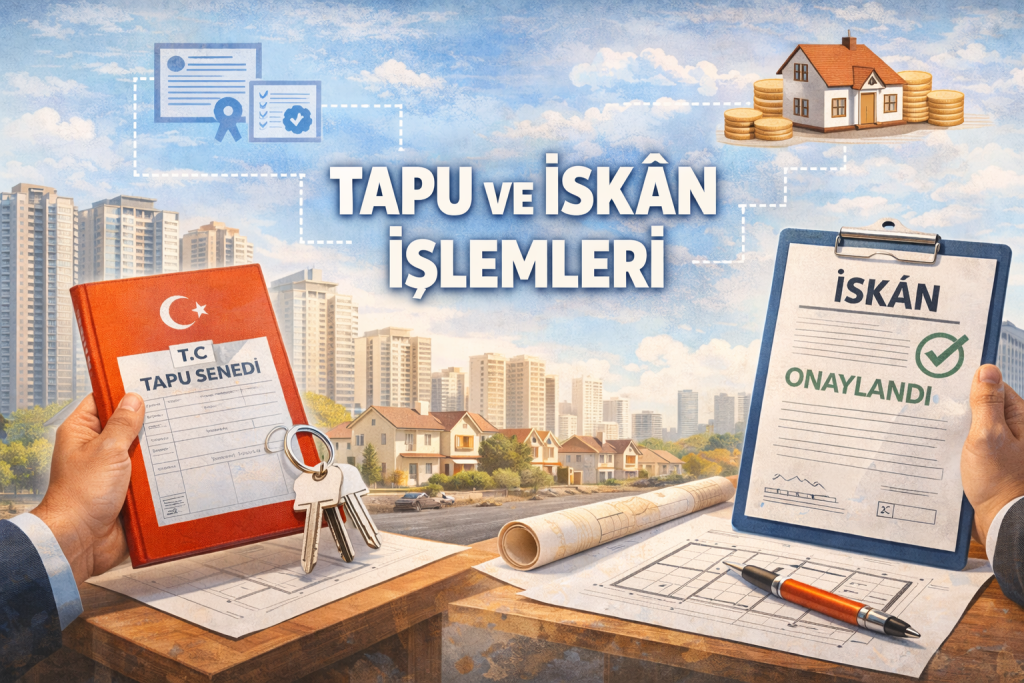
Title Deed and Occupancy Permit Procedures
Law on the Transformation of Areas Under Disaster Risk and the Implementation Regulation of Law No. 6306
Completion of construction in the urban transformation process does not mean that the legal process has also been completed. For the implementation to yield actual and legal results, obtaining the occupancy permit (iskân), followed by completion of floor easement or condominium ownership procedures, registration of new independent sections in the land registry in the name of the right holders, and initiation of the actual occupancy process in the new building are required. Law No. 6306 regulates in detail how the old title deed system will be abolished after demolition, how rights will be transferred in the new structure, and in whose name the new independent sections will be registered; the Implementation Regulation, on the other hand, concretizes the processes of entitlement, registration, floor easement, condominium ownership, and post-occupancy delivery.
1. Completion of Construction and Obtaining a Building Occupancy Permit (İskân)
For the building constructed within the scope of urban transformation to become legally usable, an occupancy permit, known in practice as iskân, must be obtained. The iskân certificate is an official document proving that the new building has been completed in accordance with the approved project, license, and relevant technical regulations. Without this document, the actual use of the new building, the delivery of independent sections with full legal assurance, and in many cases, the safe execution of subscription and title deed transactions can lead to serious problems. Especially in implementations carried out by the Presidency, the law has adopted a special accelerated regime, stipulating that if suitable conditions exist, building permits be issued within thirty days from the application and, following completion, occupancy permits also be issued within thirty days. This clearly demonstrates how central the occupancy permit (iskân) is in the urban transformation process. Law No. 6306, Additional Article 2.
What is essential at the iskân (occupancy permit) stage is not merely the physical completion of the construction; but also its completion in accordance with the license, the positive outcome of the building inspection process, and the submission of necessary technical documents to the relevant administration. The regulation also considers the completion of the project or construction work in accordance with the contract and specifications, and the obtaining of the occupancy permit, as a basis for the return of guarantees. In other words, the iskân is not just a document to start occupancy; it is also an administrative confirmation that the contractor has completed the work properly. Implementation Regulation Article 13/9-e.
2. Liquidation of the Old Title Deed System and Continuation of Rights on the Land Plot
In urban transformation, after the old building is demolished, it is not possible for the old floor ownership or floor easement arrangement to continue in the land registry. For this reason, Law No. 6306 stipulates that floor easements or floor ownership previously established on properties that have become land after the building on them has been demolished shall be ex officio cancelled without seeking the consent of the interested parties. Subsequently, the property is re-registered with its previous status or by showing the terms of the agreement in the land registry, in proportion to the shares of the owners. This transition is very important; because in practice, the transition from the old independent section arrangement before transformation to the new independent section arrangement is not automatic in the land registry, but is carried out through a special regime based on law. Law No. 6306, Article 6/1.
Furthermore, mortgages, seizures, precautionary attachments, usufruct rights, annotations, and other real or personal rights recorded in the land registry of the old building, as a rule, do not completely disappear; the law accepts that these rights will continue on the land shares. In the subsequent stage, when new floor easements and floor ownership are established, these rights are continued only on the independent sections allocated to the relevant obligated owner. This is very important in practice, especially regarding bank mortgages, seizures, and usufruct rights. In other words, transformation does not magically erase existing encumbrances; rights are transferred to suitable independent sections in the new building. Law No. 6306, Article 6/1; Implementation Regulation, Article 15/9.
3. Establishment of Floor Easement and Floor Ownership
With the completion of the new building, it is necessary to establish floor easement or direct condominium ownership in the title deed. Floor easement can be important at the stage when the building is not yet completed or when the legal infrastructure of independent sections is intended to be established before delivery; whereas condominium ownership is the final stage when the building is completed and the independent sections are legally fully formed. In urban transformation, these processes, unlike classic apartment applications, often proceed intertwined with special contracts and administrative procedures. The law has specifically stipulated that, during the establishment of floor easement and condominium ownership for new buildings, existing rights and annotations in the title deed shall continue only over the independent sections allocated to the respective owner. Law No. 6306, Article 6/1.
The Regulation, in a manner that completes this process, also stipulates that the establishment of floor easement or condominium ownership for the building to be constructed based on a construction contract in return for flats or an assignment contract in return for flats, concluded between the land owner and the contractor, can be carried out or arranged by the Presidency, TOKİ, or the administration upon request. In the contract forming the basis for this request, the independent sections to be allocated to the rights holders must be specified. For registration in the title deed, the architectural project and management plan prepared electronically and approved by the relevant administration are taken as a basis; it has also been accepted that the owner’s signature may not be required on these documents. Implementation Regulation, Article 15/12. This provision is an extremely important convenience that prevents the process from stalling, especially in urban transformation files with multiple owners.
4. Registration of New Independent Sections in the Title Deed in the Name of Right Holders
One of the most critical stages of urban transformation is in whose name, with what proportion of rights, and with what legal status the newly constructed independent sections will be registered in the title deed. At this point, Law No. 6306 regulates that the new immovable properties resulting from the implementation on immovable properties transferred to the Presidency or transferred to TOKİ or the administration at the request of the Presidency, will be registered in the name of natural persons, heirs, or legal entities with whom an agreement has been reached. Law No. 6306 Article 6/11. This provision reveals that the entitlement in the title deed of the new structure will be shaped on the basis of agreement and consensus.
The Regulation further clarifies the entitlement aspect. It is regulated that contracts can be made with property owners in the implementation area, primarily to provide them with housing and workplaces to be built in the implementation area, and if necessary, also from land or ready-made housing and workplaces purchased by the Presidency. The value of the property owner’s existing immovable property is compared with the construction cost or fair market value of the independent section to be given to them; according to this, the owner either becomes a creditor or can incur debt to the institution. The right to acquire more than one independent section is also possible under certain conditions. Implementation Regulation Article 13/1-3. Therefore, registration is not based solely on the logic of “new apartment for old apartment”; it is shaped by taking into account valuation, debt, and the project model.
5. Impact of Title Deed Annotations, Seizures, and Mortgages on the New Structure
One of the most frequently asked questions in practice is whether liens, mortgages, and annotations on the old structure will affect the title deeds of the new apartments. The legislation has established a clear system in this regard. After the demolition of the old structure, the rights and annotations in the title deed continue on the land share; however, these do not prevent consolidation, parcelling, division, abandonment, registration, establishment of floor easement, and condominium ownership transactions. In the next stage, when new independent sections are formed, these rights are maintained only on the independent section belonging to the relevant debtor or obligor owner. Law No. 6306 Article 6/1; Implementation Regulation Article 15/9.
The most significant outcome of this system is as follows: The registration process of the entire project is not locked due to an old lien or mortgage on a single owner. Urban transformation legislation, specifically to prevent this, has accepted that title deed transactions can proceed without requiring consent and that burdens can be transferred to the relevant independent sections. This is a very important guarantee for the sustainability of transformation in practice.
6. Removal of the Risky Building Annotation and Processing the New Situation in the Title Deed
It is also important what will happen to the ‘risky structure’ annotation in the land registry after demolition and transition to the new building. According to the regulation, the risky structure annotation in the declarations section of the land registry for the property that has become a land plot after the demolition of the risky structure is cancelled by the relevant land registry office upon the request of interested parties or the notification of the Presidency or the administration. However, the process does not end there; this time, an annotation stating that it is within the scope of Law No. 6306 is made in the declarations section of the property, and subsequent parcel transactions are carried out under this law. Implementation Regulation Article 8/9. Therefore, it should be noted that the old and new transformation stages are monitored with different annotations in the land registry.
7. Delivery of Independent Units and Commencement of Occupancy in the New Building
After the registration of the new independent units in the land registry and the completion of occupancy permit procedures, physical delivery is made to the rightful owners, and the process of occupying the new building begins. This stage is when the urban transformation process yields results in terms of daily life. However, in practice, delivery is not merely about handing over keys; which owner the independent unit is assigned to, the status of common areas, the implementation of the management plan, the fee system, the operation of common facilities, and if applicable, the debt repayment schedule also gain importance during this period. The regulation accepts that if the rightful owner owes a debt to the institution, payment principles can be determined on a project basis, and in cases where more than one independent unit is provided, a separate installment system can be arranged. Implementation Regulation Article 13/2.
Furthermore, in some special applications, especially for beneficiaries with low incomes or living in poverty, instead of direct full ownership over an independent unit, special models such as granting a right of residence may also be foreseen. In this case, criteria such as the value of the immovable property, borrowing capacity, and whether the beneficiary owns another residence are taken into account. Implementation Regulation Article 13/13. Therefore, the stage of moving into the new building does not yield the same legal consequences in every project; in some projects, direct ownership, in some projects, delivery with debt, and in some projects, solutions similar to limited in rem rights may come into question.
8. Critical Points Not to Miss in the Title Deed and Occupancy Permit Process
Although title deed and occupancy permit procedures are often seen as “a mere formality after construction is completed” in practice, they are actually one of the areas in urban transformation files that generate the most disputes. The following points are particularly critical: actual delivery without obtaining an occupancy permit, the independent unit distribution not being clearly defined in the contract, the incorrect transfer of old rights to the wrong independent unit during the establishment of condominium ownership, the incomplete preparation of the management plan, the debt calculation not being clearly shown, and the incorrect processing of the new 6306 designation in the title deed along with the removal of the risky building annotation. When the law and regulation are read together, it is clear that the title deed and occupancy permit stage is not only technical but also a serious matter of title deed law and contract law. Law No. 6306 Article 6/1, 6/11, Additional Article 2; Implementation Regulation Article 8/9, 13, 15/9, 15/12.
Frequently Asked Questions About Title Deed and Occupancy Permit Procedures
Kentsel dönüşümde iskan alınmadan daireye taşınılabilir mi?
Fiilen bazı projelerde bu durumla karşılaşılsa da, hukuken en güvenli yol iskân alındıktan sonra taşınılmasıdır. Çünkü iskan, yapının ruhsata ve projeye uygun tamamlandığını gösterir; ayrıca sonraki kat mülkiyeti, abonelik ve teslim uyuşmazlıklarında güçlü hukuki dayanak sağlar. Başkanlıkça yürütülen özel uygulamalarda yapı kullanma izninin otuz gün içinde verilmesine ilişkin özel düzenleme de iskanın ne kadar temel bir aşama olduğunu gösterir. 6306 sayılı Kanun Ek Madde 2.
Eski dairem üzerindeki ipotek yeni daireme geçer mi?
Kural olarak evet, dönüşüm öncesindeki ipotek, haciz, intifa ve benzeri haklar tamamen ortadan kalkmaz; önce arsa payı üzerinde devam eder, daha sonra yeni yapıda ilgili malike düşen bağımsız bölüm üzerinde sürdürülür. Ancak bu yükler tüm projeyi kilitlemez; mevzuat özellikle diğer maliklerin sürecinin tıkanmaması için bu hakların sadece ilgili bağımsız bölüm üzerinde devam ettirilmesini kabul eder. 6306 sayılı Kanun Madde 6/1; Uygulama Yönetmeliği Madde 15/9.
Kat mülkiyeti ve kat irtifakı arasındaki fark kentsel dönüşümde neden önemlidir?
Kat irtifakı, yeni yapının bağımsız bölümlerinin hukuki çerçevesinin kurulmasını; kat mülkiyeti ise tamamlanmış ve hukuken olgunlaşmış bağımsız bölüm mülkiyetini ifade eder. Kentsel dönüşümde tapu tescili, bağımsız bölüm dağılımı ve müteahhit-hak sahibi ilişkisi bakımından bu ayrım çok önemlidir. Yönetmelik, kat irtifakı ve kat mülkiyeti işlemlerinin Başkanlık, TOKİ veya idare eliyle de yapılabileceğini düzenleyerek süreci kolaylaştırmıştır. Uygulama Yönetmeliği Madde 15/12
Kentsel dönüşümde yeni tapular neye göre dağıtılır?
Yeni tapular, her zaman yalnızca eski dairenin metrekaresine göre değil; çoğu zaman sözleşme, değerleme raporu, bağımsız bölüm paylaşımı, yapım maliyeti ve rayiç değer hesapları dikkate alınarak dağıtılır. Yönetmelik, malikin eski taşınmaz değerinin, kendisine verilecek yeni bağımsız bölümün yapım maliyeti veya rayiç değerinden mahsup edileceğini; buna göre malikin alacaklı ya da borçlu hale gelebileceğini kabul eder. Uygulama Yönetmeliği Madde 13/1-3.
Kentsel dönüşümde tapu işlemleri için bütün maliklerin imzası gerekir mi?
Her zaman gerekmez. 6306 sayılı Kanun, özellikle yıkım sonrası resen terkin, tescil, tevhit, ifraz, kat irtifakı ve kat mülkiyeti tesisine ilişkin birçok işlemde muvafakat aranmaksızın ilerlenebilmesine imkan tanımaktadır. Yönetmelik de onaylı mimari proje ve yönetim planına dayanarak, bazı tapu işlemlerinde malik imzasının aranmayabileceğini açıkça düzenler. 6306 sayılı Kanun Madde 6/1; Uygulama Yönetmeliği Madde 15/12.
Why is Expert Lawyer Support Necessary in Urban Transformation?
Title deed and occupancy permit procedures in urban transformation, when viewed from the outside, appear to be merely a technical and bureaucratic closing phase. However, in practice, the most serious disputes arise precisely at this stage: problems such as incorrect registration of the new independent section, transfer of old mortgages to the wrong apartment, delivery without obtaining an occupancy permit, incomplete establishment of condominium ownership, erroneous preparation of the management plan, leaving the indebtedness calculation vague, and processing of title deed records contrary to the contract, can later turn into much more costly lawsuits. Since Law No. 6306 and its Implementation Regulation contain numerous special rules at this stage, evaluating the process as a mere title deed transfer can lead to significant loss of rights.
For this reason, expert legal support in urban transformation cases is necessary not only when a lawsuit arises, but also before reaching the title deed and occupancy permit stage. An experienced lawyer can prevent future disputes by evaluating together the independent section sharing schedule, the land-share construction contract, title deed encumbrances, the registration order, the delivery regime after occupancy permit, and the entitlement calculations. This support becomes even more critical, especially in projects with multiple owners and in cases involving the contractor’s share.
In this context, 2M Hukuk Avukatlık Bürosu is one of the offices providing legal consultancy and litigation support concerning urban transformation contracts, construction disputes arising from flat-for-land agreements, title deed registration issues, and contractor-related disputes. Especially for landowners and investors seeking an Istanbul urban transformation lawyer, receiving professional support for the transformation project not only at the contract stage but also during the occupancy permit, title deed registration, condominium ownership, and delivery phases provides a significant advantage. For projects in Tuzla and its surrounding areas, the support of a Tuzla urban transformation lawyer is also particularly important in terms of local implementation practices and the management of municipal processes.
In conclusion, title deed and occupancy permit procedures are not the “final” stage of urban transformation; they are often the most critical legal threshold. Carrying out this stage with expert support both protects the property rights of the owners and ensures the actual completion of the project.