MARITIME ACCIDENTS ARISING FROM COLLISION / ALLISION (Ship Collision and Allision Claims in Turkey)
What Are Collision and Allision at Sea? (What Are Ship Collision and Allision?)
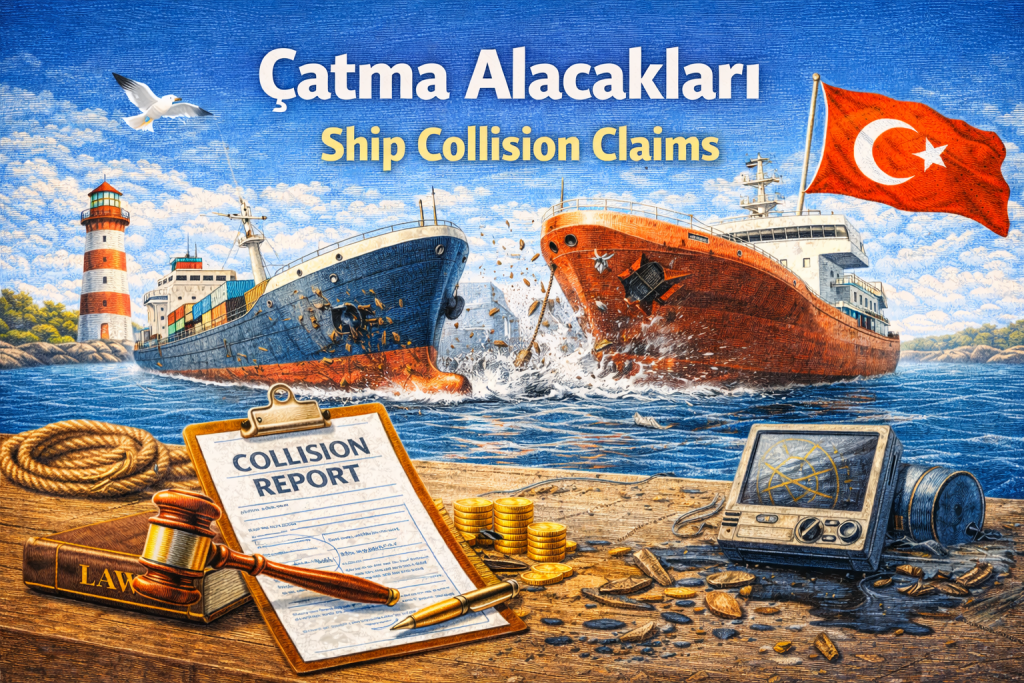
Collision at sea refers to damages resulting from two vessels striking each other. Allision, on the other hand, refers to maritime accidents that occur when a vessel strikes a pier, jetty, breakwater, port facility, or other fixed marine structures.
In maritime commercial law, collision and allision incidents are serious legal disputes leading to vessel damage, cargo damage, environmental damages, port infrastructure damage, and high-value compensation claims.
Ship collision refers to the impact between two vessels, while allision refers to a vessel striking a fixed object such as a pier, berth, port facility or marine structure. These incidents often result in significant damages, environmental loss and high-value compensation claims.
Legal Liability in Maritime Accidents (Legal Liability in Maritime Collisions)
Liability in maritime accidents is determined according to the fault ratios of the parties. In collision and allision disputes, the following factors are considered:
Compliance of vessels with navigation rules
Master’s fault or negligence
Technical malfunction or equipment failure
Pilotage service
Port traffic rules
Weather and sea conditions
Voyage plan and operation records
The determination of fault ratios directly affects compensation liability.
Liability in maritime collisions is determined based on fault allocation. Compliance with navigation rules, negligence, technical failures, pilotage services, port regulations and weather conditions are evaluated to determine responsibility.
Ship-to-Ship Collisions
In collision disputes arising from the collision of two vessels, vessel damage, cargo loss, delay damages, and commercial losses may be involved. In such disputes, technical investigation, expert reports, and navigation records are of great importance.
In ship collisions, liability is often allocated based on the principle of comparative fault.
Ship-to-ship collisions may result in vessel damage, cargo loss, delay and commercial losses. Technical investigations and navigation records play a critical role in determining liability, which is often shared based on comparative fault.
Allision with Port Infrastructure
In case of a vessel colliding with a quay, pier, port facilities, cranes, or other fixed marine structures, multi-party disputes may arise among the port authority, vessel owner, terminal operator, and insurance companies.
In such collision incidents:
Port infrastructure damage
Terminal equipment damage
Business interruption
High-cost damages such as environmental damages may be involved.
Allisions with port infrastructure may create multi-party disputes involving port authorities, shipowners and insurers. These incidents may cause infrastructure damage, equipment loss, business interruption and environmental harm.
Evidence and Technical Investigation in Collision and Allision Cases (Evidence and Technical Investigation)
Evidence gathering is of vital importance in maritime accidents. The following data, in particular, are decisive in the legal process:
AIS and VDR records
Radar and navigation records
Ship logbook records
Port traffic records
Weather and sea condition reports
Witness statements
Technical expert reports
Damage assessment reports
Failure to collect evidence in a timely manner may complicate the determination of fault.
Evidence preservation is critical in maritime accidents. AIS data, voyage data recorders, radar logs, port traffic records, weather reports and expert assessments are essential in determining liability.
Insurance and P&I Processes (Insurance and P&I Claims)
Collision and allision incidents are generally assessed under P&I insurance coverage, leading to complex legal processes among insurance companies, shipowners, and damaged parties. Insurance coverage, limits of liability, and compensation calculation require expertise.
Collision and allision claims are typically handled under P&I insurance frameworks, involving complex interactions between insurers, shipowners and claimants.
Collisions and Allisions in Istanbul Ports (Maritime Collisions in Istanbul Ports)
Istanbul is one of Turkey’s busiest maritime traffic regions, where collisions between vessels and allisions with port structures frequently occur due to intense ship movements in the Ambarlı, Haydarpaşa, and Zeytinburnu ports.
Such accidents can lead to significant commercial losses and legal disputes.
2M Hukuk Law Office provides legal services for maritime accidents and compensation disputes occurring in Istanbul ports.
Istanbul’s intense maritime traffic leads to frequent collision and allision incidents at major ports such as Ambarlı, Haydarpaşa and Zeytinburnu. 2M Hukuk provides legal representation in maritime accident claims in Istanbul.
Maritime Accidents in Istanbul, Tuzla, Kocaeli, and Yalova Region (Maritime Accidents in Tuzla, Kocaeli and Yalova)
The Tuzla Shipyards Region, Kocaeli İzmit Gulf ports, and Yalova/Altınova shipyards are centers of intense shipbuilding, maintenance, and maritime activities. Collisions between vessels and allisions with structures frequently occur in these areas during ship maneuvers, shipyard operations, and port operations.
2M Hukuk Law Office, based in Tuzla, provides rapid legal intervention and manages compensation processes in these regions.
Tuzla Shipyards Region, Kocaeli Gulf ports and Yalova shipyards are major maritime activity zones where maritime accidents frequently occur. 2M Hukuk provides rapid legal intervention from its Tuzla-based office.
International Maritime Accidents (International Maritime Accident Claims)
Due to the international nature of maritime accidents, foreign-flagged vessels, international conventions, and different legal systems may be involved. The competent court, applicable law, and liability regime require special evaluation.
2M Hukuk Law Firm provides legal consultancy in Turkish and English for international maritime accident disputes.
Maritime accidents often involve foreign vessels and international legal frameworks, requiring jurisdictional and legal analysis. 2M Hukuk provides bilingual legal services in international maritime accident claims.
Why Choose 2M Hukuk Law Firm? (Why Choose 2M Hukuk Law Firm?)
2M Hukuk Law Firm is a Tuzla-based, TR/EN bilingual maritime law office operating along the Istanbul–Kocaeli–Yalova port and shipyard line, taking swift action in maritime accident and compensation disputes. We provide legal consultancy and representation services to ship owners, operators, insurance companies, and maritime firms.
2M Hukuk Law Firm is a Tuzla-based maritime law office providing rapid legal action in maritime accident and collision claims across the Istanbul–Kocaeli–Yalova corridor.
Legal Support for Maritime Accidents (Legal Assistance for Maritime Accidents)
You can contact 2M Hukuk Law Firm to receive legal support regarding damages arising from collisions or impacts with port structures.
For legal assistance regarding ship collision and allision claims in Turkey, contact 2M Hukuk Law Firm.