What is the role of insurance companies in the shipment precautionary attachment process? Is the debt paid or a guarantee given?
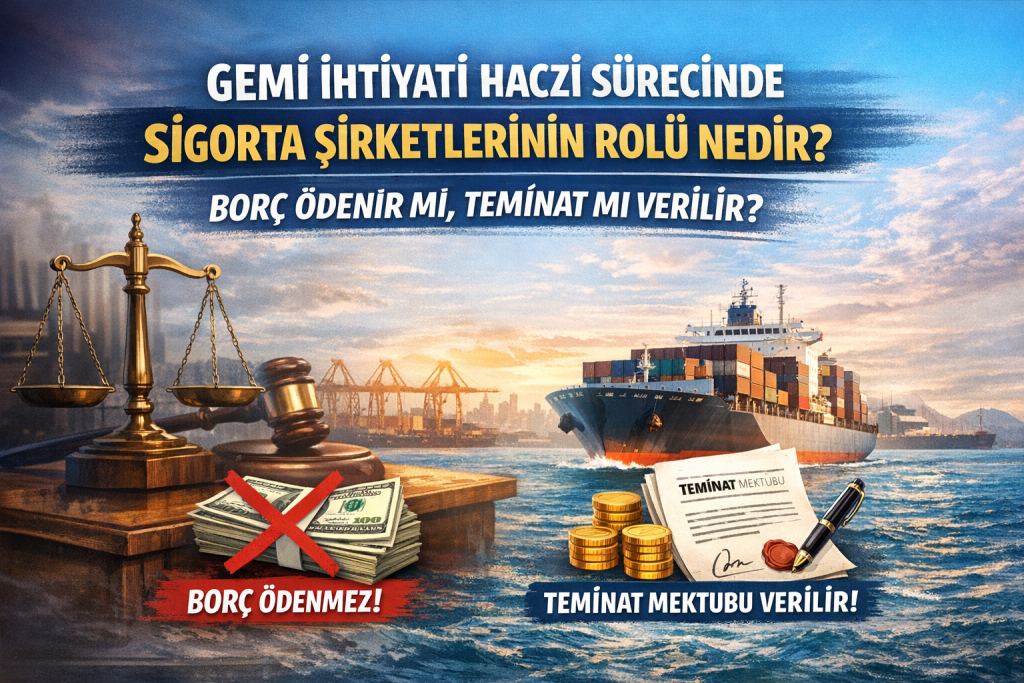
This study examines how the insurance companies intervene in the process during the precautionary attachment of the ships and whether they can pay the debt directly, within the framework of the judicial decisions submitted.
1. Intervention of insurance companies during the ship’s precautionary attachment process
The intervention of insurance companies (e.g. Club Insurance/P&I) that came into effect in favor of the debtor during the precautionary attachment process of the ships is not in the form of direct payment of the debt according to the basic decisions examined, but in accordance with Articles 1371 and 1372 of the Turkish Commercial Code (TTK). Submission of a letter of guarantee takes place through.
In the Decision of the 11th Civil Chamber of the Supreme Court of Appeals dated 13.06.2016, numbered 2016/6225 E. and 2016/6550 K. and referring to this decision In the decision of the 17th Commercial Court of First Instance dated 24.12.2019, numbered 2015/669 E. and 2019/516 K.; It is seen that the client company’s club insurance submitted a letter of guarantee with an amount of 101.010 USD to the shipowner during the lien of the ship, and this letter was delivered to the creditor. The Court of Cassation accepted this guarantee, which was understood by the parties in accordance with Articles 1371 and 1372 of the TCC, as sufficient and approved the abolition of the precautionary lien.
Payment of debt: Relevant decisions do not include a separate provision, information or detailed analysis that the insurance companies have the authority to pay the debt directly or that they have removed the lien by paying the debt in cash. The process is concluded with the submission of the letter of guarantee to the file. In the justification of the Court of Cassation, it is emphasized that only the creditor insurance company that requests a lien can benefit from this guarantee, which is presented in accordance with Article 1472 of the TCC, for the purpose of paying debt.
2. Additional Contexts and Evaluations from Secondary Sources
While the secondary information provided does not offer a specific maritime law rule regarding the direct debt payment of the insurance companies in the shipment of the shipment, they provide the following additional contexts regarding the different types of interventions in the insurance companies (intervention as creditors, the right to appeal and the payment in general disputes):
A. Intervention of Insurance Companies as a creditor (support)
Insurance companies often gain the right to succession due to the compensation they have paid to the insured, not in favor of the debtor, but to the insured foreclosure process. as a direct creditor is involved.
In the decision of the 17th Commercial Court of First Instance dated 23.11.2015, numbered 2015/54 E. and 2015/449 K.It is seen that the insurer of the cargo buyer gained succession by paying compensation and, as the maritime creditor, has reserved the ship in France as a reserve.
In the Decision of the 12th Civil Chamber of the Istanbul Regional Court of Justice dated 06.02.2020, numbered 2020/117 E. and 2020/154 K., TCC art. Pursuant to 1352/1-h, it is stated that he requested a lien on the ship with a request for marine receivables, and that the court accepted the succession, but that the approximate proof could not be obtained, he refused the lien.
In addition, insurance companies, unpaid fleet liability insurance premiums (Istanbul Regional Court of Justice 14th Civil Chamber, 20.09.2023, 2023/1512 E., 2023/1397 K.) or Financial Liability Insurance Premium Receivables (11th Civil Chamber of the Supreme Court of Appeals, 16.02.2017, 2016/1747 E., 2017/873 K.) can also request the seizure of ships as a direct creditor.
B. Insurance compensation subject to foreclosure
In the decision of the 43rd Civil Chamber of the Istanbul Regional Court of Justice, dated 07.11.2024, numbered 2024/1636 E. and 2024/1624 K.It is seen that a P&I club insurer has requested a precautionary lien on the “full ziya insurance compensation” to be paid to the owner by the boat-machine insurer in order to ensure that the debris removal costs will be receivable. Although the defendant has argued that insurance compensation is not covered by the TCC in accordance with Article 1321/2 of the TCC, this situation shows that the compensations to be paid by the insurance companies can be indirectly included in the process within the scope of the right/receivable foreclosure of third parties.
C. Direct payment of debt and objection to attachment (General Disputes Non-Ships)
Although there is no example of the insurance company paying the debt in cash in the decisions regarding the shipment, it is seen that the insurance companies intervene in the process by paying or objecting in the secondary decisions regarding the general commercial and traffic disputes:
Removal of lien by paying debt: In the decision of the 4th Civil Chamber of the Izmir Regional Court of Justice, dated 04.11.2024, numbered 2024/2996 E. and 2024/2370 K., in a general precautionary lien request, it is seen that the insurance company, which is the joint debtor of the verdict, paid 923,231.20 TL to the execution file and demanded the decision of the seizure from its own perspective. Similarly In the decision of the 17th Civil Chamber of the Supreme Court of Appeals dated 19.01.2016, numbered 2015/17708 E. and 2016/584 K., within the scope of the traffic accident policy, it was decided that the objection to the seizure remained unsubstantiated after the insurance company, which was debited within the scope of the traffic accident policy, deposited the debt in the execution file. These decisions show that insurance companies can terminate the lien by paying the debt directly within the scope of policy liability.
Objection with the defense of state control: Insurance companies object against the precautionary liens placed on their own assets, arguing that they are reliable joint stock companies subject to state (SEDDK/Treasury) control and that they are not likely to smuggle goods. The courts often accept these objections and abolish precautionary lien for insurance companies.Adana Regional Court of Justice 3rd Civil Chamber, 19.12.2023, 2022/526 E., 2023/2439 K.; İzmir Regional Court of Justice 11th Civil Chamber, 16.05.2025, 2025/548 E., 2025/808 K.; Adana Regional Court of Justice 9th Civil Chamber, 28.12.2023, 2023/1804 E., 2023/1417 k).
Result In the light of the judicial decisions examined; In the process of the ship’s precautionary attachment, the insurer of the debtor and the debtor’s intervention in the process is not in the form of direct payment of the debt, but in the TCC art. to the creditor within the scope of 1371-1372 Providing an adequate letter of guarantee and the lien is shifted on this guarantee. There is no clear provision regarding the direct payment authority or procedure of the insurance company in the decisions specific to the law. However, general law decisions, which are secondary sources, show that insurance companies actually have the opportunity to qualify the lien by making payments directly to the execution file within the policy limits. In addition, insurance companies often actively intervene in the process as the party requesting a precautionary lien as “creditor” for the compensations they have paid or premium receivables.
Can the insurance company pay the debt directly in the ship’s precautionary attachment?
How does P&I (club) fuse remove ship’s seizure?
In which cases does the insurance company demand lien as a creditor?
Why is expert lawyer support needed?
Marine trade law is a special field with a technical and international dimension, unlike classical execution and commercial law. In the shipment of shipment procedures;
Correct application of 1350 and its continuation articles of the TCC,
Legal evaluation of the adequacy of the guarantee,
Correct positioning of the role of the insurance company (Is it indebted, collateral or creditor),
Correct interpretation of the case law of the Supreme Court and the Regional Court of Justice,
It is of great importance to consider international maritime receivables and authorization rules.
The smallest legal error to be made in this process may cause the lien to be removed, the guarantee is deemed inadequate or the receivable cannot be collected. Therefore, especially ISTANBUL SEA TRADE LAW or TUZLA SEA TRADE LAW Getting support is critical to prevent loss of rights.
an expert in the field Tuzla Lawyer work with; It ensures the strategic and fast management of the process for both the creditor and the owner. At this point, obtaining support from expert law offices such as 2M Law Law Enforcement Office, experienced in maritime trade and foreclosure processes, will ensure that the process is carried out safely.